Lucy Letby – baby codes & neonatal unit classification
The parents were granted anonymity, so the court labelled the children chronologically as “Child A, B, … Q”. Here is the appeal court’s summary of the charges for which Letby was convicted in the first trial and the methods she used.
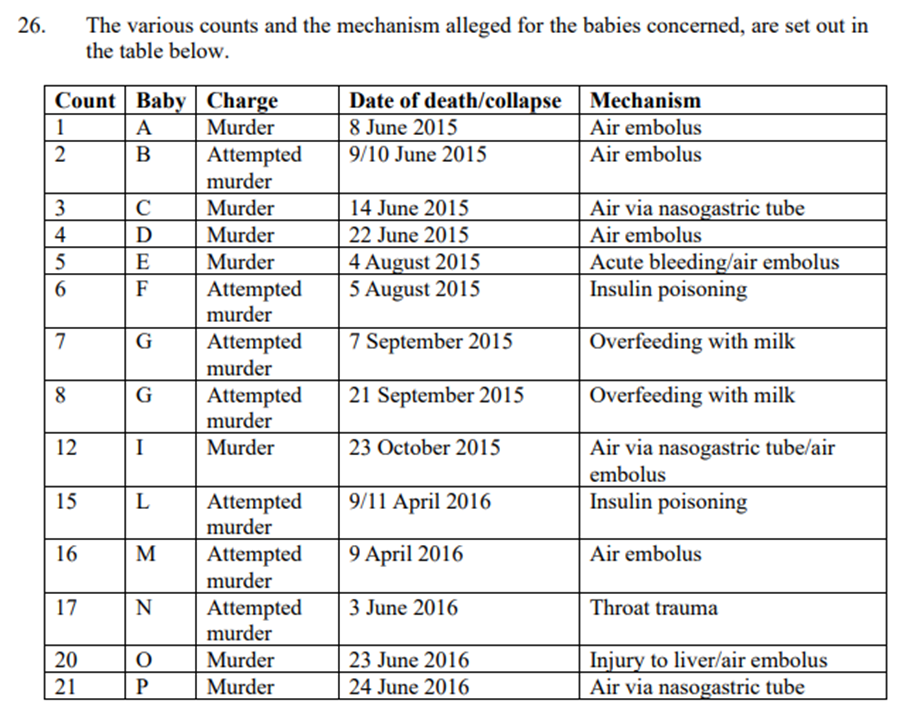
In addition there was child K, for whom the original jury were unable to agree a verdict. Letby was convicted at a second trial of the attempted murder of child K by dislodging the endotracheal tube.
She was also found not guilty of the attempted murder of baby H – dislodged ET tube, and the jury could not reach a verdict on baby J, attempted murder by airway obstruction, and on baby Q, attempted murder by air via the NG tube.
In summary Letby was convicted of using seven, or possibly eight, different methods to attack babies.
- Air embolus – seven times,
- Air via nasogastric tube – three times,
- Overfeeding with milk – twice, but both on the same baby,
- Insulin poisoning – twice.
- Throat trauma – once.
- Injury to liver – once.
- Dislodged endotracheal tube – once.
- “Gastric trauma using a rigid medical tool” – once. This last method is my interpretation, based on the BBC reports at the time (click here), of what the appeal court meant by “acute bleeding” for baby E. “Acute bleeding” seems more a mechanism of death, than a mechanism of murder.
Shoo Lee International Panel numbering
The Shoo Lee panel numbered the children 1 to 17, although they followed the court’s lettering order. They published their summaries in two parts (here and here), not in number order, together with much extraneous author biographical detail.
I’ve therefore prepared a merged Shoo Lee panel summary document with both numbers and letter codes (click here). For convenience I’ve removed the panel’s biographical details and re-ordered the cases in number/letter order, the same as the court. I have not altered the panel’s text.
Obstetricians should be aware of a further minor lettering and numbering issue. The court lettered the babies of multiple births in the order Letby was alleged to have attacked them, rather than in birth order. This is the reason baby 1/A was the second twin and baby 2/B the first. It also explains why triplet 15/O was born after triplet 16/P.
Staff anonymity
Nine of the doctors and nurses who worked alongside Letby were also granted anonymity, so although we know the identity of three consultants, Drs Jayaram, Breary and Gibbs, three others are known only as Drs B, ZA, and Dr V. One of the trainee paediatricians is known only as Dr A in the trial but confusingly as Dr U at the Thirwall inquiry. I’ve not attempted to sort out these staff name codes.
Neonatal unit levels
There are three levels of neonatal unit in the NHS (click here).
Special Care Unit (SCU), or Level 1
For babies who do not need a high level of care, and are born after 32 weeks’ gestation and where care is limited to monitoring, tube feeding, phototherapay and oxygen via face mask. Such units should also be capable of initial stabilisation and support for unwell or more preterm babies before transfer.
Local Neonatal Unit (LNU), or Level 2
For babies who need a higher level of care, born after 27 weeks’ gestation, and weighing over 1000 grams. Level 2 units provide short term intensive care including ventilation (up to 48 hours), non-invasive ventilation such as continuous positive airway pressure (CPAP), and parenteral nutrition.
Neonatal Intensive Care Unit (NICU), or Level 3
Everything else, including long term ventilation, feeding support, and cooling therapy to reduce brain injury. Some level 3 units also provide specialist neonatal sugery, ECMO or other highly specialised services.
All regions also have a neonatal transport service capable of collecting the sickest babies from level 1 and 2 units.
The Countess of Chester hospital
In 2015/16, the period of Letby’s crimes, the Countess of Chester was classed as a local neonatal, level 2, unit.
In July 2016, when Letby was removed from direct clinical duties, never to return, it was downgraded to a special care, level 1 unit.
That’s enough background. Tomorrow I’ll make a start, taking each mother in turn. First the mother of twins 1/A & 2/B (click here).
Update 19 June. There’s been a change of plan (click here).
Jim Thornton
 Ripe-tomato.org