The Beautiful Bowel Movement
By John Updike
In 1974, my first medical student “firm” at the General Infirmary at Leeds was led by two consultant general surgeons, Smiddy & Benson; Eddie Benson the taciturn straight man, and Geoff Smiddy the flamboyant Eric Morecambe character. One day, trailing round the old Nightingale wards, prodding abdomens and trying to differentiate inguinal from femoral hernia’s, we came to a poor fellow with ulcerative colitis. The teaching turned to defaecation.
“Young man,” boomed Smiddy. “Define a perfect stool.”
No adequate answer came.
“Twice round the pan and pointed at both ends. And don’t you forget it.”
I haven’t. It’s only when things go wrong that we fully appreciate the pleasure of a good shit. Updike knew it was worth a poem. Smiddy would have agreed.
Though most of them aren’t much to write about—
mere squibs and nubs, like half-smoked pale cigars,
the tint and stink recalling Tuesday’s meal,
the texture loose and soon dissolved—this one,
struck off in solitude one afternoon
(that prairie stretch before the late light fails)
with no distinct sensation, sweet or pained,
of special inspiration or release,
was yet a masterpiece: a flawless coil,
unbroken, in the bowl, as if a potter
who worked in this most frail, least grateful clay
had set himself to shape a topaz vase.
O spiral perfection, not seashell nor
stardust, how can I keep you? With this poem.
John Updike
Why the telephone wires dip and the poles are cracked and crooked
By John Updike
In the introduction to his collected poems 1953-1993 Updike wrote:
“The very first poem here, bearing a comically long title, yet conveyed, with a compression unprecedented in my brief writing career, the mythogenetic truth of telephone wires and poles marching across a stretch of Pennsylvania farmland. I still remember the shudder, the triumphant sense of capture, with which I got those lines down, not long after my twenty-first birthday”.
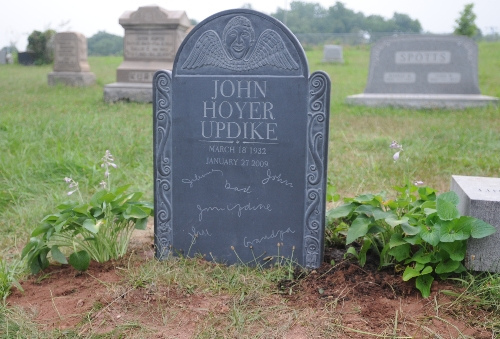
In 2011 his son Michael carved the poem on the back of a memorial stone in Robeson church cemetery in Plowville, Pennsylvania, where some of Updike’s ashes are buried. According to the local paper (click here) the poet’s memory was faulty; he had composed it at age 16.
Whatever. It’s pretty good.
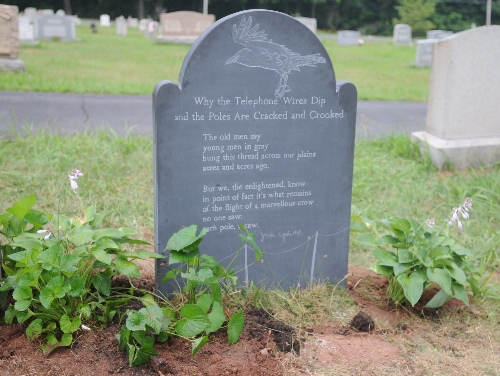
The old men say
young men in gray
hung this thread across our plains
acres and acres ago.
But we the enlightened, know
in point of fact it’s what remains
of the flight of a marvellous crow
no one saw;
each pole a caw.
John Updike
My Children at the Dump
By John Updike
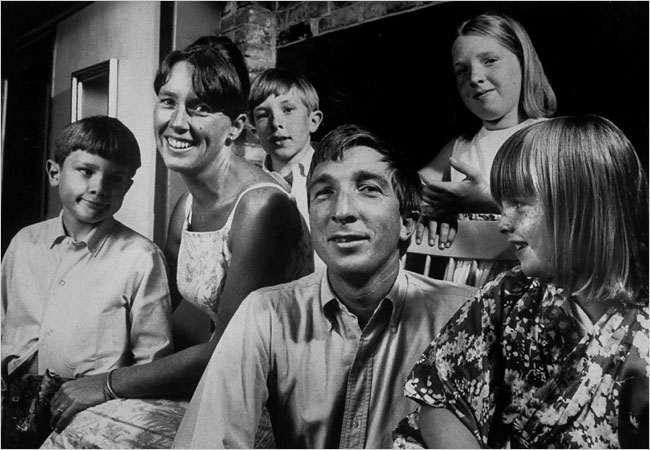
In 1962 the Updikes had just moved to Ipswich Massachusetts, where John occasionally took his three older children to the local dump, leaving their new baby with his wife Mary. When his affair with Joyce Harrington was discovered, Mary confessed to one of her own, and forgave him. But Joyce’s husband wanted a showdown, so the family decamped to Europe to let the dust settle. The drama led to a whole series of stories about adultery, culminating in his first best-seller, Couples.
This poem, – “Love it now./Love it now, but we can’t take it home.” – tells why Mary would win; he loved his children more than his mistress.
The day before divorce, I take my children
on this excursion;
they are enchanted by
a wonderland of discard where
each complicated star cries out
to be a momentary toy.
To me, too, the waste seems wonderful.
Sheer hills of television tubes, pale lakes
of excelsior, landslides
of perfectly carved carpentry-scraps,
sparkplugs like nuggets, cans iridescent
as peacock plumes, an entire lawnmower
all pluck at my instinct to conserve.
I cannot. These things
were considered and dismissed
for a reason. But my children
wander wondering among tummocks of junk
like stunted starvelings cruelly set free
at a heaped banquet of food too rich to eat.
I shout, “Don’t touch the broken glass!”
The distant metal delicately rusts.
The net effect is floral: a seaward wind
makes flags of cellophane and upright weeds.
The seagulls weep; my boys bring back
bent tractors, hoping what some other child
once played to death can be revived by them.
No. I say, “No.” I came to add
my fragments to this universe of loss,
purging my house, ridding a life
no longer shared of remnants.
My daughter brings a naked armless doll,
still hopeful in its dirty weathered eyes,
and I can only tell her, “Love it now.
Love it now, but we can’t take it home.”
John Updike
Ovarian cancer screening spin
Breathless headlines
Telegraph: “Screening could prevent one in five ovarian cancer deaths, study shows” here
BBC: “Ovarian cancer: Screening may cut deaths by a fifth” here
But a negative trial
“The primary analysis […] gave a[n ovarian cancer] mortality reduction over years 0–14 of 15% (95% CI –3 to 30; p=0·10) with [multi-modal screening] MMS and 11% (–7 to 27; p=0·21) with [ultrasound screening] USS.”
What happened?
The UK Collaborative Trial of Ovarian Cancer Screening (UKCTOCS) recruited post-menopausal women aged between 50 and 74. 50,639 were randomly assigned to undergo ovarian cancer screening by vaginal ultrasound (USS), 50,640 to ultrasound and CA125 blood testing, so called multi-modal screening (MMS) and 101,359 to be controls. The primary outcome, death due to ovarian cancer, analysis plans and sample size were all pre-specified and followed, and the results published in last week’s Lancet (click here or ukctocs)
Neither method worked (see above). But the small favourable trend in ovarian cancer deaths, which may have been an effect of chance, only appeared after seven years. Perhaps a true effect had been swamped by women who already had cancer when screened. The authors did a second data-driven analysis and concluded:
“Although the mortality reduction was not significant in the primary analysis, we noted a significant mortality reduction with MMS when prevalent cases were excluded. We noted encouraging evidence of a mortality reduction in years 7–14, but further follow-up is needed before firm conclusions can be reached on the efficacy and cost-effectiveness of ovarian cancer screening.”
First analysis fails so, having seen the data, have another go! And Ian Jacobs and Usha Menon, the two lead authors, hold shares in the company which owns the screening algorithm! And the lack of difference in all cause mortality (RR = 0.99, slightly favouring the control arm, albeit not remotely significant) was hidden deep in the appendix (Web table 6 UKCTOCS appendix). Is this spin?
There are two possible reasons why a screening test might appear to reduce one type of cancer-related death but not alter all cause mortality.
One reason is that ovarian cancer deaths are relatively rare, so even a real effect is swamped. The 45 deaths difference between the 347 ovarian cancer deaths among controls and the 302 among the two screened groups, amounts to only 0.33 percent of the overall 13,296 deaths in the trial.
The other is that a some deaths, which would have been classified as ovarian cancer in controls, get classified as something else in the screening group. This happened. There were 11 deaths due to primary peritoneal cancer among controls but 21 in the treatment arms. Primary peritoneal cancer is the label we give ovarian cancer if the woman has already had her ovaries removed. Including these makes the primary analysis even less convincing. MMS “ovarian or primary peritoneal mortality” reduction = 11% (95% CI –8 to 26; p=0·23) and USS = 9% (–9 to 24; p=0·31) (Table 3).
Once the primary peritoneal cancers are included, even exclusion of the prevalent cases leaves a difference which is no longer statistically significant. MMS “ovarian or primary peritoneal mortality” reduction = 18% (–1 to 34; p=0·064) and USS = 17% (–3 to 33; p=0·097) weighted log rank model (post hoc) excluding prevalent cases but including primary peritoneal (table 3).
To summarise
The trial showed a small reduction in ovarian cancer deaths which could have occurred by chance, and amounted to 0.33% of all deaths. After looking at the data and excluding prevalent cancers a different statistical test nominally indicated that the effect was unlikely to have occurred by chance. But they also found, as expected, that 11 women who died in the screening group of primary peritoneal cancer would have been classified as ovarian cancer deaths had they been in the control arm. So instead of nominally preventing 45 ovarian cancer deaths, the screening actually prevented only 35. Using these numbers, the difference, even with post hoc exclusion of prevalent cases, was no longer statistically significant.
Other trials
The only other big trial of ovarian cancer screening (PLCO) also showed no benefit. In that trial the direction was opposite; “118 deaths caused by ovarian cancer (3.1 per 10 000 person-years) in the intervention group and 100 deaths (2.6 per 10 000 person-years) in the usual care group (mortality RR, 1.18; 95% CI, 0.82-1.71).” The inclusion of these data will reduce nominal statistical significance still further.
Would it be worthwhile if true?
The present paper reports neither the human, time sitting in clinics undergoing blood tests or with a probe up your vagina, nor the economic costs. But here’s a “back of the envelope” calculation. If 100,000 women undergo 700,000 blood tests and 700,000 vaginal scans we might possibly save 35 lives. If each test takes up just half a day (appointments, travel, counselling, waiting, testing, going home and being given results) that would amount to 959 woman-years being screened. The lives are only saved after between 7 and 14 years, so the beneficiaries will be between age 57 and 88. If optimistically each gained an average of 10 years, the programme would deliver 350 woman-years of benefit at the cost of spending 959 woman-years undergoing the screening. Doubtless more sophisticated analyses will appear, but I’d advise scepticism if anyone claims the net benefits justify the costs.
Such blatant massaging of a positive conclusion out of a negative trial depressed me. But I was cheered by this excellent blog (click here) from Cancer Research UK, who had part funded the trial. It concludes:
“We don’t think there’s enough evidence for the NHS to introduce a national screening programme at this stage.”
Well said. The NHS will save hundreds of millions of pounds by not introducing this futile screening programme; money to spend on treatments which work. Nice trial. Happy Christmas.
Jim Thornton
Caesarean on demand
Better unsaid
In 2011 the National Institute for Clinical Excellence’s (NICE) Caesarean section guideline (here & NICECS) startled obstetricians; the authors had discovered a “right” to give birth that way.
“For women requesting a CS, if after discussion and offer of support (including
perinatal mental health support for women with anxiety about childbirth), a vaginal
birth is still not an acceptable option, offer a planned CS.”
Even NICE baulked at chaining a reluctant surgeon to the operating table, so they included a conscience clause:
“An obstetrician unwilling to perform a CS should refer the woman to an obstetrician who will carry out the CS.”
Some apologists have since claimed that NICE was referring to women with severe anxiety about vaginal birth, and indeed the guideline includes good advice about them, but it’s clear the recommendation also applies to women who request Caesarean for other reasons; those who for example believe it is safer, easier, or reduces perineal injury. The NICE authors didn’t like it, but the tabloids knew who they meant, women who believe it will keep their vaginas “honeymoon fresh” or are “too posh to push”.
NICE quoted well-established evidence of the safety of Caesarean for most women, and a tiny non-randomised study from Sweden (Wiklund et al., 2007) which they rightly judged as low quality. The latter suggested that Caesarean on maternal request was associated with a longer hospital stay but no difference in fetal risks, breast feeding at two days, maternal depression or rate of resumed coitus at three months. It was associated with higher maternal satisfaction, but lower breast feeding and rate of planning another child at three months. An economic analysis, based on these flaky data found that vaginal delivery was £700 cheaper than maternal request Caesarean. It certainly wasn’t strong evidence that drove NICE’s advice. But it’s not really clear what did.
Perhaps, wanting to make a strong statement that women had the right to refuse Caesarean, they felt the need for symmetry. They did not cite any evidence that women were being refused maternal request Caesarean, they were more concerned about the opposite issue; that women were feeling bullied or scared into unnecessary ones. Many wise people argue that for reasons of convenience, money or pressure from lawyers with their own financial agendas, doctors are normalising Caesarean as a valid option for birth.
I guess I’m one of those doctors. I agree with NICE, that Caesarean is pretty safe for the mother. It may even be slightly safer for this baby. People have small families these days and we can usually deal with the complications. The evidence that it causes infertility, atopy or stillbirths in subsequent pregnancies is fairly weak. I worry that we may lose the skills for natural birth, but can hardly expect women to have vaginal births so I can keep my skills honed for their sisters. If asked to do a Caesarean against my personal judgement, I ensure the gestation is over 39 weeks, and do the deed, rationalising that no-one’s being forced to do anything they don’t want.
But even I fret a bit. Modern obstetrics is on a hopeless quest for perfect safety. Every randomised trial, plausible theory, or half-baked idea seems to justify more interventions. Late complications and side effects are played down, just like I did above. Freedom to choose is important, but a right to choose Caesarean against the better judgement of the surgeon is not symmetrical with the right to refuse one. Patients can refuse any operation they like, but they don’t usually have a right to one against the surgeon’s judgement. They may seek a second opinion, but abortion is the only other operation with a conscience clause mandating that the second opinion comes from a surgeon who will say yes. Even the offer of choice is not neutral – it removes the option to birth in ignorance. And don’t get me started on the baby risks.
Maternal request Caesareans have wide ramifications. They have been debated by parents, obstetricians, midwives and pressure groups for years. I don’t have the answer, and nor does NICE. A final resolution of the debate is neither possible, nor desirable.
But then, almost it appears on a whim, the world’s most prestigious health advisory organisation placed its thumb on the scales. That’s a pity.
Jim Thornton
Dr Heather Currie, Menopause Matters & NICE
My passing comment last week (click here) that the National Institute for Clinical Excellence (NICE) had identified both variation in, and lack of, menopause treatment provision in the UK, on the basis of a pressure group’s website, provoked a colleague to ask who was behind it.
Good question. Who was it, who was judged to be so authoritative that NICE directed policy makers (commissioners and clinical commissioning groups) to them for advice on whether new local services are needed (click here)?
MenopauseUK.org (click here) has not been updated since 28.10.2014. The “about” link (click here) leads to the statement that it is a policy network for three other organisations, the Daisy Network, the Hysterectomy Association and Menopause Matters . The links to all three are faulty, but (thanks Google) the first two are patient support groups for women who have undergone premature ovarian failure, or hysterectomy respectively.
The third is different. Menopause Matters (click here) claims to be an independent clinician-led website, and woman’s magazine, devoted to the menopause. The managing director is Dr. Heather Currie an associate specialist in gynaecology in Dumfries and Galloway. Almost all the signed articles in the magazine and on the website are authored by her, she offers a personal £25 email advice service, and sells her books Menopause Answers at Your Fingertips, and Menopause Essentials.
Dr Currie is the editor of Post Reproductive Health (formerly Menopause International) the official journal of the British Menopause Society of which she is also chair. She writes many editorials (e.g. here, here, and here); all opinion pieces downplaying the risk of, and advocating wider prescription of hormone therapy (HT)*. Her articles in the Menopause Matters magazine, available on the website are couched for non-professional readers but give the same message – women are being deprived of effective HT treatment by doctors who foolishly believe the WHI trials.
She declares no conflicts of interests either on the website, the magazine or in her Post Reproductive Health editorials. But according to another article (click here) she “has received educational grants, lecture fees and advisory board fees from several pharmaceutical companies.” Another (click here) in which she declared similar unspecified conflicts, had been ghost written for her “Medical writing assistance […] supported by Pfizer”. At the 9th European Congress on Menopause and Andropause in March 2012 in Athens she spoke at a Novo Nordisk sponsored symposium (click here).
Help with writing favourable articles and sponsored trips to warm country conferences are common practice, but Dr Currie’s involvement goes deeper. This link is to an expensive report for pharma executives (a single copy costs £1,499) entitled Women’s Reproductive Disorders Therapeutics 2008-2018. According to the contents list the report includes four interviews with Dr Currie, and if the headline of one (subsection 5.2.3) is correct she saw “Signs of Hope Seen for HRT Market since Earlier Negative Publicity” as far back as 2008.
I have no reason to doubt that Dr Currie is an excellent and experienced doctor, prescribing HT only to those of her menopausal patients for whom she judges the benefits to outweigh the risks. But less experienced doctors who read her articles, and patients who get advice from her magazine, might like to know that she has not just been paid to speak and write about HT but also to advise the drug manufacturers on how to sell more.
The evidence that she is involved with the website to which NICE directs clinical commissioners for advice about whether they need to set up more menopause services in their region, is circumstantial; based only on a broken hyperlink. But NICE might want to investigate.
Jim Thornton
*Hormone replacement therapy (HRT) changed to hormone therapy (HT) Jan 2016
Please NICE, please shut up, please
What is it with the National Institute for Clinical Excellence (NICE)? Originally it was an authoritative body using objective methods to advise on treatments which worked and which the NHS could afford; things like screening and treating choriocarcinoma, or preventing and treating rhesus disease. It also tackled more difficult areas; screening for Group B streptococcal infection, or new ovarian cancer drugs. These were tricky issues, but by calculating cost per Quality Adjusted Life Year (QALY) NICE usually got a reasonable answer.
Now, it seems, they have an opinion on everything. Even when the data are hopelessly flaky and the issues utterly value-laden.
Last week NICE decided to advise about post menopausal hormone therapy (HT*) (click here). Not whether it works for symptoms in the short term; it does. Nor whether it is harmful in the long term; it is. Not even, the disputed risk/benefit ratio when started soon after the menopause; no-one can say for sure, despite many strong opinions.
No. NICE decide to weigh in on an even trickier question; are doctors currently giving out enough HT, and are enough women taking it? To do this they somehow had to take into account not just the facts, which no-one can agree on, but also the belief of some women in a male conspiracy to deprive them of HT, and the belief of others in a conspiracy of drug manufacturers and doctors to medicalise yet more of women’s life.
If anyone thinks that is an answerable question, they don’t understand it. But NICE was undaunted. Their answer; doctors are not giving out enough HT.’
Apparently they identified “A knowledge gap” among GPs and healthcare professionals, which makes them reluctant to prescribe HT because they “overestimate the risks and contraindications, and underestimate the impact of menopausal symptoms on a woman’s quality of life.” And on the basis of a pressure group’s website (click here) they identified variations in practice and lack of overall provision.
Is that really an evidence-based finding? Read the guidance as carefully as you like. You won’t find objective evidence of under provision there.
Please understand me. I’ve no objection to women, doctors, journalists, drug companies or anyone else weighing in on the HT debate, although they should declare their interests (click here). My objection is to NICE, with all it’s authority, and alleged objectivity, pretending to have discovered that one side of the debate, the HT enthusiast side, is correct. They might be. They might not be. But no-one can possibly know.
NICE is too powerful to get involved in this sort of question. It risks closing down debate. And by joining in a partisan shouting match, NICE debases itself. Please NICE, please shut up, please.
Jim Thornton
Next non clinically indicated Caesareans.
*Hormone replacement therapy (HRT) changed to hormone therapy (HT) Jan 2016
What changed?
Pro-pharma bias in the NICE menopause guidelines
Last week’s headlines about NICE’s (National Institute of Clinical Excellence) new menopause guidelines (click here) will have pleased the hormone therapy (HT*) manufacturers.
“One million women could benefit from HT, says NHS menopause guidance” The Guardian
“Women SHOULD be given HT to fight menopause, says health watchdog because the benefits far outweigh the risks” Daily Mail.
This is a big change from the long-standing Medicines and Healthcare Devices Regulation Authority (MHRA) advice:
“to use HT only for symptoms and in the lowest dose and for the shortest time possible.”
That cautious advice had been based on two Cochrane reviews, the latest versions of which had concluded:
“combined HT significantly increased the risk of a coronary event (after one year’s use: Attributable risk 4 per 1000, 95% CI 3 to 7), venous thrombo-embolism (after one year’s use: AR 7 per 1000, 95% CI 4 to 11), stroke (after three years’ use: AR 18 per 1000, 95% CI 14 to 23), breast cancer (after 5.6 years’ use: AR 23 per 1000, 95% CI 19 to 29), gallbladder disease (after 5.6 years’ use: AR 27 per 1000, 95% CI 21 to 34) and death from lung cancer (after 5.6 years’ use plus 2.4 years’ additional follow-up: AR 9 per 1000, 95% CI 6 to 13).” Click here for the full review.
“there is strong evidence that treatment with hormone therapy in post-menopausal women overall, for either primary or secondary prevention of cardiovascular disease events has little if any benefit and causes an increase in the risk of stroke and venous thromboembolic events.” Click here for full review.
There hasn’t been any significant new research since either review was written, and NICE couldn’t avoid concluding that combined HT increased venous thromboembolism and stroke. But by conducting a new review and restricting their main analysis to women under 60, which ruled out most Women’s Health Initiative (WHI) trial participants, NICE managed to conclude that there was no increased risk of cardiovascular disease or breast cancer. The point estimate remained that for every 1000 women taking combined HT there would be an additional five heart attacks and five breast cancers, but with fewer trial events, NICE was able to claim that the differences could have occurred by chance. Casting doubt on the evidence that HT increases cardiovascular disease and breast cancer made it easy to spin the conclusion that it was under-prescribed.
But surely NICE would not have commissioned doctors who were biased in favour of HT? The conflicts of interest are listed in appendix C (click here). Here are the pecuniary ones.
Terry Aspray consultant physician, member of advisory board for Lilly Pharmaceuticals.
Deborah Holloway nurse, chair RCN women’s health conference sponsored by Bayer.
Sally Hope general practitioner, lecture fee from Consilient Health.
Nick Panay gynaecologist, advisory board and sponsored conference fees from Pfizer, sessions sponsored by Bayer and Novo-Nordisk and advisory board meeting coordinated by Shinogi pharmaceuticals.
Anthony Parsons gynaecologist, International Menopause Society meeting attendance fee paid by Novo Nordisk, and advisory board fee from Novo Nordisk.
None withdrew from discussion of the HT advice section.
Dr Panay also forgot to mention his consultancies with Bayer and Abbott (click here) or his other fees from Baxter, Schering, Eli Lilly, Galen, Janssen Cilag, Merck, Novo Nordisk, Novogen, Organon, Orion, Procter & Gamble, Se-cure, Servier, Shire, Solvay, Storz, and Wyeth (click here).
The report’s chair Professor Mary Anne Lumsden and the expert advisor Professor Peter Collins declared no pecuniary interests, but were also forgetful.
I’m happy to forgive Professor Lumsden forgetting her 2004 HT research supported by grants from NovoNordisk and Solvay pharmaceuticals (click here); after all it was along time ago.
But it’s disappointing that Peter Collins so conveniently forgot his more recent service as paid consultant to Eli Lilly, Berlex, Merck, Pantarhei, and Pfizer, and his lecture fees from Berlex, Merck, Pfizer, Novo Nordisk, and Organon (click here). Was he really the best person to interpret HT’s cardiac risks?
I don’t think I’m being overly cynical in seeing bias here? In 2000, and 2004 Elena Hemminki and Klim McPherson wrote two important papers in which they extracted data from a large number of HT trials in younger women, and showed, long before the WHI trials, that evidence of cardiovascular harm was being withheld by pharma. Neither paper was in an obscure or difficult to access journal.
Hemminki E, McPherson K. Value of drug-licensing documents in studying the effect of postmenopausal hormone therapy on cardiovascular disease. Lancet. 2000 Feb 12;355(9203):566-9. (Click here)
McPherson K, Hemminki E. Synthesising licensing data to assess drug safety. BMJ. 2004 Feb 28;328(7438):518-20. (Click here)
Failing to cite these two papers is a pretty good test of a biased HT review. The 253 page NICE guidelines with their five huge appendices had plenty of space to do so, but failed the test.
NICE should be ashamed of itself. Pharma must be pleased with their investment.
Jim Thornton
*Hormone replacement therapy (HRT) changed to hormone therapy (HT) Jan 2016
#RCTinaTweet
Doing it in 140 characters
The PICO method of summarising randomised controlled trials – Population studied, Intervention and Control group treatments, and primary Outcome – is good, but we often need to know more. Has the question already been answered, has it been judged important by patients and stakeholders, and is the trial large enough to have a reasonable chance of answering it reliably? Some protocols take many pages to tell us all that, some a side of A4, and a few fit it in to a 500 word abstract. Can anyone do it in 140 characters? Here’s two attempts.
PITCHES trial. Protocol here PITCHES CTIMP protocol V2 2 19_07_15 (4)
Here’s the tweet
JLA5preterm, http://onlinelibrary.wiley.com/doi/10.1002/14651858.CD000493.pub2/full P f obs cholest, I300UDCA, C300placebo, O perinat death morbid, α.05, β.2, ER.05, RR.5
Total 129 characters because twitter contracts the hyperlink to 23; Seventeen to spare. The trial was funded before the James Lind Alliance completed its top ten list of research priorities for preterm labour, so the question has not actually been ranked. My made-up ranking of 5th in the preterm labour JLA list took 11 characters. The evidence is summarised in the hyperlinked Cochrane review. The population is [pregnant] females with obstetric cholestasis, the intervention group get a drug called ursodeoxycholic acid, and the control group placebo. There will be 300 women in each group. The primary outcome is a composite of baby death in the perinatal period or morbidity [severity undefined]. Assuming that we are willing to accept a 5% chance of getting a positive result when really there is no difference (alpha = 0.05) the trial has 80% power (beta = 0.2) of showing a difference, if the rate of death or morbidity is 5% (event rate 0.05) and the treatment (UDCA) really halves the risk of death or morbidity by 50% (a relative risk of 0.5). Cool eh?
35-39 trial. Protocol here
Here’s the tweet
JLA9stillbirth, http://onlinelibrary.wiley.com/doi/10.1111/1471-0528.12328/abstract P preg f>35yrs, I315 IOL39w, C315 wait T+7-14, O Caesar, α.05, β.2, ER.3, RR.68
Hyperlink contracted to 23 again, making total 119, with 21 to spare. Again the 35-39 trial was funded before the James Lind Alliance completed its top ten list of research priorities for stillbirth prevention, so the 14 characters of “JLA9stillbirth” describe a fictional ranking. The hyperlink is to the relevant Cochrane review. The population is pregnant women aged over 35, the intervention group are offered labour induction at 39 weeks and the control group to wait until the usual time of term plus 7-14 days. 315 participants will be recruited to each group. The primary outcome is Caesarean section. With a 5% chance of getting a positive result when really there is no difference (alpha = 0.05) the trial has 80% power (beta = 0.2) of showing a difference, if the control Caesarean event rate (ER) is 30% (event rate 0.3) and induction really reduces this by one third (a relative risk of 0.67).
My suggested hashtag #RCTinatweet is only 12 characters so could be added to both. I really need to get out more!
Jim Thornton
Design
By Robert Frost
There are two reasons to disbelieve the argument from design for a divine creator; Darwinian natural selection is a more parsimonious explanation, and this sonnet. A mutant white spider has killed a mutant white moth on a mutant white flower. If that was by design … .
I found a dimpled spider, fat and white,
On a white heal-all, holding up a moth
Like a white piece of rigid satin cloth —
Assorted characters of death and blight
Mixed ready to begin the morning right,
Like the ingredients of a witches’ broth —
A snow-drop spider, a flower like a froth,
And dead wings carried like a paper kite.
What had that flower to do with being white,
The wayside blue and innocent heal-all?
What brought the kindred spider to that height,
Then steered the white moth thither in the night?
What but design of darkness to appall?–
If design govern in a thing so small.
Robert Frost
 Ripe-tomato.org