What changed?
Changing Childbirth 20 years on
Baroness Julia Cumberledge’s 1993 report, Changing Childbirth, (sadly unavailable online) was a landmark in UK maternity care; a key pushback by the advocates of natural childbirth against excessive interventionism. Powerful and timely, it upset the obstetric establishment.
At a 20-year anniversary meeting at the Royal College of Obstetricans and Gynaecologists (RCOG) last week many of the original Expert Maternity Group recalled the hostility of the RCOG nabobs who, having largely ignored the reports preparation, objected to its conclusions. Someone alleged that Mary Anderson’s later bid for the college presidency failed because, as the obstetrician on the Expert Maternity Group she had been perceived as having “gone native”.
But not all obstetricians were hostile, and many recommendations – women carrying their own records, keeping them informed, treating them with respect – were already well underway. Changing Childbirth just gave a crucial push for this sort of humanisation of maternity care.
But reversing interventionism? The report recommended increasing midwife numbers so women knew the person who cared for them in labour, and stopping the closure of smaller units? Rather than directly recommending births at home or in midwife-led units (MLUs), the report said that women should have a choice, and presumably their choice would result in more such deliveries. The hope was to reverse the rise in Caesareans, inductions, electronic fetal monitoring, epidurals, and instrumental deliveries? But did the rates of any of these fall? Have normal births risen in the last 20 years?
The answer of course is no, no and no again! The tide of obstetric intervention rolled right over Changing Childbirth. Hospitals continued to centralise, instead of midwives it was medical staff numbers that increased, and hardly anyone now knows the midwife who delivers them. Sure, home birth rates rose by a percentage point or so, and some new MLUs opened, albeit mostly alongside consultant ones. But the home birth rate was already rising slightly in 1993, and free-standing MLUs closed as fast as new ones opened. (Examples here and here.)
There were many reasons. Litigation had already been rising in 1993, as parents became less forgiving of bad outcomes. Much of the new interventionism followed efforts to make birth safer, or at least mount a successful defence against the lawyers. The increase in consultant obstetrician numbers was intended to ensure that more of them spent time on the labour ward, and it partly succeeded. In service training, audit and governance got tighter for good reasons. Emergency care outside the security of hospital shift patterns, and continuity of midwife care are both difficult to reconcile with modern demands for a reasonable work/life balance. And perhaps, whisper it softly, perhaps the desire for natural birth is just a middle class fad!
Or maybe Cumberledge was ahead of its time – 20 years ago there was little evidence about the safety of home or MLU births. But in 2011 the Birthplace Study (click here) showed that both were safe for many women; they may even save money by reducing interventions. It’s early days, but some recent free-standing MLUs, such as those in Huddersfield and Burnley Blackburn, have got off to a good start.
I wonder. Sceptics about the real unmet demand for natural childbirth still report that parents seem to care more about safety and good pain control. But they’re mostly male obstetricians. What do they know?
Jim Thornton
Declan Joyce
Another Edingley photographic exhibition
Edingley is becoming the photographic capital of the East Midlands! Another exhibition today in the revitalised Old Schoolroom – Declan Joyce was the star. Here are two of his Edingley views, and one of Southwell Minster.


Click here for Declan’s website.
See also James Clay here.
Jim Thornton
Placerville
By Robert Conquest
Historian of the Soviet republics, cold warrior, and friend of Amis and Larkin, Conquest was also both player and poet. This is from Penultimata (2009), a collection largely devoted to his late life thoughts on love. You get the feeling that after a lifetime of watching his words in the hope of not missing a chance, he’s finally writing freely. He is 96!
The point is made in the final line, but the first line is the best.
Placerville
(California mining country)
After the tremblor the strata settle
What was gold-dust in a slowing stream
Falls from that suspended gleam
Into solidities of lode-metal.
Shock, aftershock – over in days,
Consolidation of gold – eons:
But on our conceptual screens
Time knows its place.
In ten minutes a couple buy
At the store where such are sold
A ring struck from that gold
Engraved Eternity.
Robert Conquest
Ripe-tomato.org comment. Danielle Lee was treated rudely. Her response on the Scientific American blog was measured and witty. But Scientific American took it down without explanation. So I’ve reblogged it. Jim Thornton
North Stainley toll booth
On the Ripon to Masham turnpike?
Driving in North Yorkshire the other day I came across this building opposite the Stavely Arms on the north bound carriageway of the A6108.

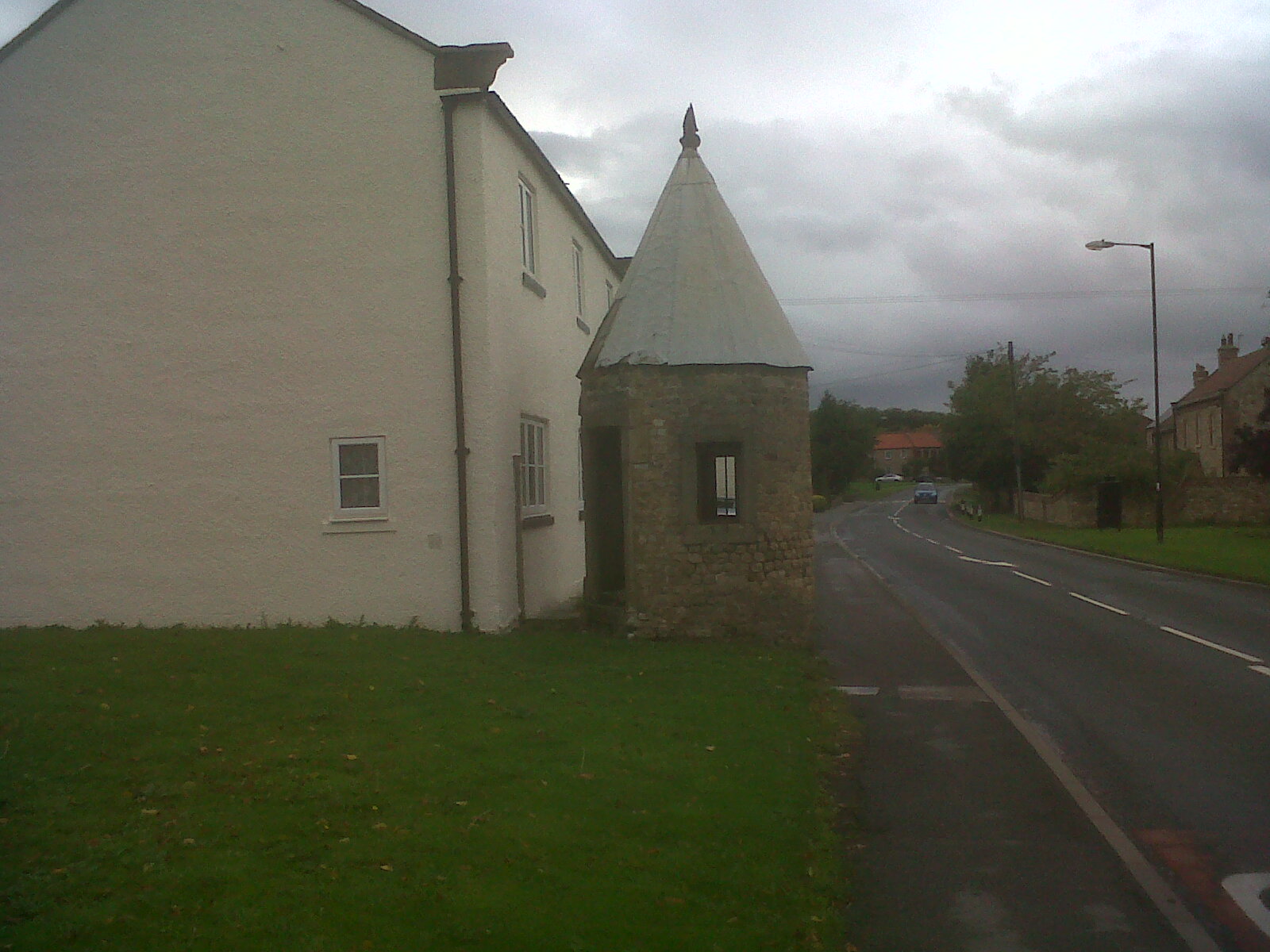

It has no label, plaque or any other identifier. The door and window glass are missing, but the roof is keeping out the rain. I guess it was once a toll booth, and therefore that the A6108 between Ripon and Masham was once a turnpike. But neither are listed here. Odd. What is it?
Jim Thornton
Boston/Botswana circ. trial update
How did three babies die?
Earlier this year a randomised trial by US researchers comparing different ways to circumcise newborn African boys appeared to alter both its sample size and the number of treatment arms, between registration and publication (click here). Unmentioned in the abstract, three healthy babies also died (click here). My letter to JAIDS and the author’s response (click here, uploaded here Thornton and Plank) have now been published.
Dr Plank says the registration/publication discrepancies resulted from muddle and ambiguity, and I agree. Far from attempting any sort of data driven analysis, she appears to have little interest in the randomised comparison. The trial seems primarily part of a campaign to introduce newborn circumcision to Botswana; it probably reduces sexual transmission of HIV in adults, so let’s get kids done at birth!
She also reveals that one baby died 25 days, and another 10 weeks, post surgery. Neither death appears to have been procedure-related, and again I agree. However, here is Dr Plank on the third death:
“The last death occurred in a baby who died of suspected sepsis on day of life 3. The baby was circumcised using a Mogen clamp on day of life 2 and discharged to home later that day. The following day he was brought to the local health center with respiratory distress and was noted to be febrile and was transferred to the district hospital. The study team was not notified of his admission until the next morning, after he had died. The circumstances of this baby’s death were reviewed in great detail with several groups to obtain independent assessment of the cause of death: the hospital staff, the Botswana Ministry of Health, the Botswana Health Research and Development Committee, the Partners Institutional Review Board (IRB), and our own Data Safety Monitoring Committee (DSMC). All parties agreed that based on all the clinical data available, the most likely cause of death was neonatal sepsis or pneumonia and that it was extremely unlikely that the baby’s death was related to the circumcision procedure.
Autopsies are very rarely performed in Botswana and were not performed in any of the 3 deaths in the study. Detailed diagnostic work-ups are also often not available in resource-limited settings or are not performed (eg, because a baby dies at home). Finally, prenatal screening for group B streptococcus is not routinely performed, and mothers do not receive prophylactic antibiotics.”
A healthy term baby dies 24 hours after a research operation and no tests nor autopsy are done. However the researchers, their own DSMC, and the two IRB’s who had approved the research all conclude “that it was extremely unlikely that the baby’s death was related to the circumcision procedure”!
Am I going mad? “Extremely unlikely”! How can any sane doctor possibly conclude that?
Of course no-one can prove the death was procedure-related. But the time course strongly suggests a relation. Even if the baby had some unrecognised congenital heart disease, or streptococcal infection, as the direct cause of death, it would remain highly likely that the research circumcision was an aggravating factor.
My enquires of the Partners IRB in Boston led to another internal investigation but the same conclusion, (Partners reply) and a refusal to reveal their reasoning; “we don’t publish our deliberations.”
Together with some colleagues I formally requested the United States Office of Human Research Protection to investigate the decisions of the Partners IRB allegation-to-ohrp. They declined to do so ohrp reply.
Perhaps one day, when the United States gets over it’s obsession with male genital mutilation and can look at the issue dispassionately, historians will add a small footnote to the sad history of casual experimentation on brown people. For now it makes you want to weep.
Jim Thornton
Larkin on Love
Discussing An Arundel Tomb with Monica
Some say Larkin disliked this poem. How could the clear-eyed facer of death endorse the final line, even with its qualifications? Didn’t he mean it when he wrote: “Love isn’t stronger than death just because two statues hold hands for six hundred years”, or when he said: “I don’t like it much… . Everything went wrong with that poem: I got the hands wrong – it’s right-hand gauntlet really – and anyway the hands were a nineteenth-century addition, not pre-Baroque at all”?
But that can’t be true. He also said: “I was very moved by it. Of course it was years ago. I think what survives of us is love, whether in the simple biological sense or just in terms of responding to life, making it happier, even if it’s only making a joke.”
Here’s what he wrote to Monica during the poem’s composition.
11 Jan 1956 – “I’m trying to write a poem on something we saw in Chichester. Can you guess what?”
26 Jan – “How time goes. I laid down my pen at 9 and picked up my pencil [he wrote his poems in pencil] now it’s 11. I’ve added 6½ lines, but only 4 are ‘firm’.”
12 Feb – “I’m absolutely sick of my tomb poem, and thought I wd send it you unfinished as a token for St Valentine’s Day. Not that it’s in any sense a valentine, but to give you something special from me on that day. It’s complete except for the last verse, which I can’t seem to finish; but I can‘t feel it’s very good even as it stands. It starts nicely enough, but I think I’ve failed to put over my chief idea, of their lasting so long, & in the end being remarkable only for something they hadn’t perhaps meant very seriously. Do let me know what you think of it. I hope you don’t find any grammatical solecisms, any ‘secret shagging split infinitives’ nestling among the inflexible lines.”
21 Feb – [Offering some word choices] “They hardly meant has come/grown to be
[…] That what/All that survives of us is love. Comments please.”
22 Feb – [Monica had earlier offered ‘blazon’ in response to Larkin’s request for a word of two syllables meaning a sign] “I think myself ‘their final blazon’ fairly satisfactory, carrying just the right overtones of heraldry & medievalism, so for the moment I’ll keep your [other] suggestion in reserve. “
26 Feb – [Riffing on love] “Coveney showed me Cyntha Asquith’s biography of Barrie wch contains an account of a visit to Hardy at Max Gate. […] Barrie reported that Hardy had taken him out to show him where he would like to be buried. The next day he took him out again to show him where he would next like to be buried! According to the account the only difference was a few inches nearer one wife or the other, though since one wife was still unburied then I don’t see how this could be. I may be remembering it wrong. This leads naturally onto love being stronger than death: I expect I’m being rather silly, but it is a sentiment that does seem to me only justifiable if love can stop people from dying, which I don’t think it can, or not provably. One might say ‘Penicillin is stronger than death, sometimes’ with fair truth, but love is stronger than death’ reminds me of that slogan ‘Britain (or London) can take it’, wch irritated me in the same way. It surely meant that people can stand being bombed as long as they aren’t bombed. If A says ‘we can take it’ & B is hit by a bomb, then clearly B can’t take it, so A’s statement only means ‘A can take B being bombed’: similarly ‘love is stronger than death’ means ‘A’s love is stronger than B’s death’ which is self evident. A’s love is not stronger than A’s death. At least we’ve no reason for thinking it is. Does this all sound very Bertrand Russellish? Perhaps it is not as logical as I think. Of course love is not just a word: I don’t mean to be ‘cynical’ about it. Nor do I want to enlist myself under it because, again, it isn’t just a word, & I can see clearly that my life isn’t governed by it. Some bright lad (E.M.F.?) said the opposite of love wasn’t hate but individuality (personality, egotism) and I’ve been feeling increasingly that it is this that keeps me from love – I mean love isn’t just something extra, it’s a definite acceptance of the fact that you aren’t the most important person in the world. Here again I feel a fallacy lurking: if A isn’t the most important person in the world then why shd B be? The better conclusion wd be that if A wasn’t, then nobody is. Of course I’m not speaking of love as an emotion but as a motive, that leads to action, which seems to me the only real proof of a quality or a feeling. Do I sound like some horrible young don, half-Jewish, at Birkbeck college? Don’t let me. There isn’t anything very new in my remarks: obviously people who think themselves the most important person in the world are ‘immature’ – part invalid, part baby & part saint, as I wrote. I suppose most people have spells of abrogating their own importance, & spells of trying to get it back, until they settle down into some way of living that ensures it isn’t abrogated or reclaimed too often, because most people not only want but must have their cake and eat it as well.
Later – […] I’ve about finished the tomb. I don’t feel very pleased with it, somehow. The end of v 4 now runs: […] The air, changing to soundless damage,/Turns the old tenantry away;
V 6 [line 6] […] Only their attitude remains
Verse 7 ends: […] Our nearest instinct nearly true;/All that survives of us is love.
The ‘almost’ line wouldn’t do if the last line was to start with All; I didn’t think it pretty, but it was more accurate than this one, & I felt an ugly penultimate line would strengthen the last line. Or rather, a ‘subtle’ penult. line wd strengthen a ‘simple’ last line. Sea-water mean?”
2 March – “Lehmann [editor London Magazine] is taking Tomb: he doesn’t like “voyage damage”, that’s all. It occurs to me that I pronounce it “voij”, not “voi edj”, wch makes it more acceptable I think. […] Shall ponder the last two lines. I quite like the “almost” set up, but don’t like that “That what” construction it entails.”
16 March – “Proofs of Tomb have come – the penult. verse (stanza) is really shocking: still, no time now. I think by “washing at their identity” I was trying to suggest that succeeding generations of visitors (or worshippers) in the cathedral (it is Chichester, you know) slowly detracted from the individual personalities of the earl and countess simply by being so different from them and knowing so little about them.”
Larkin often followed sincere remarks with negating ones, but they rarely weakened his sincerity. Imagine receiving this as a valentine! He worked away until he got it right because he knew it was good.
An Arundel Tomb closed The Whitsun Weddings collection, and the final lines have moved and puzzled readers ever since.
An Arundel Tomb
Side by side, their faces blurred,
The earl and countess lie in stone,
Their proper habits vaguely shown
As jointed armour, stiffened pleat,
And that faint hint of the absurd –
The little dogs under their feet.
Such plainness of the pre-baroque
Hardly involves the eye, until
It meets his left-hand gauntlet, still
Clasped empty in the other; and
One sees, with a sharp tender shock,
His hand withdrawn, holding her hand.
They would not think to lie so long.
Such faithfulness in effigy
Was just a detail friends would see:
A sculptor’s sweet commissioned grace
Thrown off in helping to prolong
The Latin names around the base.
They would not guess how early in
Their supine stationary voyage
The air would change to soundless damage,
Turn the old tenantry away;
How soon succeeding eyes begin
To look, not read. Rigidly they
Persisted, linked, through lengths and breadths
Of time. Snow fell, undated. Light
Each summer thronged the grass. A bright
Litter of birdcalls strewed the same
Bone-littered ground. And up the paths
The endless altered people came,
Washing at their identity.
Now, helpless in the hollow of
An unarmorial age, a trough
Of smoke in slow suspended skeins
Above their scrap of history,
Only an attitude remains:
Time has transfigured them into
Untruth. The stone fidelity
They hardly meant has come to be
Their final blazon, and to prove
Our almost-instinct almost true:
What will survive of us is love.
A Map of the City
By Thom Gunn
Gunn, a gay English intellectual in San Francisco, wrote this poem about big cities’ opportunities for risky sexual adventure; why else view the city at night? Somehow he got through the AIDS epidemic unscathed, and died in 2004, age 74, of something else. Perhaps he was more cautious than he let on.
A Map of the City
I stand upon a hill and see
A luminous country under me,
Through which at two the drunk sailor must weave;
The transient’s pause, the sailor’s leave.
I notice, looking down the hill,
Arms braced upon a window sill;
And on the web of fire escapes
Move the potential, the grey shapes.
I hold the city here, complete;
And every shape defined by light
Is mine, or corresponds to mine,
Some flickering or some steady shine.
This map is ground of my delight.
Between the limits, night by night,
I watch a malady’s advance,
I recognize my love of chance.
By the recurrent lights I see
Endless potentiality,
The crowded, broken, and unfinished!
I would not have the risk diminished.
Thom Gunn
Scraping the SCOPE barrel
Predicting pre-eclampsia
Between 2004 and 2008, the Screening for Pregnancy Endpoints (SCOPE) Consortium collected blood samples from 3529 nulliparous pregnant women at 14-16, and at 19-21 weeks gestation. The idea was to see if they could predict the development of various nasty pregnancy outcomes. In September’s BJOG the consortium report on three biomarkers – PlGF, sFLT-1 and endoglin (click here or here angioPET_BJOG_2013), as predictors of pre-eclampsia. According to the paper only PlGF has any predictive power, and that was modest.
SCOPE was a lovely study. It involved obstetricians from New Zealand, Australia, UK and Ireland, and unlike many previous observational studies in the field the design was registered here before any analyses began. In theory this should have prevented the researchers picking and choosing among biomarkers, or subtly altering the definition of pre-eclampsia to make their favoured biomarker look good.
Unfortunately – I grumbled about it at the time – no biomarkers were prespecified at study registration, so readers have to take on trust that all those tested were reported. The SCOPE website (click here) reveals other reports of lipids, clusterin, vitronectin and high-molecular-weight kininogen, as well as various “proteomic” and “metabolomic” analyses in subsets of the data, so there may have been a bit of cherry picking.
More worryingly, according to the study registration, the consortium planned to test prediction of pre-eclampsia occurring “at any stage during pregnancy after recruitment until delivery or in the first 2 weeks after delivery”. They also pre-specified a secondary analysis for predicting “early onset pre-eclampsia” defined as “pre-eclampsia resulting in delivery at <34 weeks”. However, neither of these outcomes are reported in the paper. Instead they report “pre-term pre-eclampsia” defined as “pre-eclampsia before 37 weeks”. Search as I might I cannot find this endpoint in the registry.
Choosing a new endpoint would be fine if the primary analyses had been reported elsewhere. Two years ago a clinical prediction paper in the BMJ (click here) used the pre-specified definition of pre-eclampsia, but reported no biomarker results. Nor is there any mention of an earlier biomarker report in the present paper, and the SCOPE website doesn’t reveal one either. This looks like data dredging.
Alere, the manufacturer of the PlGF test, “funded the retrieval and shipping of specimens and measured the angiogenic biomarkers”. Did they influence the choice of endpoint?
Jim Thornton
Cheap caseload midwifery
Or Mumbo Jumbo Economics?
The authors of last week’s randomised trial of caseload midwifery in the Lancet (click here, or for those without access here caseload midwifery) claim to have shown that this way of organising midwifery care is both “safe and cost effective”.
Main results
The trial from Australia, was registered in 2009 (click here) with a planned sample size of 1950 against an achieved sample of 1748 (871 caseload, 877 standard). So far so good. But the registry lists three [sic] primary outcomes – unassisted vaginal births, Caesareans and instrumental deliveries. None differed significantly between the groups, so the trial was negative. In the paper the authors reported “no pharmacological analgesia” as a primary outcome and claimed that it was increased with caseload midwifery, but it had been a secondary outcome at trial registration.
Secondary outcomes
By my count 30 secondary outcomes (tables 3, 4 and 5) were reported, although the trial registry lists only seven, of which three (staff attrition, staff satisfaction and patient satisfaction) were not reported in the paper. Labour induction, a predefined secondary outcome, was reduced (nominal P value 0.05). Neither elective Caesareans which were reduced (nominal P value 0.05) and reported in the abstract, nor breast feeding rates at various time points, which were reported at length, and supposed to have increased with caseload midwifery, had been even secondary outcomes on the trial registry.
If this sort of cherry picking is allowed, let’s note the three (caseload) versus zero (standard) unexplained stillbirths of normal babies at term (Table 6). The difference may well have occurred by chance, but these are exactly the sorts of deaths which elective Caesarean and labour induction are designed to avoid!
Health economics
The authors then took their negative trial, attached costs to all the chance differences they observed, and came up with an estimate that caseload midwifery was on average AUS$566.74 [sic] cheaper (P=0.02)!
The main drivers for the apparently lower nominal cost seem to be one less antenatal visit and a shorter hospital stay. Both laudable achievements, but even if real, they would only lead to savings if caseload midwifery allowed the employment of fewer midwives, or the same number on lower salaries. Is that really what the authors are saying? I doubt it. Caseload midwifery may well have some good effects but it is less convenient for the midwives involved than shift work in hospital, and therefore likely to only suit a few enthusiasts. To make it attractive long term will require either more midwives or higher remuneration.
Here’s a good way to squeeze a nominally positive result out of a negative trial and get the Lancet’s attention – tie a cost to all your secondary outcomes, and any others that look interesting, boil hard (these authors call it bootstrapping – Gawd save us!) and hope for the magic P value <0.05. No wonder health economics has a reputation as mumbo jumbo!
Jim Thornton
 Ripe-tomato.org