Xi’an City Moat
I’m visiting Xi’an, the ancient capital of China, in May 2013, and I guess I’ll be taken to the Terracotta Warriors. But I’m more interested in the world’s largest walled city. You can cycle or walk the 8.5 mile circuit along the top, or run three laps for the Xi’an marathon (click here).

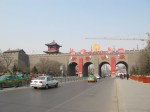
A moat runs alongside the wall – I wonder if I dare try to canoe it.
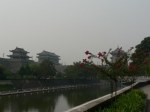


Or perhaps a wild swim?
Jim Thornton
24-hour labour ward consultants
Another lost debate
Last week I debated with my friend Nigel Simpson from Leeds.
“The time has come for 24-hour consultant resident labour ward cover.”
I was for the motion, and I really thought that this time I would win. There haven’t been any randomised trials, and it’s tricky to prove that consultants do a better job than senior trainees. But I’ve never heard of anyone asking if they could have their forceps or Caesarean done by someone in training. I was able to quote loads of observational evidence that consultants generally provide better care, faster and more cheaply that doctors in training.
My opponent put up some smoke and made lots of good jokes, but couldn’t really provide much more of a reason than that it would be expensive, tough on senior doctors and that it was good to learn from experience.
The expensive argument has less validity than might first appear. If senior doctors genuinely prioritised labour ward work, instead of giving it up as soon as every new colleague was appointed, the number of extra consultants required nationally to provide 24-hour cover in the larger maternity units would be about 300. There have been an additional 1000 since 1997 and the government plans for only slightly slower consultant expansion over the next 15 years.
I was sad. Not because I lost the debate, but because I failed to get across how much the quality of obstetrician’s lives would be enhanced. If each individual did say 12 hours on the floor per week, alongside a modest daytime clinical and administrative load they could drop the 16 hours on call from home they currently do. Most obstetricians would love that.
Jim Thornton
Why doesn’t sex education work?
Don’t ask the educators
A recent review (click here) by Daniel Wight, the director of the SHARE research programme (click here for my blog on SHARE), discusses the SHARE and RIPPLE trials. He summarises the results accurately. Both programmes improved “process” outcomes – they were popular with teachers and pupils, and increased knowledge.
But when it came to preventing pregnancy, neither had any effect on either total pregnancies, or abortions. Indeed SHARE had a non-significant adverse effect. Wight considers possible reasons.
- The trials were badly designed.
- Control sex education was so good that the intervention could have no extra benefit.
- The sex education was given at the wrong time.
- Social forces, sexual imagery and external peer pressure are so strong, that sex education can’t influence behaviour.
- The teachers delivered it badly.
As he rightly states, none are likely to be the true explanation. Poor Dr Wight is left puzzled.
But he omits the most obvious one – sex education encouraged sexual activity. Or more precisely, it discouraged sexual activity and encouraged contraceptive use for some, but encouraged or facilitated sexual activity for others. It is easy to see how this might happen – talking about sex is a great first step on the way to getting laid.
This leads to two obvious testable hypotheses. Do single-sex classes reduce pregnancy and abortion? Does support for parent-led sex education do the same?
But teachers and sex educators are not allowed to even entertain the idea that their classes might encourage even some pupils to engage in sexual activity. So instead they ignore the evidence of these two wonderful research trials, and plough on with conventional sex education classes. It’s not surprising my abortion clinic never runs out of customers.
Jim Thornton
Sex education
Vested interests
At a Westminster Sexual Health Policy Forum earlier this week (click here), many speakers claimed that Sex and Relationship Education (SRE) had a firm evidence base for preventing unwanted pregnancy. I wonder.
In 2002 a BMJ review of randomised trials (click here) suggested that many types of sex education did not prevent unwanted pregnancy. More recently, the latest Cochrane review (click here) concluded that mixed interventions (education and contraceptive promotion) may reduce unintended pregnancies, but that the trials had methodological weaknesses. Besides the usual problems of small size and lack of registration, trials in this area typically relied on self-reported outcomes. Even apparently hard self-reported endpoints such as unintended pregnancy or abortion are susceptible to bias; abortions may be concealed, and judging if a pregnancy is wanted is subjective.
In 2000 UK experts recognised that better trials were required. They should be of cluster design to avoid contamination, and the primary outcome should be both unambiguously bad, namely abortion, and collected in unbiased fashion by record-linkage, rather than self-report. The UK Medical Research Council funded two such trials.
The SHARE trial, registered here in 2000, studied pupils attending non-denominational secondary state schools in Tayside and Lothian. The intervention group got the SHARE (sexual health and relationships) programme which had all 10 characteristics identified by experts as necessary for effectiveness – five days teacher training followed by 10 pupil sessions at ages 13-14, and 10 more at age 14-15. Controls got their school’s usual sex education. Only two control schools demonstrated condom use and none taught negotiation skills for sexual encounters. The planned sample size was 24 schools, 7,200 pupils, 3,400 per arm. The primary endpoint was terminations by age 20 assessed from abortion registration statistics. The final results are here. There were no significant differences in terminations by age 20 per 1000 pupils (127 SHARE v 112 control; difference 15, 95% CI −13 to 42). i.e. there were non-significantly more terminations among pupils who got the best possible teacher-led sex education.
The RIPPLE trial was registered here, also in 2000. Classes of pupils aged 13–14, either received peer-led sex education by older pupils aged 16-17 (the intervention group), or the usual teacher-led sex education (controls). Twenty seven schools and 9,000 pupils were studied. The primary endpoint was again termination of pregnancy by age 20 assessed from abortion registration statistics. Final results here. Exactly five percent of girls had abortions in each group. The odds ratio (OR) adjusted for randomisation strata was 1.07 (95% CI 0.80–1.42, intervention v. control). i.e. peer-led sex education had no effect on abortions.
My efforts to draw the meeting’s attention to these results were met by silence – like the man in the Bateman cartoon. Sex educationalists have a vested interest and no longer talk about these trials. For them sex education is obviously good, so trials which show it doesn’t work must be wrong. The rest of us, who have to pay for their ineffective and possibly harmful programmes, and who care about really reducing unwanted pregnancy, should look for another approach.
One other lone speaker spoke up for programmes to help parents deliver the sex education. That sounds a good idea. Let’s evaluate it.
Jim Thornton
For Why doesn’t sex education work? click here.
Closed Stapels
A lesson for all
The final report of the Diederick Stapels investigation – English version here – makes sobering reading.
Not just the 55 fraudulent publications, the unsound theses, or the sloppy work of some of his collaborators, but for the generally low level of scientific rigour revealed in social psychology. Here are some extracts from the report, of practices which were widely tolerated by his collaborators and ignored by journals.
“An experiment fails to yield the expected statistically significant results. The experiment is repeated, often with minor changes in the manipulation or other conditions, and the only experiment subsequently reported is the one that did yield the expected results. It is unclear why in theory the changes made should yield the expected results. The article makes no mention of this exploratory method; the impression created is of a one-off experiment performed to check the a priori expectations. […]
“[…] a given experiment does not yield statistically significant differences between the experimental and control groups. The experimental group is compared with a control group from a different experiment –reasoning that ‘they are all equivalent random groups after all’ – and thus the desired significant differences are found. This fact likewise goes unmentioned in the article.
“The removal of experimental conditions. For example, the experimental manipulation in an experiment has three values. Each of these conditions (e.g. three different colours of the otherwise identical stimulus material) is intended to yield a certain specific difference in the dependent variable relative to the other two. Two of the three conditions perform in accordance with the research hypotheses, but a third does not. With no mention in the article of the omission, the third condition is left out, both in theoretical terms and in the results. […]
“Research findings were based on only some of the experimental subjects, without reporting this in the article. On the one hand ‘outliers’ (extreme scores on usually the dependent variable) were removed from the analysis where no significant results were obtained. This elimination reduces the variance of the dependent variable and makes it more likely that ‘statistically significant’ findings will emerge. There may be sound reasons to eliminate outliers, certainly at an exploratory stage, but the elimination must then be clearly stated.
“Conversely, the Committees also observed that extreme scores of one or two experimental subjects were kept in the analysis where their elimination would have changed significant differences into insignificant ones; there was no mention anywhere of the fact that the significance relied on just one or a few subjects.”
I’ve seen all these sins – committed some myself – and they’ve got into print. For a clinical triallist, altering the sample size, primary endpoint, failing to define either, or choosing post hoc between “intention to treat” and “per protocol” are equivalent. Examples here, here, here, and here. The only rigorous defence is adherence to written protocols. Yes social psychology is largely pseudo-scientific babbling for the glorification of its practitioners. But so too is much clinical research. If social psychology goes wrong we waste a bit of money. If clinical researchers get the wrong answer, people die.
Jim Thornton
Reviving Oldbury-on-Severn
Hitachi’s nuclear plans
Hitachi is to buy the Horizon programme from E.ON UK and RWE nPower, and build new nuclear power stations at Wylfa on Anglesey and Oldbury in Gloucestershire – all without subsidy, apart presumably from a favourable feed-in tarrif as reward for their low carbon emissions.


As a kid, my dad took our family for walks along the Severn to see the world’s first commercial nuclear power station at Berkeley (1962) the twin reactors of Oldbury (1967), the Aust Severn powerline crossing, upgrading the National Grid, and the M4 motorway construction. But us children were more impressed by the first Severn bridge (1966).
We had no idea how nuclear power, and the motorway network, would transform our lives. Let’s hope the anti-nuclear brigade don’t scupper Hitachi’s plans.
Jim Thornton
Old Communist
Eric Hobsbawm
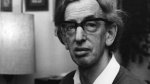
Here’s my obituary from AO Deadpool. Not my favourite historian.
Eric Hobsbawm became a communist at the very start of the century in which communism killed millions and impoverished its followers, while the capitalist democracies lifted unprecedented numbers out of poverty for the first time in human history. He is remembered today as the last Party apologist standing. For an ignorant peasant without access to books, this might be forgivable. For a professional historian it was a tour de force of pigheadedness.
Hobsbawm’s support for the Nazi-Soviet pact of 1939, which set in train the Second World War (on the grounds that it was “an anti-capitalist war”) was an early sign he was a slow learner. But when he called the Russian invasion of Hungary a “revolt of workers and intellectuals against the pseudo-Communist bureaucracies and police systems of Poland and Hungary,” he was willfully blind. By the time he labelled the Prague Spring suppression by 50,000 Soviet tanks “only a limited, even nominal, use of armed coercion” he was to all intents mad. If he hadn’t lived so long, no one would have taken much notice.
But he refused to die, and never changed his views. Most notoriously, in 1994 after the fall of the Berlin Wall, when asked by Michael Ignatieff if the 15 to 20 million dead at Stalin’s hands would have been justified if communism had achieved its aims, he answered with the single word: Yes.
Even in his later books he omitted inconvenient facts, the Russian massacre of Polish officers at Katyn, and tried to exonerate Stalin from blame for the suppression of the Warsaw uprising. There were few communist dictators he couldn’t find a good word to say about. He called Honecker and Ceaucescu “far from unimpressive.”
The general public ignored him — his books never sold outside academia, and to the working class he was an irrelevance. In 1978, after he had criticised the Labour leadership for failing to progress socialism, the left-wing MP Dennis Skinner said “the writings of bloody ‘Obsbum were as relevant to the Labour party as Sporting Life.”
His views had become a joke, but not his hypocrisy. He never made any effort to live in the countries he so admired — in later life he did the opposite and took up university posts in the United States. Despite arguing for redistribution of wealth, he failed to redistribute that bit which he had control over; he lived in a nice house in Hampstead and maintained a second holiday home in Wales.
But at least he was a left winger, so the chattering classes never disowned him. Tony Blair made him a Companion of Honour, and obituaries in the Guardian and New York Times praised him as a historian, although they couldn’t spell his name. And ugly as he was, he still got laid occasionally – he had two wives, two children by the second one and a third, illegitimate son.
Eric Hobsbawm saw a lot happen,
But whatever it was, his mind did not open.
Stalin’s great purges, even Prague Spring,
He’d started a Commie, to his faith he would cling.
It wasn’t too hard to see the problem with fascism
And he had a good eye for the flaws of capitalism
But his books had no room for communist sin
For the murdered officers in the graves of Katyn
The people ensured that he stayed unread,
Apart from homes in leafy Hampstead.
While communist victims languished in jails.
Hypocritical Eric kept another in Wales.
The lesson of all this – some never learn.
We’ll never make people like Hobsbawm turn.
It’s no good trying to persuade ’em.
The best we can hope for – to outlive ’em.
Jim Thornton
Domestic Violence
Poem by Simon Armitage
When UK birth and death registries were properly linked a few years ago, it suddenly became clear that violence – suicide and partner killing – had become a leading causes of maternal death (click here). Absolute numbers are small, but it’s still a shocking statistic.
Simon Armitage’s understated lines around “punched her in the face”, also shock. Poem is from his 1992 collection, Kid.
Poem
And if it snowed and snow covered the drive
He took a spade and tossed it to one side.
And always tucked his daughter up at night
And slippered her the one time that she lied.
And every week he tipped up half his wage.
And what he didn’t spend each week he saved.
And praised his wife for every meal she made.
And once, for laughing, punched her in the face.
And for his mum he hired a private nurse.
And every Sunday taxied her to church.
And he blubbed when she went from bad to worse.
And twice he lifted ten quid from her purse.
Here’s how they rated him when they looked back:
Sometimes he did this, sometimes he did that.
Simon Armitage
Havelian Story
Dr Sadia Malik

Dr Sadia Malik, a feisty Birmingham obstetrician, is returning to Havelian in NW Pakistan. Ammalife’s man on the ground says the people have fond memories of her – the local buses still pull up at the “Dr Sadia stop’. Here’s why.
In 2000 Sadia was in the clinic (her toddler with her) when a distraught woman clutching a dead infant came in. The child had developmental abnormalities and had died soon after birth. There was a commotion outside. Armed men from the woman’s village had come to kill her as a witch who had given birth to a ‘monster’ child. The clinic workers urged Sadia to leave. The woman was weeping behind her, armed men in front, her terrified daughter holding tight. But Sadia stood her ground and ordered the men to put their guns down. If they want to kill the ‘witch’, they’ll have to kill her first. To her astonishment, they did as she told them!
And then, in Sadia’s own words, ‘ I gave them my neural tube defects lecture’. She asked the clinic worker to get a year’s supply of folic acid from the pharmacy. She told the men – and the now slightly less terrified woman – that she must take one tablet every day and next year she would have a healthy child.
‘But you might be wrong and where will we find you next year’, remonstrated one of the men.
‘I’ll still be here,’ she answered.
And so, 18 months later, the same woman came back with a healthy newborn son to seek out Dr Sadia. Soon after bags of corn started to arrive from the men who wanted to show their thanks.
Years later Sadia met up with Arri Coomarasamy who had just started Ammalife, and the Havelian project was born.
Sadia will be blogging news of her trip. Follow and support her here.
Jim Thornton
Bernard Lovell
The man behind Jodrell Bank
This first appeared on AO Deadpool, where obits tend to be irreverent nonsense cribbed from Wikipaedia, or at least mine do. But my friend, the historian Peter Liddle, gave me the transcript of an interview he did with Bernard Lovell for his World War 2 Experience Centre a few years ago. So this may contain something original. I’ll try to be serious. Apart from the poem of course. Here goes.
Bernard Lovell was the man behind the 76-metre Jodrell Bank radio telescope, the first, largest, and most famous, steerable “big dish” in the world — it’s now number three, but don’t pretend you’ve heard of Effelsberg or Green Bank. The iconic structure in the fields near Manchester is now so familiar that it’s difficult to recall the bother of getting it built. The engineers were nervous that it would suddenly crumple — rightly so, it later turned out, when other cheaper telescopes collapsed dramatically — so they kept putting on more expensive bracing. The budget overruns became a national scandal, and Lovell was hauled before Parliament, hounded in the press, and even threatened with personal bankruptcy.
And then he was saved. The telescope worked. It not only hoovered up unimaginable quantities of data from distant galaxies, but was the only Western device capable of tracking the first Russian Sputniks as they flew over, and later the first pictures from an unmanned Russian moon landing. The bureaucrats pressured Lovell for a couple of years but eventually Lord Nuffield, the car magnate, wrote the cheque that sprung him free.
Bernard Lovell was born in Oldland Common near Bristol. His father, a lay reader in the local church (where Bernard played the organ) founded the Oldland Cycle and Radio Company. Bernard built his first wireless at school, and recalls that an inspiring public lecture in the university’s WD & HO Wills Physics lab encouraged him later to build the Jodrell Bank visitor centre — some good coming out of tobacco. At Bristol University in the late 1920s, he found himself researching next door to Klaus Fuchs, then a fugitive from the Nazis, later the famous spy who leaked atomic secrets to Russia.
After Bristol he went to work with the Nobel Prize winner, X-ray crystallographer William Bragg, in Manchester, having just failed to get his first choice job with the physicist Patrick Blackett in London. Not a bad consolation prize! But soon Blackett moved to Manchester, and they worked together on cosmic radiation. When the war started, Blackett sent Lovell to work at the Bawdsey research station on radio wave detection. This was the work that eventually led to the first workable radar systems. Lovell, still in his twenties, was right in the thick of it, shortening the wavelength to improve resolution, altering bombers to fit the equipment, mixing with the generals, and on occasion even visiting Downing Street to get Churchill’s blessing. He admitted it went to his head and led to his near downfall twenty years later.
Lovell later claimed that on a visit to a radar station near Scarborough he saw masses of echoes on the screen and rebuked the operator for not reporting them. The reply (“That’s not echoes, it’s what we call the ionosphere.”) gave him the idea of radio astronomy and, eventually, the radio telescope. Lovell’s claim wasn’t true — Karl Jansky had made the first radio telescope in 1931 and knew that the background hiss came from outer space, and Grote Reber had built the first parabolic dish in 1937 — but it made a good story.
But the first moon pictures were Lovell’s. In the late ’60s, while monitoring an unmanned Soviet spacecraft which had landed on the moon, he suddenly realised it was transmitting back a picture. He had to borrow a local newspaper’s digital picture technology — this was long before jpegs or bitmaps — to create a print, but it flew ’round the world. The Russians had kept it secret, and he’d scooped the Americans with the first picture of the surface of the moon.
Now the telescope spends its days searching for pulsars and its nights hosting musical events. A few weeks before they closed the Olympic ceremony, Manchester’s rock gods, Elbow, performed in front of it. Lovell the showman would have approved.
Sitting up in Manchester
He was just plain Mr Lovell
When he first got the idea
To build a telescope at Jodrell
He was expert on the radio waves
But he knew no economics
So he had to bluff the money
And talk about astronomics
But the telescope was pricey
The money was overspent
He nearly went to prison
There were questions in Parliament
Then Sputnik flew over
And only he could track it
The first photo from the moon
Jodrell Bank got it
Pulsars and galaxies
Soon they came fast and thick.
Wanna see the Big Bang?
Get yourself to Jodrell quick
Pop stars came and went
But Jodrell’s fame went on so long
That instead of the Elbow,
They gave Lovell a gong
— Jim Thornton
 Ripe-tomato.org