Lowdham Apple Day
Took some of last year’s cider to Lowdham Apple Day on Sunday 21st Oct. One bottle of still cider, and one of sparkling. The sparkling was lively and both were very dry, but most people managed to say something nice about them.
As a contrast someone from Much Markle was selling real perry and cider. Wow! The real stuff, made with a proper blend of cider apples is quite different from the mass market bottles, and quite different again from what I make with whatever apples are to hand.
Adrian Baggaley (click here) was there with his “juicy girls” pressing all sorts of varieties to make apple juice. Here we all are.

Jim Thornton

Medsin 2012,
Maternal and menstrual health care
Shifted twelve boxes of Primary Mother Care at the Medsin 2012 annual conference in Coventry yesterday.
The MEDical Students International Network is a bunch of idealistic young people, working for global health equity. All sorts of groups and projects were on show.
I was rather taken with IRISE, a group working to empower women in East Africa, and in particular to help young girls get hold of menstrual sanitary ware. It sounds mundane, and is certainly unglamorous, but many teenagers miss school during their menstrual periods, for lack of the sort of towels and tampons Western women take for granted.
Most attendees were medical students jetting off to developing countries for their electives, so I persuaded them to take a copy of Mother Care with them, and leave it behind. Let’s hope it does some good.
Jim Thornton
The Hero’s Journey
by Tony Hoagland
It’s easy to make underdog poems sound patronising, political or worst of all, sentimental. Hoagland leaps over all that with one heroic metaphor.
From the New Yorker, October 16 2012.
The Hero’s Journey
I remember the first time I looked at the spotless marble floor
| of a giant hotel lobby
| and understood that someone had waxed and polished it all night.
and that someone else had pushed his cart of cleaning supplies
| down the long air-conditioned corridors
| of the Steinberg Building across the street.
and emptied all two hundred and forty- three wastebaskets
| stopping now and then to scrape up the chewing gum
| with a special flat-bladed tool
| he keeps in his back pocket.
It tempered my enthusiasm for “The Collected Sonnets of Hugh Pembley-Witherton”
| and for Kurt von Heinzelmann’s “Epic of the Seekers for the Grail,”
Chapter 5, “The Trial” in which he describes how the
| “tall and fair-complexioned “knight, Gawain,
| makes camp one night beside a windblown cemetery
But cannot sleep for all the voices
| rising up from underground –
Let him stay out there a hundred nights, the little wonder boy,
| with his thin blanket and his cold armour and his useless sword,
until he understands exactly how
| the glory of the protagonist is always paid for by a lot of secondary characters.
In the morning he will wake and gallop back to safety;
| he will hear his name emblazoned into toasts and songs.
But now he knows there is a country he had not accounted for,
| and that country has its citizens:
the one armed baker sweeping out his shop at 4 A.M.;
soldiers fitting every horse in Prague with diapers before the emperor’s arrival;
And that woman in the nursing home,
| who has worked there for a thousand years,
taking away the bedpans,
| lifting up and wiping off the soft heroic buttocks of Odysseus.
– Tony Hoagland
Derbyshire Threesome
The love life of Hilary Mantel’s parents
Fascinating titbit this week from a New Yorker profile of Hilary Mantel by Larissa Macfarquhar (Oct 16 2012). Mantel, the best selling, Booker Prize-winning author of Wolf Hall and Bring up the Bodies grew up in modest circumstances in the village of Hadfield in Northern Derbyshire.
“From when she was about eight to when she was eleven, she lived with her two brothers, her mother, her father, and her mother’s lover, Jack. It was hard to say when Jack had moved in; he’d been coming over for tea more often until one afternoon he didn’t leave. He moved into her mother’s bedroom, and her father moved to a room down the hall. This arrangement had a number of consequences. Her family was talked about, and children at school asked her who slept in which bed. Her mother’s parents, to whom she had been very close, no longer spoke to their daughter. It was not possible for her mother to go to the shops. At first, she’d had only one brother, and then a second brother was born. After she was old enough to understand where babies came from, she assumed that this second brother must be Jack’s child, and perhaps Jack and her mother did as well, but when he was grown he turned out to look so much like her father that it was clear he was not. Her mother, then, was sleeping with both men.”
It’s not just the threesome, but the mixture of normality and its opposite. Jack staying on after tea and her father moving down the hall, as if this sort of thing happened all the time. But her grandparents still disapproved and the school children asked where everyone slept.
Eventually her father moved out, and her mother, Jack Mantel and the children moved to Cheshire, where the children took his name, and they pretended to be married. In the late 1950s these things still mattered, but not everyone was fooled.
Click here for the full article.
Jim Thornton
Rhaeadr Dhu
Wild swim between the power stations
Half way down the Llennyrch gorge, is Rhaeadr Dhu, the Black Waterfall, a magical spot for a swim. We walked up the south west side of the valley – the best walk, but a tricky scramble down to the falls. It’s slightly easier access from the road on the opposite bank.


Despite the steel water pipes along the valley rim, it’s easy to forget Maentwrog hydro-electric power station at the foot of the valley, or even the two decommissioned Magnox reactors of Trawsfynydd a mile upstream, but we should thank them, and not just for the power they generated – flash floods made swimming risky until the dam was built.



In 1928 the original hydro-electric power station, provided 18 megawatts, enough for North Wales. Fifty years later it took the combined power of both nuclear reactors, 470MW, to supply the same area. Aren’t they impressive, nestled in the Welsh hills?
Trawsfynydd closed in 1991, and the only remaining Welsh nuclear power comes from Wylfa on Anglesey. But Maentwrog is still going. After upgrading it generates about 30 MW.
Jim Thornton
Progesterone for short cervix
Ripe-tomato.org often criticises triallists for not following a pre-specified analysis plan. Today we examine one trial that registered late, and another that did all the right things, but tripped up on a secondary data-driven analysis.
Background
Pre-term birth is an important health problem. A short cervix (neck of the womb) detected on ultrasound scan may predict it, and perhaps progesterone hormone treatment can prevent it. There have been two trials.
- Fonseca and colleagues (click here) randomly allocated 250 women with a short cervix to treatment with progesterone (n=125) or placebo (n=125). The rate of spontaneous pre-term birth before 34 weeks was significantly reduced in the vaginal progesterone group. But the trial had not been registered at clinicaltrials.gov (click here) until Jan 15 2007, despite ending in May 2006, nearly a year earlier. This means we cannot be certain that the primary endpoint, sample size and analysis plan were all pre-specified. Hitting the target of exactly 125 participants per group, with zero losses to follow up, in eight hospitals spread over three countries and two continents, also seemed a bit too good to be true!
- The next trial by Hassan and colleagues in 2011 (click here) had no such problems. It had been registered here in 2008. It was double-blind. The planned sample size was 450 (achieved sample size 465), and the primary endpoint of delivery before 33 weeks was the same in the trial registration and the published paper. Only seven women were lost to follow up. “Women allocated to receive vaginal progesterone had a lower rate of pre-term birth before 33 weeks than did those allocated to placebo (8.9% (n = 21) vs 16.1% (n = 36); relative risk (RR), 0.55; 95% CI, 0.33–0.92; P = 0.02″ Ripe-tomato.org was impressed.
But in Jan 2012 the US Federal Drugs Administration (FDA) turned down the manufacturer’s request for progesterone to be licensed for this indication. Here are the publicly available FDA pre-meeting briefing documents progesterone fda background doc. Unsurprisingly the share price of the manufacturer, Columbia Laboratories, fell off a cliff the day they were released.
For those who are interested, study 300 is a negative trial (O’Brien et al. 2007 – click here for the published report) of the same drug used to prevent pre-term labour in high risk women in general. In a secondary analysis the applicants had tried to show that it worked in women with a short cervix. The FDA were unimpressed.
But nor were they impressed by Hassan (study 302 in the briefing document). The problem was that pretty much all the benefit came from a half dozen or so small non-US sites, which between them recruited only 50 participants, and had 8 pre-term labours in the treatment group and only 1 in controls. The FDA statistician redid the analysis, including these worrying cases, but adjusting in a statistically more conservative way. The difference in the primary endpoint (bold row) was no longer statistically significant.

They also re-plotted the primary endpoint results for US and non US sites separately.
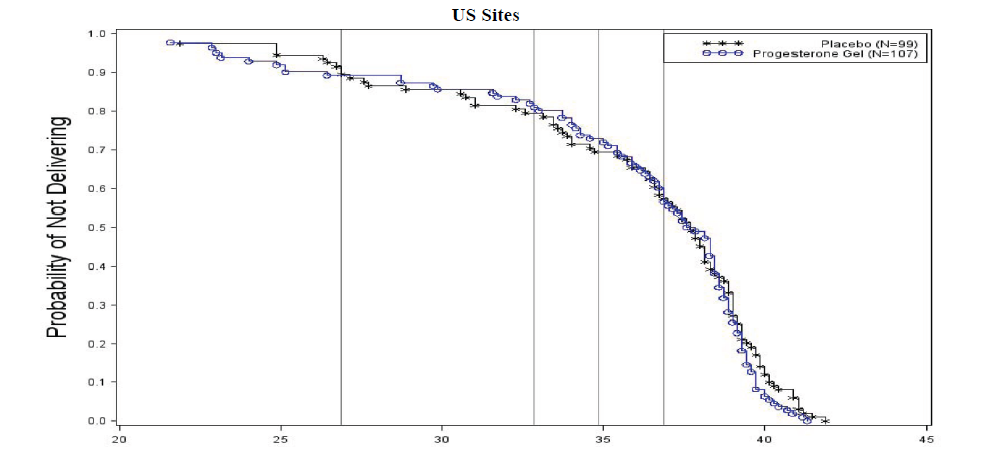

Of course this is a post hoc analysis, and the triallists must have felt hard done by. But the FDA was considering a hormone to be given to thousands, perhaps tens of thousands of pregnant women. They must have remembered another hormone used to prevent miscarriage, diethylstilboestrol (DES), which later turned out to be not only ineffective, but to cause vaginal cancer and other problems in the baby (click here). Unless a single trial’s data are very convincing, it’s best to demand another trial.
The FDA appears not to have commented on another issue. Although the mean gestational age at first dose was the same in both groups (Table 1 main trial report), the appendix to this main report (click here) reports an imbalance in recruitment outside the planned gestational age window of 20 and 24 weeks gestation. 29 women were recruited before 20 weeks (20 placebo and 9 progesterone) and 26 women after 24 weeks (7 placebo, 19 progesterone). The appendix does not say where these erroneous recruits came from, but the imbalance is unlikely to have occurred by chance and in both cases would tend to favour the active treatment.
Fortunately other trials are ongoing. In Nottingham we are recruiting similar patients to vaginal progesterone or placebo in the UK-wide OPPTIMUM trial led from Edinburgh – click here for details. Let’s get that one completed quick.
Jim Thornton
Eldzier Cortor “Tête à Tête”

This early work by the Chicago-based African-American painter Eldzier Cortor, who is still alive age 96, is coming up for auction at Swann Galleries in New York on Oct 18th. It dates from 1934, when the 18-year-old Cortor was attending Saturday classes at the Chicago Art Institute, and depicts a street encounter in Bronzeville, then as now the centre of African-American life in Chicago. But what is going on? Is the man looking at the food, or her breasts? Is she reprimanding or instructing him? Is she his wife, or mother? Who knows? It well justifies the estimate of $80-$120,000.
Eldzier Cortor was not always a politically correct artist. His iconic works such as Southern Gate (right below) objectified women, in both title and paint, despite being toned down from his preparatory pen and ink study (left).


His main subject was African-American women







Sexist or not, this is great art.
Jim Thornton
Abortion again
Why subsidise it?
As a pro-choice doctor (click here) who performs abortions, I don’t support the health secretary, Jeremy Hunt’s call to restrict them to a 12 week limit. But I’d like to see fewer done.
There are 190,000 a year, almost a quarter of pregnancies in the UK. Although it’s not for me to judge other people’s lives, many are for relatively minor reasons – child spacing, or to time birth more conveniently. But the way forward is not to re-criminalise late ones. That would punish the most vulnerable, who might indeed return to illegal backstreet abortionists.
The way to reduce them is simple. Keep it legal, but stop subsidising them. Why do we pay for abortion via the NHS? Are not enough done? Why was abortion a criminal act on the last day of 1966 and then paid for by the taxpayer on Jan 1st 1967? Things can be permitted without being subsidised.
Of course poor people need abortions. But abortion is cheap, and charities could easily pay for the tiny number of women who really couldn’t afford the few hundred pounds it costs. One such charity already exists, the wonderful Marie-Stopes. It would expand and others would spring up.
I don’t know how much effect paying for abortion would have. Since the cost is so modest, the effect might be quite small. But the signal, that if you want an abortion you need to sort it out for yourself, could be quite powerful. Give it a go Mr Hunt.
Jim Thornton
Scrumping for cider
A poor year


Scrumping for apples today. But a poor crop in my own garden. The few on my three-year-old Bramley trees were small, and the wild neglected orchard nearby was just as bad. Half a dozen apples and not a single pear, where normally I’d collect twenty bags. Even my local crab apple tree yielded only a dozen fallers. Fortunately my friend Kevin had a few Russetts and a reasonable crop on his America Mother tree, which never seems to fail. But I had to supplement all these with some nasty crab apples collected further afield to get enough juice to fill my 20 litre container. I presume the weather was bad when the blossom was out, and the bees stayed indoors.
I didn’t expect much sugar, but to my surprise the starting SG was 1.050. Fermented out that would give me over 6% alcohol, which is a bit more than I want, so I diluted it down to 1.045. I’ll add a little sugar at bottling to make sparkling cider.
I wonder what they’ll make of it at the Lowdham apple day.
Jim Thornton
Getting trials done – the Dutch way.
Castle Course in Einthoven

Just back from Ben Mol’s clinical research methods course. Amazing.
No fretting about bureaucratic, financial or time constraints. Instead serious discussion about getting the right answer quickly, and protecting patients from ineffective and harmful treatment while still getting what really work to them. Click here for the website.
Ben is having considerable success in persuading health insurers to fund clinical research. You might imagine that each would leave it to the others – they don’t. But neither do they like wasteful gold plating – spending millions to ensure that every nurse who hands out a questionnaire has done a course in research ethics! It’s difficult to compare systems, and Ben may hide some costs in his clinical service, but the Dutch consortium seems able to rattle off game changing trials much more cheaply than we can.
Consider the recent PPROMEXIL trial of induction v. expectant management for pre-labour rupture of the membranes between 34 and 36 weeks. This recruited 535 participants (target 520 – five times more than the previous largest trial) over 2.5 years, and reported neonatal sepsis, the pre-specified primary endpoint, in all but four. It showed with considerable confidence that induction does not reduce sepsis. Click here for the main publication.
The whole trial, including health economics and an updated meta analysis, cost €400K. It would have cost over £1M in the UK, and taken twice as long to complete. We have much to learn from the Dutch.
Jim Thornton
 Ripe-tomato.org