What’s wrong with Open Access?
Scientific publishing used to follow its own business model. Authors wrote for the prestige and publicity, and peer reviewed their colleagues’ work voluntarily, and journals made money by selling subscriptions. It worked because scientists are paid from other sources, but it led to a lot of unread rubbish. Lack of access was hardly an issue because libraries let the occasional poor scholar in free.
Then came the internet. Scholars from well-funded universities read most articles for free on their computers but noticed when they occasionally got charged. Less privileged ones suffered because libraries reduced paper copy holdings and electronic access was never given away. Lefties complained about academic publishers excessive profits.
The problems were soluble. Publishers soon made articles freely available after an interval, and various aid agencies paid for access for reputable scholars from poor countries. Even the excessive profits soon disappeared as the internet lowered publishers’ barriers to entry.
But the clamour for scientific publishing to be made free remained. Why should the taxpayer who had funded the research have to pay for the results? What about poor researchers? We want Open Access!
But even articles submitted for free, cost money to publish. They need editing and formatting, and figures need redrawing. Someone has to chase up peer reviewers. Editors want honorariums and expense account meetings. Under Open Access the author pays for all this.
Privileged researchers charge the fees to their institutions or research funders, and less privileged ones still put their hands in their pockets. Publishers still make money. But the editorial incentive to reject rubbish has receded – let’s publish and claim a fee. Authors have less incentive to write good stuff. Even a fee of $500 or $1,000 is money well spent if the paper gets you promotion. We now have mega-tons of rubbish science.
But it’s all electronic now, and no-one need read it. Google will sift out the good stuff. So maybe it’s all for the best.
Jim Thornton
Unpopular or unsupported?
Midwife-led birth units replacing consultant ones
Many consultant maternity units have closed recently as the NHS has centralised care, and free-standing midwife-led ones have often replaced them. Enthusiasts welcome the opportunity for low intervention births, while opponents see them as a sop to soften the blow of closure, and destined to decline when the controversy dies down.
I’ve used newspaper and local council reports to identify all such units created over the last 20 years in England and Wales (table). These are not the only new ones; Barkantine and Tooting in London, not listed, were created de novo, and many others have been created alongside or within consultant units.
Of those created more than five years ago, half (9/18), have since closed, with a mean lifetime of 6.5 years. Of the 24 that remain, 12 opened within the last 5 years. The reasons were always too few births to make them financially viable.
Were women fearful of birth without epidural or of transfer in labour, or did managers and obstetricians give insufficient support? We need to know.
|
Midwife led unit |
Closing consultant unit |
Year opened |
Status |
|
1. Tair Afon Birth Centre |
Aberdare Hospital |
1995 |
Closed 2012 |
|
2. Grantham |
Grantham General |
1999 |
Open |
|
3. Dover Birth Centre |
Buckland hospital |
1999 |
Open |
|
4. Helme Chase, Kendal: |
Westmorland Hospital |
2001/02 |
Open |
|
5. Jubilee Midwife Unit Castle Hill |
Beverley and Castle Hill Hull |
2002 |
Closed 2011 |
|
6. Wakefield |
Pinderfields |
2002 |
Closed |
|
7. Southport MLU |
Southport GH |
2003 |
Closed 2005 |
|
8. Hemel Birth Unit |
Hemel Hempstead Hospital |
2003 |
Closed 2005 |
|
9. Caerphilly Birth Centre |
Caerphilly Miners Hospital |
2003 |
Open |
|
10. Brent |
Central Middlesex |
2004 |
Closed 2008 |
|
11. Bishop Auckland |
Bishop Auckland |
2004 |
Open |
|
12. Neath Port Talbot Birthing Centre |
Neath Port Talbot Hospital |
2004 |
Open |
|
13. Canterbury Midwife Unit |
Kent and Canterbury Hospital |
2004 |
Closed 2012 |
|
14. Hexham Birth Centre |
Hexham General Hospital |
2004 |
Open |
|
15. Llandough Birth Centre |
Llandough Hospital |
2005 |
Closed 2011 |
|
16. Huddersfield |
Huddersfield Royal Infirmary |
2008 |
Open |
|
17. Hartlepool Midwife Unit |
Hartlepool |
2008 |
Open |
|
18. Ascot Birth Centre |
Heatherwood |
2008 |
Closed 2011 |
|
19. Wycombe Birth Centre |
Wycombe Hospital |
2009 |
Open |
|
20. Blackburn Birth Centre |
Royal Blackburn Hospital. |
2010 |
Open |
|
21. Rossendale Birth Centre |
Royal Blackburn Hospital. |
2010 |
Open |
|
22. Friarwood Lane Birth Centre Pontefract |
Pontefract Hospital |
2010 |
Open |
|
23. Netherbrook Birthing Unit |
Solihull |
2010 |
Open |
|
24. Maidstone Midwife Unit |
Maidstone |
2011 |
Open |
|
25. Cheltenham |
Cheltenham general |
2011 |
Open |
|
26. Salford Birth Centre |
Salford |
2011 |
Open |
|
27. Royal Bournemouth Hospital Birth Unit |
Poole Hospital |
2011 |
Open. |
|
28. Portsmouth Birth Centre |
St Marys Hospital |
2011 |
Open |
|
29. Halcyon Birth Unit |
Sandwell |
2011 |
Open |
|
30. Barking |
King George |
2012 |
Open |
|
31. Eastbourne Birth Centre |
Eastbourne DGH |
2013 |
Open |
Update 9 Feb

This picture, courtesy of Birth Choice (click here), shows the same data another way. Co-located midwife units are increasing steadily, but the number of free-standing ones remains pretty steady. As fast as new ones open, old ones close.
Update 10 Feb
Click here for a report by Miranda Dodwell from BirthChoice, published by RCM, on what has happened to freestanding midwife units in general since 2000. It’s full of excellent information, and shows the same trends. Total freestanding units in England rose from 54 to 59 between 2001 and 2012, and delivery numbers in such units rose from 8,800 to 11,800. That’s 1.8% of births.
Jim Thornton
It is not easy to survive nowadays
By Xu Zhimo

The fragrant osmanthus is a potent Chinese cultural symbol. Osmanthus wine and flavoured tea are drunk on special occasions, plucking osmanthus in the toad palace means dying, breaking the osmanthus twig and mounting the dragon is a euphemism for sex, and Osmanthus flowers blooming everywhere in August one of the Red Army’s most popular revolutionary songs.
In this poem Xu uses a failed osmanthus season as metaphor for his own outsider status.
It is not easy to survive nowadays
Yesterday I went to the Yanxia Mountains, visiting osmanthus flowers in a downpour;
The Southern Peaks were invisible in the mist.
In front of a thatched cottage.
I stopped to ask a country girl
Whether this year’s osmanthus flowers at Wongjiashan were as fragrant as last year’s.
The country girl looked me up and down,
as if looking at a soaked bird,
I supposed she must be feeling queer –
Walking along in the torrential rain
For no reason, asking whether this year’s osmanthus is aromatic or not.
“My guest, you are unlucky. You have come too late and too early.
This is the famous Manjianong Village,
Normally the aroma would be everywhere by now.
In the past few days frequent rain and wind have made a mess,
Nearly all the osmanthus flowers have wilted.”
As expected, even a forest of osmanthus could not bring me cheer;
Only withered flower buds remained.
Dreary to look at. Alas, unexpected calamity.
Why is there languishment everywhere?
It is not easy to survive nowadays. It is not easy to survive nowadays!
Xu Zhimo
The Cinnamon Peeler
By Michael Ondaatje
Many people, including me, mistakenly call this supremely erotic poem The Cinnamon Peeler’s Wife – so many that Google offers the wrong title as you type. Our mistake is understandable. It’s about a married couple’s sexual game, one in which the lady plays along: “I am the cinnamon peeler’s wife. Smell me.”
The Cinnamon Peeler
If I were a cinnamon peeler
I would ride your bed
and leave the yellow bark dust
on your pillow.
Your breasts and shoulders would reek
You could never walk through markets
without the profession of my fingers
floating over you. The blind would
stumble certain of whom they approached
though you might bathe
under rain gutters, monsoon.
Here on the upper thigh
at this smooth pasture
neighbour to you hair
or the crease
that cuts your back. This ankle.
You will be known among strangers
as the cinnamon peeler’s wife.
I could hardly glance at you
before marriage
never touch you
— your keen nosed mother, your rough brothers.
I buried my hands
in saffron, disguised them
over smoking tar,
helped the honey gatherers…
When we swam once
I touched you in water
and our bodies remained free,
you could hold me and be blind of smell.
you climbed the bank and said
OOOOOOOOthis is how you touch other women
the grass cutter’s wife, the lime burner’s daughter.
And you searched your arms
for the missing perfume
OOOOOOOOOOOOOOOand knew
OOOOOOOOwhat good is it
to be the lime burner’s daughter
left with no trace
as if not spoken to in the act of love
as if wounded without the pleasure of a scar.
You touched
your belly to my hands
in the dry air and said
I am the cinnamon
peeler’s wife. Smell me.
Michael Ondaatje
The ARRIVE trial
Labour induction for all at 39 weeks
The Eunice Kennedy Shriver National Institute of Child Health and Human Development (NICHD) i.e. the US government, has just funded a randomised controlled trial (RCT) to test the effect of inducing labour at 39 weeks for all women. It hasn’t yet started, but the details are all here.
The idea is that the risk of stillbirth rises after 39 weeks, and it is almost impossible to predict. So why not prevent it by inducing labour? Concerns that induction would increase Caesarean section rates have not been born out in other trials (click here), although they may not apply to this setting. It’s also vital to ensure that induction does not harm the baby.
- Participants will be women in their first pregnancy, with a single baby, who have reached 38 weeks without any significant pregnancy complication.
- The intervention group will have labour induced between 39w+0d and 39w+4d.
- The control group will await spontaneous labour. Induction will be offered at the usual time of 40w+7d to 40w+12d depending on local policies, but not before 40w+5d.
- The primary outcome is a composite of baby death, brain damage and other serious morbidity.
The plan is for 6,000 women to participate. The investigators hope to finish by June 2016.
It strikes me as rather a good trial. The question is important, and the hypothesis plausible. But we don’t want people offering induction to everyone without being sure it is safe and effective. Some women will rush to join, others will be horrified at the idea. Midwives and obstetricians will be equally divided. That’s why the research is needed. No-one is forced to join, so the trial is ethical.
I have two concerns. Why 39 weeks? Term, i.e. the mean gestation of a normal pregnancy, is 40 weeks. Why not first ensure that induction at term is safe? Secondly I doubt we could extrapolate the results, whatever they are, to the UK. US maternity care is very different; midwives are few and far between, and Caesarean rates much higher.
Perhaps we need an RCT of induction at 40 weeks in the UK.
Jim Thornton
The world’s most popular poem?
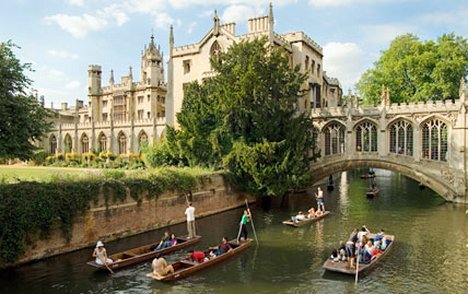
Saying goodbye to Cambridge again by Xu Zhimo
Follow the Chinese tourists as you walk behind Trinity, Clare and King’s colleges.


They will lead you unerringly to this Beijing marble stone inscribed with the first and last verses of the best loved poem by China’s most popular poet.

Photo credit Silas S. Brown. (Click here)


Xu had been in an arranged marriage when he arrived to study English in Cambridge in 1921, but he fell in love with another woman, Lin Huiyin, despite her already being promised to someone else. In 1922 he returned to China and fell in love again, this time with Lu Xiaoman, the wife of a friend. They married in 1926, but their families ostracised them, there were money troubles, and Lu became depressed. Xu died in a plane crash in 1931, allegedly flying to meet Lin Huiyin.
He wrote the poem after a second and final visit to Cambridge in 1928. Every Chinese schoolchild learns it by heart, along with the story of Xu and Lin.
Stand a moment with the tourists, as they recall their own movings on; gently flicking their sleeves, not taking away even a wisp of cloud.
Saying good-bye to Cambridge again
Very quietly I take my leave
As quietly as I came here;
Quietly I wave good-bye
To the rosy clouds in the western sky.
The golden willows by the riverside
Are young brides in the setting sun;
Their reflections on the shimmering waves
Always linger in the depth of my heart.
The floating heart growing in the sludge
Sways leisurely under the water;
In the gentle waves of Cambridge
I would be a water plant!
That pool under the shade of elm trees
Holds not water but the rainbow from the sky;
Shattered to pieces among the duckweeds
Is the sediment of a rainbow-like dream?
To seek a dream? Just to pole a boat upstream
To where the green grass is more verdant;
Or to have the boat fully loaded with starlight
And sing aloud in the splendor of starlight.
But I cannot sing aloud
Quietness is my farewell music;
Even summer insects heap silence for me
Silent is Cambridge tonight!
Very quietly I take my leave
As quietly as I came here;
Gently I flick my sleeves
Not even a wisp of cloud will I bring away
Something fishy in Florence
When routine science drives out the good stuff
The Society for Gynecological Investigation (SGI) is one of the première research societies for obstetrics and gynaecology in the US. This year they are holding their annual congress in Florence, – no global warming worries for them – and have just declined the offer of an oral presentation of the forthcoming results of the Control of Hypertension in Pregnancy study (CHIPS).
CHIPS, led by Professor Laura Magee from British Columbia, is an important randomised trial. It is testing the hypothesis that tight control (i.e. normalisation) of raised blood pressure harms the baby but is good for the mother. Both arms, tight and loose control, are widely practised, but no-one knows which is better. Millions of pregnant women need the answer now. I’m only distantly involved, but the trial appears to have been well conducted. The protocol was peer reviewed, published, and followed, and the planned sample size achieved. It cost five million dollars, with 1,031 women participating from 97 centres in 16 countries.
I’m not privy to SGI deliberations, but I know what usually fills their congresses. Observational studies relating fancy Doppler fetal blood flow measures or the blood levels of various chemicals, to things like birth weight or pre-eclampsia. Worthy but hardly ground breaking. It would be sad if the audience in the main hall were forced to listen to some grandee rambling on about his serum rhubarb measurements while the results of this major trial were hidden away in a remote poster display.
Let’s hope I’m wrong. Perhaps the first public presentation of the results so many major international multi-centre trials have been offered, that there wasn’t room for CHIPS. I’ll be looking out for the programme.
Jim Thornton
Full disclosure – My hospital was a recruiting centre for CHIPS.
Ariel Sharon
1928-2014
Reprinted from AODeadpool, but presently only available in the AODeadpool Facebook group (click here). Currently invitation only but “like” if you want to join.
If you thought Tony Blair or George W Bush were controversial, you never met Ariel Sharon. War hero and alleged war criminal, handsome soldier and bloated politician, peacemaker and warmonger, everything he did annoyed someone new. But he didn’t deserve his end; eight years of vegetative state, futile surgery and horrible indignity. He slipped the leash on January 11.
Young Ariel Sharon was a raging firebrand
Stoutly defending his beleaguered homeland
A hero of the Six Day War
And the one on Yom Kippur
But later came the refugee massacre
Among the tents of Shatila and Sabra.
When into the camps he allowed
A murdering Phalangist crowd
Since he was Minister for Defence,
The lawyers said he should have sensed,
That it would end in the blackest day
When Arafat’s lot got sent away.
But as Prime Minister he got a firmer grip
Took his army out of the Gaza strip.
Although some thought that he messed around
With the West Bank settlers’ facts on the ground.
So did he deserve such a horrible death?
Eight long years till he took his last breath.
The doctors carrying on regardless.
That’s what you get for being largest.
Bigger than a blooming ox
They couldn’t get him in the box
Instead they kept him ‘live and slimmin’
Until he fitted in the coffin.
Jim Thornton
When the Time Comes
By Louis de Bernières
Every now and again a novelist, not primarily known for his poetry, delivers a corker. Michael Ondaatje did it with The Cinnamon Peeler. John Updike did it more than once. De Bernières has done it with this one. It ends his 2013 collection in memory of CP Cavafy, Imagining Alexandria.
When the Time Comes
When the time comes, it is better that death be welcome,
As an old friend who embraces and forgives.
Sieze advantage of what little time is left,
And if imagination serves, if strength endures, if memory lives,
Ponder on those vanished loves, those jesting faces.
Take once more their hands and press them to your cheek,
Think of you and them as young again, and running in the fields,
As drinking wine and laughing.
And if you wish, let there be Spanish music, Greek seas
And French sun, the hills of Ireland if you loved them,
Some other place if that should please, some other music
More suited to your taste.
Consider, if you can, that
Soon you’ll shed this weariness, this pain,
The heaped-upon indignities, and afterwards — who knows? —
Perhaps you’ll walk with angels, should angels be ,
By fresher meadows, unfamiliar streams.
You may find that those who did not love you do so now,
That those who loved you did so more than you believed.
You may go on to better lives and other worlds.
You may meet God, directly or disguised.
You may, on the other hand — who knows? — just wander off
To sleep that seamless, darkest, dreamless, unimaginable sleep.
Do not be bitter, no world lasts forever.
You who travelled like Odysseus,
This is Ithaca, this is your destination.
This is your last adventure. Here is my hand,
The living to the dying;
Yours will grow cold in mine, when the time comes.
Obesity and NHS fertility treatment
Debate at the British Fertility Society Sheffield 9 Jan 2014
This house believes that obese patients have the right to NHS fertility treatment
The case against.
Reasons for not providing government funding for fertility treatment for obese patients, fall into two main groups; reasons for not providing infertility treatment in general, and reasons for not providing it specifically to obese parents.
In general infertility treatment does not fulfil any of the widely recognised requirements for state intervention in the market.
1. It’s not a public good, i.e. something like mosquito control programmes to prevent malaria, which would not be provided in a free market.
2. There are no beneficial externalities e.g. the accidental benefit to others from treating infectious diseases like TB. Rather in an overpopulated world there may even be net harmful externalities from the resource use of additional people.
3. State funded infertility treatment does not help the poor, because infertile patients are on average richer.
4. There is no “rule of rescue” mandating infertility treatment on humanitarian grounds.
Specific extra reasons for not providing NHS fertility treatment to obese patients are as follows.
1. Obese patients have lower success rates on average than normal weight patients, and if they succeed in becoming pregnant have higher pregnancy complication rates.
2. Obese parents tend to have obese children and the attendant health complications. Therefore in the interests of the children we should not subsidize them reproducing.
3. For many women obesity is a cause of their infertility. Treating their infertility on the NHS reduces their incentive to lose weight and in the long run imperils their health.
4. Obese patients are less deserving of fertility treatment than normal weight patients, because it is a self-inflicted problem. Obesity is caused by over eating and under-exercising.
None of these reasons apply to self-funded obese patients paying for private infertility treatment. Like everyone else, obese people are generally the best judges of their financial and reproductive priorities. Their choices should neither be constrained nor subsidized by government without good reason.
Jim Thornton
 Ripe-tomato.org