Boston/Botswana circumcision trial – 2
Is death a “minimal risk”?
Yesterday’s post (click here) concerned a randomised trial from Botswana (accessible here), which was so poorly designed and executed by the researchers from Boston, that it failed to answer the question it ostensibly asked; which method of neonatal circumcision is best? But at least it provided data on the risks of newborn circumcision by supervised but inexperienced practitioners in Africa.
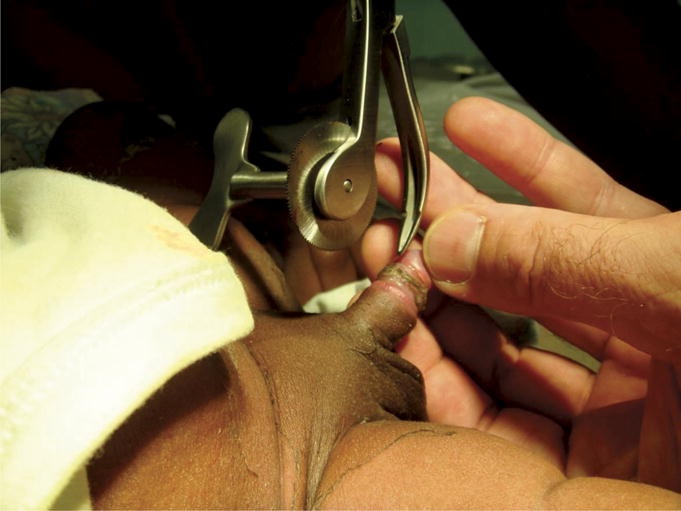
The abstract and table of complications list 34 adverse events in 30 out of 300 infants, of whom 295 were followed up, a complication rate of 10%. They included 5 cases of bleeding, no infections, 27 removals of too little skin, 14 adhesions or skin bridges, and 2 Plastibell rings migrating proximal to the corona. This latter complication can be catastrophic if not noticed, but if an expert removes it in time, is just a painful scare. One Plastibell ring had to be removed with a ring cutter (above). There were no cases of “removal of too much skin” although the definition of that was strict, namely “>1/2 shaft denuded”.
These complication rates are an order of magnitude higher than other reviews (Gee and Ansell click here; Weiss et al click here ) which report median rates of 0.2% and 1.5% respectively. Ascertainment and classification issues probably explain some of the difference, but the authors don’t even cite these references, or for that matter any other comparative statistics. Nor do they state what rate of complications they would have judged unsafe. They simply conclude “Neonatal male circumcision can be performed [safely] in Botswana […]”. The abstract omits the word safely but this must be a typo. The statement is meaningless without it, and the conclusion of the main paper has safely included.
Alert readers will note that the adverse events above add up to 48 rather than 34. They don’t add up in the paper either, another cause for concern.
What about deaths?
Read the whole paper. At the end of the third paragraph under the heading “study participants”, a section few would ever read, is this:
“Of the 5 infants with no follow-up after the immediate post procedure assessment, 2 moved out of the study area (mothers reported by phone that babies were well) and 3 died. Of these, 2 died of gastroenteritis and one died of suspected neonatal sepsis on his second day of life, with the death reviewed by the study Data Safety Monitoring Committee, Botswana Health Research and Development Committee and Brigham and Women’s Hospital Institutional Review Board [IRB] and not thought to be procedure related.”
Three deaths out of three hundred is a mortality of 1%. That’s higher than the mortality from a triple coronary bypass in Boston! The deaths are not mentioned in the abstract, not included in the complication tables, and no further details are given. What age were the babies at death? What was the time relation between circumcision and death? The baby who died from neonatal sepsis was only two days old, so he must have died within 48 hours of the operation. What examinations and tests were done? Were autopsies performed? What did they show?
Instead we are essentially told: It’s OK. The IRBs that approved the research, shown a summary by the researchers, decided they were probably not procedure-related. The singular “death reviewed” also suggests the IRB only reviewed the suspected neonatal sepsis death. Did the researchers themselves judge the other two as not related?
Death of healthy term newborns is uncommon, even in Africa. In Botswana, the neonatal mortality rate (death in the first month of life) is 19 per 1000 (UNICEF 2010 click here), and most of those would be from prematurity, birth trauma or asphyxia, or congenital abnormality, all of which were exclusion criteria and should mostly be obvious at birth.
It can be difficult to determine cause of death in newborns, but neonatal death from gastroenteritis among breast-feeding babies, the majority in Africa, is not common. Death of a healthy baby from suspected sepsis within 48 hours of circumcision must be procedure-related until proven otherwise.
The deaths are mentioned again in one other section of the paper – not the abstract, which will be widely read, but towards the end of the discussion section. Here’s what the authors say:
“Finally, the issue of neonatal mortality must be addressed. […] Where diagnostic capabilities are limited, it can be difficult to make a definitive diagnosis as to the cause of a neonate’s death. Therefore, we would strongly recommend that if a provider detects any sign of neonatal illness, that the NMC [neonatal male circumcision] procedure be postponed until the neonate is deemed clinically well. Although NMC has been shown to be very safe in resource-rich settings and should be equally safe in resource-limited settings, it is important that providers perform NMC only when the risks of the procedure can be absolutely minimized, and that the public be educated about the safety of NMC so that neonatal deaths are not erroneously attributed to the procedure.”
In other words. It’s safe in rich countries, so it must be safe in poor ones. If poor babies die after circumcision, they must have died of something else. If any foolish mother blames her healthy baby’s death on the unnecessary operation performed 48 hours earlier, she needs educating.
The ethics of this trial
In Botswana, according to the authors, “neonatal male circumcision is rarely performed”. That means that, in the absence of this research, these babies would not have been circumcised. Here’s The Declaration of Helsinki on research in children.
For a potential research subject who is incompetent, the physician must seek informed consent from the legally authorized representative. These individuals must not be included in a research study that has no likelihood of benefit for them unless it is intended to promote the health of the population represented by the potential subject, the research cannot instead be performed with competent persons, and the research entails only minimal risk and minimal burden.
A 10% complication rate, two life-threatening Plastibell retentions, and three healthy newborns dead. Brigham and Women’s IRB could hardly have foreseen this, but they must be doing some soul searching. Did they approve research with “minimal risk and minimal burden”?
Jim Thornton
For other posts on adult circumcision trials click here, on neonatal risks here, and on ethics here.
Boston/Botswana circumcision trial
Two/three arm? 300/1250 participants?
This randomised trial of different methods of neonatal male circumcision in Botswana (click here, or Plank Botswana circ trial), has just been published online in J Acquir Immuno Defic Syndrome. The paper version will appear on April 15th.
The trial was led by US researchers, sponsored by Brigham and Women’s Hospital in Boston Massachusetts, an affiliate of Harvard Medical School, and funded by a grant from the United States National Institutes of Health. This is non-therapeutic research on a vulnerable group – participants were healthy newborn boys born in three government hospitals in Botswana. You’d expect such an ethically sensitive trial, performed by researchers from some of the world’s leading academic institutions, to be done correctly.
First inspection looks promising. The trial was registered in Sept 3rd 2009. This is four months after it started, which is not ideal, but over a year before it ended, which should be early enough to prevent the researchers altering the sample size or primary endpoint to get the result they want. Unfortunately there are serious inconsistencies between registration and publication. I’ll describe two, the sample size and design, and the primary endpoint.
Sample size and design
The published paper describes a two-arm randomised trial including 300 infants, comparing the Mogen clamp method (n=153) with the Plastibell device (n=147). There is no mention of any alteration in design or sample size.
However the trial registration on ClinicalTrials.gov (here) describes a three arm trial with the AccuCirc device added as a third arm, making a total sample size of 450! Various older versions of the trial registration give a “total anticipated enrolment” of either 1000 or 1250. On the latest version “anticipated enrolment” of 1250 has been altered to “achieved enrolment” of 1020.
What is going on? It’s bad enough to alter your sample size between registration and publication without giving a reason. To change a three-arm trial into two-arms makes a mockery of trial registration. Was the registration wrong, or are the authors failing to report the third AccuCirc arm?
Primary outcome
In the paper the primary outcome is ambiguous – undefined in the abstract, and defined only as “adverse events and parental satisfaction” in the methods/outcomes section. The statistical analysis section states “this study was designed to detect a 20% difference in parental satisfaction between the 2 techniques”.
In the trial registration document the primary outcome is clear. In all versions it is “bleeding within six weeks”.
This is not reported as such in the paper, but since most bleeding occurs early, the outcome “bleeding”[with no time period given] is probably the same. Five cases occurred in the Mogen group and zero in the Plastibell. The authors did a chi-square test and estimated P=0.03. i.e. nominally a positive result. This finding makes it into the abstract.
Unfortunately, there are other statistical problems. In the statistical methods section of the paper the authors said they would use Fisher’s exact test for dichotomous outcomes, which is indeed preferable, and when I redid the test that way, the P value for “bleeding” became 0.06 i.e. not quite statistically significant. Maybe it doesn’t matter, because the abstract conclusion is the opposite of the bleeding data – Mogen is said to be safer because there were two cases of migration of the Plastibell.
The details of the satisfaction questionnaire are not described. and the results are presented only as summary percentages “highly or completely satisfied” at 6 weeks (95% Mogen, 96% Plastibell; P = 0.5) and at 4 months (95% Mogen, 99% Plastibell; P = 0.04). Despite this nominal statistical significance at four months, and the earlier statement in the paper that maternal satisfaction was a primary outcome, the authors made nothing of this and did not even mention it in the abstract.
I could go on. Read the paper. For now a letter to the editor of J Acquir Immuno Defic Syndrome may bring clarification. I will report back.
But this is non-therapeutic research in newborn children who cannot consent. It is the sort of research that should be only done to the highest possible standards and monitored ethically more closely than any other. Tomorrow (click here) I’ll take a closer look at the complications these babies suffered, and the trial’s ethical monitoring.
Jim Thornton
Larkin’s animal poems – 3
Myxomatosis
Larkin to Monica Jones on 28 September 1954:
[…] I thought of you last night when I was finishing an 8-line poem: it began as a furious diatribe in response to filthy Ronald Duncan [Punch writer who had welcomed this solution to the rabbit problem], but it finished as a very casual little anecdote: I’ve sent it to the Spectator along with Church Going.
And again on 14 November 1954:
I’m not keeping “the rabbit one” from you: it’s only that in it I kill the rabbit, which makes it totally out of character and rather like a piece of journalism. I’ll transcribe it. [he types the poem with two variants – Blind/Caught and sightless/soundless in line 1]
It’s not much of a poem. But of course I felt strongly enough about it. I hardly dare ask what you think of it. I strove (queer word) to give the essential pathos of the situation without getting involved in argument. Give me your opinion on sightless/soundless. I believe rabbits are both blind and deaf so either wd do – a field with no sights or sounds in. Oh dear. Is this “using” the rabbits? Honestly, my motives are really good – better than the poem, I’m afraid […]
Dear bun, I know what you mean about turning life into art – I sometimes have you with me for long stretches, noticing things together – actually that sounds horrible, but yesterday I walked up the Lisburn Road, a very dull road, for about 2 miles, a road nobody would ever walk along for pleasure – rather like say the Melton Road in Leicester, but I enjoyed it and so wd you, & I thought as much at the time. Simple pleasures!
Then on 28 November:
[…] Did you notice the rabbit poem, tucked away in the Spr on Friday? Wonder if I shall receive any letters about it. I don’t like the broken line: the first half has insufficient carry-on from the first 3 lines; the second is rather stupidly enigmatic, suggesting a farcical interpretation, like a belch or something of the sort. But I like lines 5 & 6, & lines 7 & 8 are vitiated only by the unspoken “Yes and you may not” hanging about them. I should have done better to choose something more incontrovertible for my finale, but the thing was written in such a tearing hurry I didn’t stop to consider such niceties.I do hope you find it respectful to the awful state of yr nation. I should hate it if you thought I was just earning a couple of guineas from their sufferings.
Finally on 29 January 1955:
I hear the Myxomatosis Committee says it will rage again this year. If this is so, I don’t want a holiday in England. It would be quite dreadful to be afraid to go out lest we shd happen upon any pitiful stricken ones. This Christmas was quite enough for me. […]”
The letters are full of his usual self deprecation about his technical facility, but there’s real concern as well. Rabbits were part of his and Monica’s private love language – he drew pictures of them both as rabbits in the margins and called her “bun” – and he twice worries that she might accuse him of using the rabbits. It sounds like a genuine worry, although whether about the rabbits, or Monica’s response, I’m not sure.
Imagine The Spectator poetry editor opening the envelope to find Church Going, with this tucked in as a filler. That must’ve been a good day!
It was later included in The Less Deceived, which was dedicated to Monica. Here it is.
Myxomatosis
Caught in the centre of a soundless field
While hot inexplicable hours go by
What trap is this? Where were its teeth concealed?
You seem to ask.
TTTTTTTTTTTTTI make a sharp reply,
Then clean my stick. I’m glad I can’t explain
Just in what jaws you were to suppurate:
You may have thought things would come right again
If you could only keep quite still and wait.
Philip Larkin
See also Take One Home for the Kiddies here, At Grass here, First Sight here, Pigeons here and Laboratory Monkeys here.
Sell Watchman
Bayesian? Or data driven?
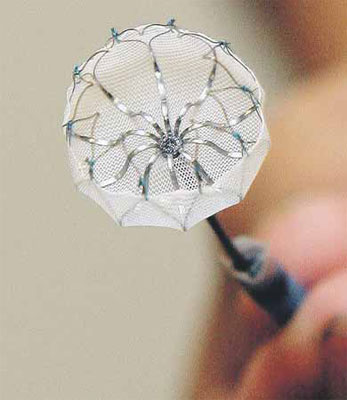
The Watchman is a clever widget, implanted via the femoral vein, for stopping atrial fibrillation-related blood clots floating off and causing strokes. It is already licensed for those who cannot tolerate warfarin, but the big money will come if it works better than warfarin and can be used for everyone.
The first trial (click here for the 2009 Lancet paper) had been registered here with a planned sample size of 1550. With a randomisation ratio of 2:1 device:control, we should expect approx 1000 intervention:500 control. The published numbers were 463 intervention: 244 control. On the face of it not good.
However a trial description had also been published in 2006 (click here) which pre-specified a Bayesian analysis testing for device non-inferiority. The minimum of 300 participants followed up for one year, and 100 for two years pre-specified there, was achieved. So OK. Back on track.
But the trial failed to convince the FDA. Perhaps they were annoyed that the analysis plan was not clear on the trial registration site. Perhaps they just found the Bayesian analysis confusing. Forgivably so! Here’s an extract:
“The pre-planned primary analysis of efficacy and safety used a Bayesian Poisson model, stratified for CHADS2 score, with a non-informative gamma conjugate prior distribution.”
Urgh! Anyway the FDA demanded another trial. It’s called PREVAIL and the researchers are making a complete hash of it.
It was registered here on August 12 2010. The original primary endpoint was:
“stroke, cardiovascular death and [presumably or] systemic embolism” by six months.
On March 1st 2013 this was changed to three co-primary endpoints of:
“7-Day procedure rate of death, ischemic stroke, systemic embolism and complications requiring major cardiovascular or endovascular intervention;”
“Comparison of the composite of stroke, systemic embolism and cardiovascular/unexplained death”;
“Comparison of ischemic stroke and systemic embolism occurring greater than 7 days post randomization”.
These three new co-primaries were to be measured at 18 months. i.e they’d altered the timing of the original primary outcome, and added two more!
On the face of it this is cheating. The trial started in Nov 2010, with 18 month follow-up by Dec 2013. By March 2013 the triallists would have had the original, six month primary outcomes, so a change at that stage is data driven!
However, according to this blog:
“[…] Boston Scientific told me that the endpoint changes had been put in place several years ago by Atritech, the company that developed Watchman and which was acquired by Boston Scientific. Atritech, the representative said, had neglected to update the PREVAIL ClinicalTrials.Gov website.”
I guess cock ups happen. But the trial is not double blind, so the investigators would have known how the data were going long before any formal analysis. Let’s hope the relevant email trails can show the changes were not data driven.
There are other problems. The planned sample size was 475. But Boston Scientific are already leaking data to their shareholders here (accessed 17 March 2013). According to that 407 patients were randomized 2:1 device v warfarin control.
The first co-primary <7 day safety data were not presented by group, but the event rate in the device arm was 2.2%. For the second and third co-primaries data were limited because only 88 patients had reached 18 months, but risk ratios were presented! For the new second co-primary, i.e. the original primary endpoint measured at 18 months, the risk ratio is 1.07, device versus control. For the third co-primary, the observed difference in adverse event rate between the device and control group was 0.0051 per 100 patient years. It’s is not clear in the data released to investors if this favoured the device or control. However, a slide presentation for the American College of Cardiology meeting in March, which was never presented because a press embargo had been broken (That’s another story. Details here!) gives a clue. I got my copy from here. Here it is, PREVAIL slides pdf. The results favour controls.
Although I can’t find any published analysis plan, this slide set suggests that PREVAIL is also Bayesian. Slide 28:
“Bayesian piecewise exponential technique used to model 18-month rates, with the historical priors based on data from the previous pivotal trial, PROTECT AF”
So that’s it. PREVAIL is a Bayesian trial using the PROTECT trial’s posterior credibility intervals as historical priors.
In theory that’s exactly how Bayesian trials should be analysed. But we still need a data independent analysis plan, and we need the triallists to keep to it. Otherwise they have too many chances to get the “right” result.
Here’s one area of possible muddle. Since PROTECT is still accumulating data, which results will form the priors for PREVAIL? The Lancet ones, or the ones on the day of analysis?
Eventually PREVAIL will be published in all its glory, and perhaps all these questions will be answered. But unless the authors have some date-stamped analysis plans, I suspect the FDA will ask them to try a third time.
Personal note
I’m an obstetrician, not a statistician, but I’ve had my own fingers burned by the reverend! Ten years ago my colleagues and I conducted a trial (GRIT) of timed delivery for premature babies failing to thrive in utero. Click here for the main Lancet report. Full text grit-Lancet-2004 for those without institutional access. The trial was registered here, and we analysed it in a Bayesian way, following a published analysis plan (click here, or GRIT Bayesian analysis). It’s still the only trial of this important intervention, but it’s influence has not been great. One reason was that it was a negative trial, but another may have been that the Bayesian analysis was confusing. In our case we used three different prior beliefs (enthusiastic for delivery, for delay, and sceptical), which we said different obstetricians held, so we ended up with three different results!
Randomised trial have two jobs to do. The first is to give an unbiased estimate of treatment effect. Frequentists and Bayesians can both do that. The second is to convince practitioners. Frequentists are better at that.
Jim Thornton
A Blessing
By James Wright
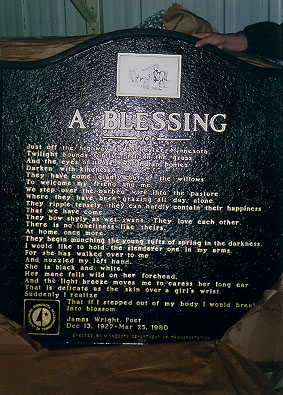
Larkin’s poem about Brown Jack, click here, reminded me of this. It neither rhymes, nor scans, but it’s accessible and by golly it captures the moment – Larkin would have approved.
In 1958 Wright was driving back with his friend the poet Robert Bly from a visit to Bill Duffy and his Swedish wife Christina in Pine Island. He was going through a bad patch. His marriage was breaking up over his affair with crazy Anne Sexton (click here), he was drinking heavily and about to lose his job. He’d just written the puzzling Lying in a Hammock at William Duffy’s Farm in Pine Island, Minnesota (click here).
He started A Blessing back in the car after they’d stopped to pet the ponies, and omitted all his troubles; perhaps Lying in a Hammock, perhaps the ponies, had sorted him out. Whatever the cause, the result is pure celebration, one of the best loved poems of the 20th century.
Years later Wright’s most famous pupil, Garrison Keillor, engineered the placing of a plaque at the spot. Here’s a poor quality picture. I’d love a better one. It’s on Interstate-90, at the eastbound High Forest rest area, near Stewartville.
Stevns Klint



Gifts from the cliffs
Thirty miles south of Copenhagen a dark layer runs through the chalk sea cliffs. It dates to about 66 million years ago and occurs in sedimentary rocks of that age all over the world. Stevns Klint is one of the best exposures in Europe. Below it dinosaur fossils are abundant, above it they’re absent, and many years above mammal fossils appear. The layer itself contains high levels of iridium, an element rare on earth but common in asteroids.
You’ve guessed. This is the c[K]retaceous-tertiary (K-T) boundary, caused by an asteroid hit on the coast of Mexico; global winter, mass extinction and the Chicxulub crater the result.
Hojerup, with car park, museum and an excellent restaurant, a bit south of the red arrow on the map above, is the best access spot. Descend the steps by the old church on the cliff edge; legend says it never falls into the sea despite the eroding cliffs, because every night, when no-one’s looking, it hops inland a bit! A few yards south along the shingle, scramble up to see and touch the boundary layer. So many people have done so that there is a large overhang, so don’t stay long. Have a swim instead.
I’ve been twice, and collected quite a few bits of the boundary layer. I often award visiting speakers to our department with a piece, but I rarely get round to adding a note to remind them why their gift of crumbly grey rock is interesting. Now I can print off this post.
Jim Thornton
Larkin’s animal poems – 2
At Grass
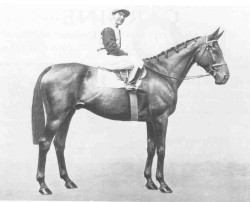
Brown Jack won the Queen Alexandra Stakes at Ascot six years in a row between 1929 and 1934. A few years later the short film Where is Brown Jack now? inspired this poem.
It’s about death of course, Only the groom and the groom’s boy, with bridles in the evening come, but there’s little sadness or regret, rather a celebration both of the horses’ famous primes, and of their comfortable retirement.
Brown Jack died in 1949, the year the film was made and the poem composed. Here’s a story about him, nicked from here.
In 1934 after winning his 6th Queen Alexandra Stakes he was taken away to his stables for the last time amid wild scenes of jubilation. To assist in getting through the crowds the police thought of organising an escort. But instead they made a simple sign which they stuck on the front of his horsebox, “Brown Jack”. The traffic and the crowds parted to let him through and to watch the passing of a horse whose like they knew they would not see again.
The poem is one of Larkin’s most popular. He knew it was good – he closed The Less Deceived with it.
The eye can hardly pick them out
From the cold shade they shelter in,
Till wind distresses tail and mane;
Then one crops grass, and moves about
– The other seeming to look on –
And stands anonymous again
Yet fifteen years ago, perhaps
Two dozen distances sufficed
To fable them: faint afternoons
Of Cups and Stakes and Handicaps,
Whereby their names were artificed
To inlay faded, classic Junes –
Silks at the start: against the sky
Numbers and parasols: outside,
Squadrons of empty cars, and heat,
And littered grass: then the long cry
Hanging unhushed till it subside
To stop-press columns on the street.
Do memories plague their ears like flies?
They shake their heads. Dusk brims the shadows.
Summer by summer all stole away,
The starting-gates, the crowd and cries –
All but the unmolesting meadows.
Almanacked, their names live; they
Have slipped their names, and stand at ease,
Or gallop for what must be joy,
And not a fieldglass sees them home,
Or curious stop-watch prophesies:
Only the groom, and the groom’s boy,
With bridles in the evening come.
Philip Larkin
See also Take One Home for the Kiddies here, Myxomatosis here, First Sight here, Pigeons here and Laboratory Monkeys here.
Larkin’s animal poems – 1
Take One Home For the Kiddies
People rarely think of Philip Larkin as an animal lover. But he was, genuine, sensitive and unsentimental, as these poems and many of his Letters to Monica make clear.
He was ahead of his time. Only in 1978 did Clarissa Baldwin’s slogan A dog is for life, not just for Christmas begin to make pets as presents, socially unacceptable. It took Larkin six years, 1954-1960, to perfect these eight lines. They still shock.
Published in The Listener, 5 December 1963, and in The Whitsun Weddings.
Take One Home For the Kiddies
On shallow straw, in shadeless glass,
Huddled by empty bowls, they sleep:
No dark, no dam, no earth, no grass –
Mam, get us one of them to keep.
Living toys are something novel,
But it soon wears off somehow.
Fetch the shoebox, fetch the shovel –
Mam, we’re playing funerals now.
Philip Larkin
See also At Grass here, Myxomatosis here, First Sight here, Pigeons here and Laboratory Monkeys here.
Independent Midwives
Leave them alone – ignore the EU legislation
Many friends are pushing a petition against the new EU directive compelling independent midwives to carry malpractice insurance. This will make it impossible for most of them to practice, because the premiums are unaffordable, and will push women into the arms of untrained people, or even to deliver alone. Petition here. Background here. Consultation here.
Since we need more diversity in UK health care, not less, I signed. But I’ve just read it more carefully:
“Independent Self Employed Midwives are asking the Government to re look at EU directive (2011/24/EU) which becomes effective in October 2013 and links a health care professionals registration to Professional Indemnity Insurance. […] Government help is requested in securing workable and affordable commercial insurance to find a way forward.”
That sounds like a request for government support to pay the premiums, or to set up a government-backed scheme. That won’t happen. No government can indemnify independent health care providers, who it neither employs nor controls. It’s expensive enough indemnifying NHS employees, who can be forced to follow guidelines and keep up to date.
The solution is less government, not more. The current system works, and should be allowed to continue. Women who choose to deliver under the care of an independent midwife know they they might not get compensation for negligent damage – just like they don’t for a non-negligent accident. Independent midwives keep their assets in a partner’s name, and otherwise ignore the problem – lawyers only go where the money is!
By all means insist that women are fully informed, but don’t forbid a perfectly reasonable contract between two adults. Ignore this foolish bit of EU legislation.
Jim Thornton
Kimeru circumcision
Glans exposure with no foreskin removal
In the early 1980s I spent nearly four years in Chogoria Mission Hospital (click here), near Meru, on the eastern slopes of Mount Kenya. The local Kimeru were close relations of the largest Kenyan tribe, the Kikuyu. As general duty medical officer I treated a lot of men, and saw a lot of penises. The older ones had all been circumcised in a rather unusual way.
I’ve not come across a description, although this website mentions that the neighbouring Chuka did it the same way, without describing how. Here is what I remember seeing, and being told, 30 years ago. I hope no-one was pulling my leg.
Appearance
The Kimeru circumcised penis had an exposed glans as normal, but also a flap of loose skin on the ventral surface, the “beard”. Men being men, a large “beard” was something to be proud of!
The procedure
The operation was done at puberty. The surgeon pulled the dorsal foreskin forward, and made a longitudinal incision through both layers, creating a buttonhole which he pulled over the glans penis, leaving it exposed. No skin was removed.
It doesn’t sound much fun, but I guess it was a good deal less painful and less mutilating than the usual procedure. I wonder what the effect was on HIV transmission.
Related posts here, here, here and here.
Jim Thornton
 Ripe-tomato.org