Coming
A single shot at emotion, hit or miss
Spring was the other poem, of the six, that Monica really liked (click here). But I, and Larkin, prefer this one.
In 1964, in Further Requirements, Larkin wrote perhaps the finest explanation ever, of this particular poetic technique – the master describing his masterpiece:
The most difficult kind of poem to write is the expression of a sharp uncomplicated experience, the vivid emotion you can’t wind yourself into slowly but have to take a single shot at, hit or miss. Some fifteen years ago in February, I heard a bird singing in some garden when I was walking home from work: after tea I tried to describe it, and after supper revised what I had written. That was the poem, and I must say I have always found it successful. It is called ‘Coming’ — what is coming, I suppose, is Spring.
This, despite the forgotten boredom, is the uncynical Larkin baring his feelings. Amis would have harrumphed, but the rest of us know exactly what he’s talking about.
Coming
On longer evenings,
Light, chill and yellow,
Bathes the serene
Foreheads of houses.
A thrush sings,
Laurel-surrounded
In the deep bare garden,
Its fresh-peeled voice
Astonishing the brickwork.
It will be spring soon,
It will be spring soon —
And I, whose childhood
Is a forgotten boredom,
Feel like a child
Who comes on a scene
Of adult reconciling,
And can understand nothing
But the unusual laughter,
And starts to be happy.
Philip Larkin
Wedding Wind
Larkin’s “first good poem”
On 20 Nov 1950 Larkin sent Monica Jones six poems, Wedding Wind, Spring, Wires, Coming, Modesties, and The Dedicated: “Herewith the six anticlimaxes”. (LM p 20)
She replied 21 Nov: “I like best Wedding-wind & Spring […] Wedding-wind I like extremely, it’s a lovely title, breathing Hardy and Houseman; and, marvellously, breathing a genuine rusticity – that’s a horrid word for it – a real countrified air, like you was bred & born in it. Stables, horses and chicken pail anyone could do; but candlelight, floods, the girl’s apron – these are the real close intimate touches […]. (LM p 21 note)
Larkin replied on 26 Nov: “Wind is about the oldest – 1947 or so. […] On the whole I think Wind is the best: I wish I could write more like that, fuller, richer in reference: I am quite pleased with the to-me successful use of the floods & the wind as fulfilment & joy. Shouldn’t write like that now!” (LM p 25)
In 1975, in an interview in Radio Times, Larkin said “I wrote my first good poem when I was 26”. Archie Burnett (CP p 358) thinks Wedding Wind was probably that poem, on the basis that a completed draft appears in Workbook 1 dated 26 Sept 1946. Others have suggested At Grass completed in 1950. Since Larkin was born in 1922, neither was completed at exactly the right age, but in the letter to Monica, Larkin himself got the date of composition off by a year, so by 1975 he could easily have been wrong again.
Wedding Wind is his only poem written from a female perspective. Somehow the simple images of wind and water bring out both the innocence and sexuality of the wedding night. There’s all the perfectionism of the mature Larkin –
“Cloths is right. I think it sounds more impressive than clothes. Anyway it is unlikely that there would have been a heavy wash on that particular day.” (26 April 1955 to DJ Enright. SL p 240).
But no trace of the cynicism. This tender, religious poem is his first really great one. And Larkin knew it was good.
Wedding Wind
The wind blew all my wedding-day,
And my wedding-night was the night of the high wind;
And a stable door was banging, again and again,
That he must go and shut it, leaving me
Stupid in candlelight, hearing rain,
Seeing my face in the twisted candlestick,
Yet seeing nothing. When he came back
He said the horses were restless, and I was sad
That any man or beast that night should lack
The happiness I had.
Now in the day
All’s ravelled under the sun by the wind’s blowing.
He has gone to look at the floods, and I
Carry a chipped pail to the chicken-run,
Set it down, and stare. All is the wind
Hunting through clouds and forests, thrashing
My apron and the hanging cloths on the line.
Can it be borne, this bodying-forth by wind
Of joy my actions turn on, like a thread
Carrying beads? Shall I be let to sleep
Now this perpetual morning shares my bed?
Can even death dry up
These new delighted lakes, conclude
Our kneeling as cattle by all-generous waters?
Philip Larkin
References
LM – Philp Larkin; Letters to Monica. Ed. Anthony Thwaite. Faber & Faber. London (2010)
CP – Philip Larkin; The Complete Poems. Ed. Archie Burnett. Faber &Faber . London (2012)
SL – Selected Letters of Philip Larkin 1940-85. Ed. Anthony Thwaite. Faber & Faber London (1992)
2012 in review
The WordPress.com stats helper monkeys prepared a 2012 annual report for this blog.

Here’s an excerpt:
4,329 films were submitted to the 2012 Cannes Film Festival. This blog had 17,000 views in 2012. If each view were a film, this blog would power 4 Film Festivals
Predatory
The new Vanity Publishing
The scientific literature has long been burdened with papers which advance the author’s career more than they advance science. I’ve long believed (click here) that Open Access, in which the author pays to get published – they used to call it Vanity Publishing – aggravates the problem. It provides a golden opportunity for scammers to set up fake journals, with ghost editors, and little or no peer review, and claim that living off author fees is somehow virtuous.
A fellow called Jeffrey Beale (click here), has been keeping tabs on these Predatory Publishers (click here). He’s found 243, many with a hundred or more titles on their lists, as well as another 126 individual journals. All are Open Access, and most are pretty obvious villains.
But a brief scroll through the articles in them, reveals much genuine stuff. It appears that real researchers, of modest talent, grind out overlong, cliché-ridden, more or less scientific papers, and when they’ve been rejected by a few reputable journals, cut their losses, pay a fee to get published, and move on. Presumably for many young doctors, a thousand pounds or so, to help get a well paid consultant job is money well spent.
How long before Readers Pay returns to being the prestigious publishing model?
Jim Thornton
The ROLO trial
Trial endpoint troubles
The ROLO trial (BMJ Sept 2012 – click here) tested the effect of a low glycaemic diet in pregnancy, for women who had previously delivered a very big baby. Controls got no special dietary intervention.
The idea was good. Birthweight above 4kg often causes trouble, and a low glycaemic diet minimises the blood-sugar driven insulin rise rise after food, which crosses the placenta and makes babies bigger. But it didn’t work. Oh well. Let’s look at the trial registration
The trial was registered here in August 2009, and participants were recruited from Jan 2007-Jan 2011. Although the planned sample size was 700, they don’t explain why 800 were actually randomised, of whom 759 ended up being analysed, but that’s a minor point.
The registered primary outcome was “mean birth weight centiles and ponderal indices […] measured at 14, 28, and 34 weeks, at birth and 3 months post-partum”. Ignoring the prenatal time points, that still leaves two outcomes measured twice, i.e. four primary outcomes. That’s three too many – a trial should have one primary outcome.
But the reported primary outcome was different again – raw birth weight. Birth weight centile, and ponderal index were secondary. None were reported at three months.
Turning to secondary outcomes the initial registration listed: maternal weight gain in pregnancy, urinary metabolomics, cord insulin, leptin and IGF-1, and placental weight, villous and vascular development, all measured at 14, 28, and 34 weeks, at birth and 3 months post-partum. On 1 Sept 2009 maternal weight gain at the various time points became the only planned secondary outcomes.
However, in the paper, besides maternal weight gain at the four time points, another eleven secondary outcomes are listed in table 2, and six more in table 3. None appear in the trial registration document.
Does this matter?
It matters because if triallists don’t choose one primary outcome and stick to it, their tests of statistical significance will be wrong. If they don’t pre-specify and report all secondary outcomes, readers can never be sure that outcomes have not been selected to support a particular point of view.
When this paper eventually gets included in the relevant Cochrane review, it will be marked as “susceptible to bias” because of potential selective reporting. Which is a pity because it seems to be otherwise a well conducted trial. The BMJ should know better.
Trial funding – Health Research Board of Ireland, and National Maternity Hospital Medical Fund, i.e. Irish taxpayer.
Final point: if anyone knows what ROLO stands for, let ripe-tomato.org know
Jim Thornton
Cheltenham Birth Centre
A new free-standing midwife led unit
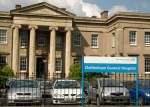

Cheltenham and Gloucester have each had their own consultant led maternity hospitals for as long as anyone can remember. The NHS took them over in 1947, and “Cheltenham General” and “Gloucester Royal” have each delivered about 2,500 babies a year ever since.
That’s more babies than the largest of Amsterdam’s six maternity hospitals – the mighty Onze Lieve Vrouwe Gasthuis helps only 2,100 new people into the world every year. If Cheltenham was in Germany it would be among the largest maternity hospitals in the country – the huge Humboldt clinic in Berlin, created by the merger of three smaller hospitals delivers only just over 3,000 women per year. But in England they were too small – the NHS loves centralisation – so in 2011 the maternity department in Cheltenham General closed, and the obstetricians all decamped to Gloucester Royal.
The people of Cheltenham were a bit miffed at having to go elsewhere to have their babies, so NHS managers created a midwife led unit (MLU) at the old Cheltenham General. This was an excellent idea, because most low risk women have less interventions and just as good baby outcomes in such units. The Cotswolds are full of “back to nature” ex pop stars and city financiers – just the place where natural childbirth should be popular. In theory 2/3 of the Cheltenham births could safely take place there, plus a good slice of the Gloucester ones. Maybe a couple of thousand.
Early numbers have been more modest. Gloucester delivered 5,200 babies last year, Cheltenham Birth Centre 423. The reason of course is that when push comes to shove, pun intended, low tech childbirth is not that popular. You can have water birth, bean bags and every sort of aromatherapy, but you can’t have an epidural in Cheltenham. If labour gets stuck and you need a Caesarean or forceps, it’s an ambulance to Gloucester. It’s all perfectly safe, about 80 women made the trip last year, but not much fun in advanced labour. And Stroud Maternity Centre, a long established MLU just down the road, already catered for many of those who really wanted a low tech birth, about 250 women a year.
And 423 births is a fine achievement. If Cheltenham can maintain 4-500 births per year that would place it among the largest free-standing MLUs in the country. If they can do it without fatally undermining Stroud, planners will surely regard it as a success.
Elsewhere the success of new free-standing MLUs, created when consultant units closed, has been mixed. Brent in North London (click here), Wakefield, Castle Hill in Hull, Llandough in South Wales, Southport, and Hemel Hempstead all closed after a few years. But Grantham, Maidstone, Neath & Port Talbot, Huddersfield, Edgware in North London, and Barkantine in the East End of London hang on. Interesting to see how things pan out in the Cotswolds.
Jim Thornton
Brent Birth Centre
Not wanted in North London



When the Central Middlesex Consultant-led maternity unit closed, and its deliveries moved to Northwick Park in 2004, Brent Birth Centre was created on the Central Middlesex Hospital site. It had everything going for it – beautiful buildings, all the best facilities for natural childbirth, and support from obstetricians, midwives and women’s groups. Almost everyone asked said that if they could, they’d want to deliver in such a unit. The plan was to deliver at least a thousand women a year. Click here for the publicity at the time.
The timing was auspicious. London’s birth rate was rising, and most maternity hospitals were crowded and understaffed. Edgware Birth Centre was the only other NHS free-standing midwife-led unit (MLU) in the whole of London, Tooting Independent Birth Centre was many miles away in South London, and the local hospital, Northwick Park, was unpopular. It had had a run of maternal deaths, was about to have ten more, and had just undergone the first of two devastating investigations into the poor standard of maternity care. Click here for details. Surely women would queue up to deliver in the shiny new Brent Centre.
But they didn’t. Less than 300 women a year chose to deliver there, and it was soon clear that it was not viable. After public consultation (click here) it closed in 2008, and a co-located MLU was created alongside the Northwick Park consultant-led unit (CLU).
What happened?
We can’t blame the NHS. The Tooting private unit, run by the charismatic Caroline Flint, also closed a few years ago due to lack of demand.
Not so many people really want to deliver in a free-standing MLU, at least in urban areas. It’s a case of what people say, and what they do giving different answers. People say MacDonalds provides terrible food, but its profits keep going up. People say they want more government spending on the NHS, education, and police, but vote for lower taxes. They say they want to stop smoking, but keep on puffing. Actions speak louder than words.
Reasons are not hard to find. It’s difficult for a mother to predict whether she will want or need an epidural, instrumental delivery or Caesarean section, and MLUs provide none of these. Women who need them, have to get back in an ambulance and travel to the nearest CLU. About one in five women in a free-standing MLU end up being transferred in labour. There’s nothing unsafe about this, the NHS has a fabulous ambulance service and blue lights can get through any traffic jam. Overall, delivery in a free-standing MLU is just as safe as delivery in a consultant unit. But women don’t want to miss out on an epidural if it turns out more painful than expected, or to be that one in five. Nor is it just mothers who say one thing and do another. Midwives’ enthusiasm may cool somewhat during a long night with a slow labour, an anxious woman, and a testy partner.
Things are different in rural areas. If the consultant unit is 50 miles away, and there is a tradition of delivering in the local midwife unit, such units can work well. But they seem to be a minority interest in London. Edgware Birth Centre battles on, also delivering about 300 women a year, and the new Barkantine Birth Centre in the East End has survived its first few years – 429 women delivered there in 2009. But that’s it for the whole of London. I wouldn’t bet on the success of too many new ones.
Jim Thornton
Hobsballs
Video clips from the sage of Hampstead
Some felt I was hard on Hobsbawm here. Take a look at these interviews, and judge for yourself.
First Paxman – click here. At 2 mins 10 seconds in, Hobsbawm says “one element of production has become surplus to requirement, namely people”. I guess that’s why wages – the price of people – keep rising. Real wage rises were a sign of falling demand in Hobsworld! Oh where was Julian Simon?
At 3:45, after noting that we can feed ourselves with the labour of two percent of people, and a similarly small fraction can provide most other basic goods, he says: “And that’s where the real danger lies.” For Hobsbum, comfortable in his academic lifestyle, freeing others from the grind of subsistence farming was a problem.
Here’s the infamous Michael Ignatieff interview – key exchange about 13.05.
Ignatieff: “Had the radiant tomorrow actually been created, the loss of 15, 20 million people, might it have been justified?”
Hobsbawm: “Yes.”
It’s no slip of the tongue. When I first heard about it, I assumed it would look different in context. But the context makes it worse. Eric “for the Party the more blood the better” Hobsbawn, draws analogies between Stalin’s genocides and deaths caused by the Allies in the 1st and 2nd World Wars. Pure sophistry. Does anyone really think the 1st WW deaths were justified by the fragile peace that came after? Who else compares Allied sacrifices to defeat Hitler, with Stalin killing his own people in the name of Communism?
There’s more. At 18:30, he openly admits to lying by omission about the Soviet Union. At 23:15, Ignatieff asks why he didn’t leave the Party after the repeated Soviet invasions of independent countries, and as analogy tells a politically incorrect joke about a Southern Belle: “It was rape, rape, rape, judge. All summer long”. Hobsbawm just sniggers.
Here is Sue Lawley from Desert Island Discs. At 22:40, referring to why he stayed in The Party after the Hungarian invasion, “I didn’t wish to lose that moral high ground.” Lawley is struck speechless! At 29:00, “I’m a common sense communist!” We’re all struck speechless! At 32:30, he sees increasing barbarism in the West, and claims late 20th century life in Northern Ireland would have been intolerable in the 19th century. Was this man really a historian?
He’s dead now, but state violence in the name of communism isn’t, and his books still lie around. Don’t forget.
Jim Thornton
Never events
“It happened to me”
Two medical students attended my list last week. After the “huddle” and “time out”, I made a little speech about avoiding “never events” in medicine, and reminded them of poor Wayne Jowett who in 2001 received his fatally mal-administered vincristine dose at the same hospital, Queens Medical Centre, where we were operating. The doctors involved came within a whisker of prison. I hoped the lesson would hit home. But I didn’t expect one of them to say “a never event happened to me.”
She had dislocated her right shoulder, but her GP had mis-written “left” on the referral letter. “Left shoulder” was then copied on to the operation list, consent form, operation record and discharge letter. Fortunately, as the nerve block was started, she had been able to say, “No. This one.” and the correct, right shoulder had been operated on. She showed us the scar.
It was a “near miss”, not a “never event”. Four years ago, it had been treated as just “one of those things” – no correction made in the notes, no lessons learned. Only years later did the student discover the error.
I promised I would not mention her name, and I won’t, but she was treated on the NHS in Nottingham. I think things are better now. I hope so.
Jim Thornton
BJOG KT Journal Club
Katherine Twining Journal Club
My friend Khalid Khan, the new editor of the British Journal of Obstetrics and Gynaecology (BJOG), has set up the KT Journal Club as a Twitter group to discuss important BJOG papers. The next virtual meeting is Thursday 13 Dec. at 6:30 pm.
Topic – Timing of prophylactic antibiotics in Caesarean section. Click here for the paper. Follow @kt_network. To contribute add the hashtag “#ktjc”. If you’re stuck – email: ktnetwork@qmul.ac.uk, or contact: @elaineleung (twitter) or elaine.leung@qmul.ac.uk (email).
And Katherine Twining?
She was a young nurse who in 1889 bought a modest house in Howard’s Road, Plaistow and started providing maternity care to local women. She called it St Mary’s Nursing’ Home. A few years later she converted two nearby houses into a midwifery training school, and later opened branches all over the East End. The original premises expanded until 1923, when Queen Mary opened a new building on Chesterton Road. In 1926 this was renamed the Plaistow Maternity Hospital, the first such hospital in the East End of London. By the time the NHS took it over in 1948 it had 60 beds. In 1976 the NHS transferred its services to Newnham General Hospital, and the buildings have long since been been pulled down and replaced by flats. But on 1st April this year Newnham merged with Bart’s, Whipps Cross, and The London Hospital, to form one of the largest NHS organisations in the capital, Barts Health NHS Trust.
Is it too fanciful to trace a link from her modest beginnings to the swish new Barkantine Maternity Centre and the mighty Royal London Hospital Maternity Unit?


Jim Thornton
 Ripe-tomato.org