What is she doing?
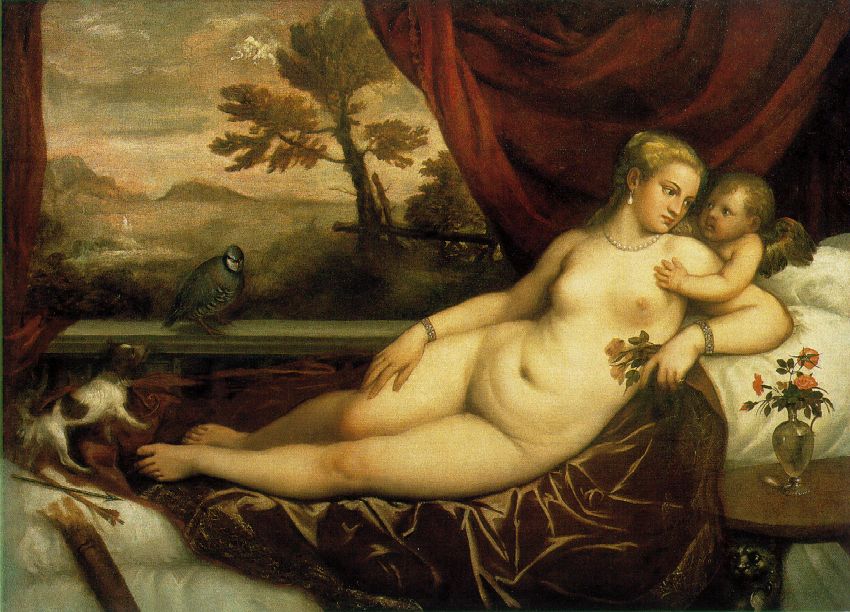
Titian’s Venus of Urbino
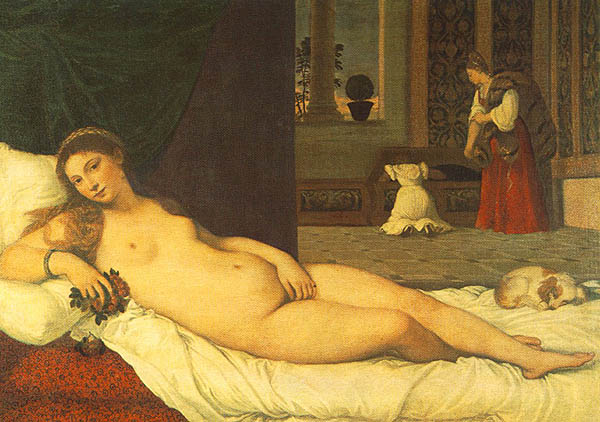
Is she? Or is she modestly covering herself? Mark Twain was in no doubt. Here’s what he wrote:
“You enter, and proceed to that most-visited little gallery that exists in the world–the Tribune–and there, against the wall, without obstructing rag or leaf, you may look your fill upon the foulest, the vilest, the obscenest picture the world possesses–Titian’s Venus. It isn’t that she is naked and stretched out on a bed–no, it is the attitude of one of her arms and hand. If I ventured to describe that attitude, there would be a fine howl–but there the Venus lies, for anybody to gloat over that wants to–and there she has a right to lie, for she is a work of art, and Art has its privileges. I saw young girls stealing furtive glances at her; I saw young men gaze long and absorbedly at her; I saw aged, infirm men hang upon her charms with a pathetic interest. How I should like to describe her–just to see what a holy indignation I could stir up in the world–just to hear the unreflecting average man deliver himself about my grossness and coarseness, and all that. The world says that no worded description of a moving spectacle is a hundredth part as moving as the same spectacle seen with one’s own eyes–yet the world is willing to let its son and its daughter and itself look at Titian’s beast, but won’t stand a description of it in words. Which shows that the world is not as consistent as it might be.
There are pictures of nude women which suggest no impure thought–I am well aware of that. I am not railing at such. What I am trying to emphasize is the fact that Titian’s Venus is very far from being one of that sort. Without any question it was painted for a bagnio and it was probably refused because it was a trifle too strong. In truth, it is too strong for any place but a public Art Gallery. Titian has two Venuses in the Tribune; persons who have seen them will easily remember which one I am referring to.”
The painting has inspired many artists. TF Chen’s Venus Today and African Venus, performance artist Kalup Linzy, Skip Rohde’s Venus of Ashville, Krassimir Kolev’s Amanda from Boras, and Ramiro Arrango’s gourd Venus.



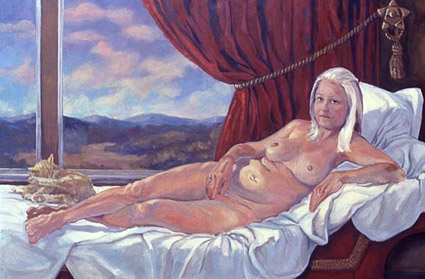
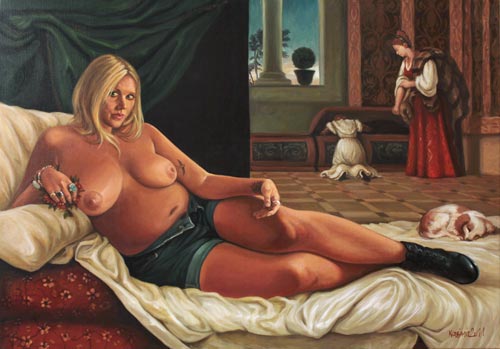

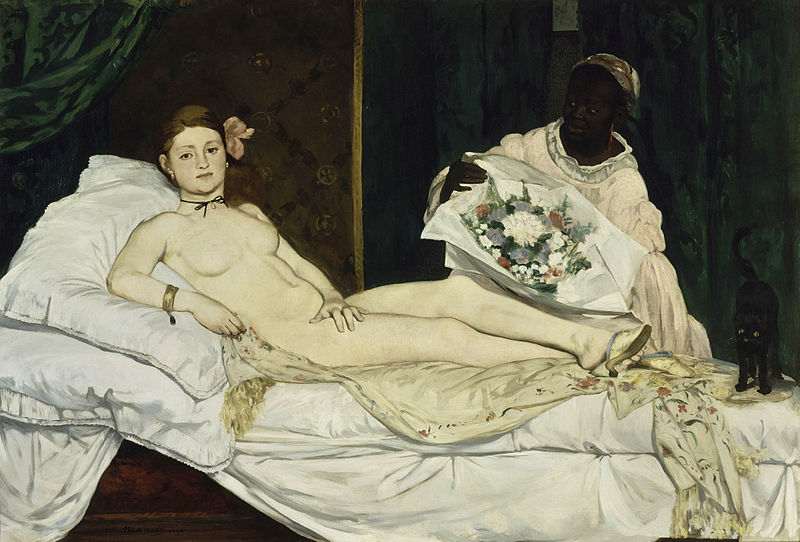
Not to mention the most controversial of all, Manet’s Olympia. Whatever else she was up to, she wasn’t masturbating.
Just in case you’re wondering, here’s the other Titian Venus in the Uffizi. Venus and Cupid with a partridge. I think I can see which one Mark Twain means.
Confused psychobabble trial
Bury it quick
We generally limit our reports of trial registry troubles to the major journals, BMJ, Lancet, NEJM, JAMA. For lesser journals we’d need a team of hundreds!
But some cases are irresistible. We learned of this trial (click here) from retractionwatch.com. They had noted a retraction where the alleged reason was that an analysis by intent to treat had been muddled with a per protocol one. RW commended the authors for their honesty.
The trial purported to test the effect of being invited to look at an educational website prior to genetic counselling about breast cancer risks. It was registered here. The sample size (100 per group) and the primary outcome “Counselees’ participation, i.e. content and amount of questions asked and information received during the visit” were pre-specified. Apart from those being three primary outcomes, so far so good.
But none of the three primary outcomes appeared in the paper. Ten secondary outcomes (cleverly numbered 1-9!) were listed on the trial registration site. Of these four were reported correctly in the paper (one twice, same values!), one which was planned as a change score was reported as an actual score, and five were not reported at all.
The authors also found space to report another 28 outcomes. In total eight knowledge scores (table 3), ten “fulfilment of needs” scores (table 4), six scores measuring “risk perception, anxiety and perceived personal control” (table 5), and eight variations on “topics discussed and recalled” (table 6). Tests of statistical significance were performed on all 32 reported outcomes, of which five were nominally “significant” at the 5% level. Failing to report any of your three primary outcomes, correctly reporting only 4/10 of your secondary outcomes and then bunging in 28 other outcomes, must be some sort of record.
Am I being cruel? Does it matter? After all no-one dies from looking at a website. This sort of pseudo-science pours out of psychology departments all over the world. Buried in Breast Cancer Research, a vanity publisher, sorry, an Open Access journal, no-one would have taken any notice if the authors had not retracted it. But the Dutch public via the Dutch Cancer Society paid for it. They should ask questions.
Jim Thornton
Day-Lewis and Larkin; on age
My Mother’s Sister by Cecil Day-Lewis tells the story of Agnes Squires.
When Cecil’s mother, Kathleen, died when he was four, Agnes came over from Ireland to help his father Frank look after him. She stayed for ten years until Frank eventually remarried, at which point she was unceremoniously sent home, all chance of marriage and children gone.
Did they have a closer relationship? Two red-blooded young adults together so long – it surely crossed their minds. But he was a parish priest, times were different, and perhaps sex was unthinkable. Cecil’s son Sean thinks the law against marrying the sister of your deceased wife restrained them, but that can’t be right. The Deceased Wife’s Sister’s Marriage Act allowed such marriages in 1907, the year before Kathleen died. Maybe the church retained the prohibition? Who knows? Here’s the poem.
My Mother’s Sister
I see her against the pearl sky of Dublin
Before the turn of the century, a young woman
With all those brothers and sisters, green eyes, hair
She could sit on; for high life, a meandering sermon
(Church of Ireland) each Sunday, window-shopping
In Dawson Street, picnics at Killiney and Howth…
To know so little about the growing of one
Who was angel and maid-of-all work to my growth!
– Who, her sister dying, took on the four-year
Child, and the chance that now she would never make
A child of her own; who, mothering me, flowered in
The clover-soft authority of the meek.
Who, exiled, gossiping home chat from abroad
In roundhand letters to a drift of relations –
Squires’, Goldsmiths, Overends, Williams’ – sang the songs
Of Zion in a strange land. Hers the patience
Of one who made no claims, but simply loved
Because that was her nature, and loving so
Asked no more than to be repaid in kind.
If she was not a saint, I do not know
What saints are…Buying penny toys at Christmas
(The most a small purse could afford) to send her
Nephews and nieces, sh’d never have thought the shop
Could shine for me one day in Bethlehem splendour.
Exiled again, after ten years, my father
Remarrying, she faced the bitter test
Of charity – to abdicate in love’s name
From love’s contentful duties. A distressed
Gentle woman housekeeping for strangers;
Later, companion to a droll recluse
Clergyman brother in rough-pastured Wexford,
She lived for all she was worth – to be of use.
She bottled plums, she visited parishioners.
A plain habit of innocence, a faith
Mildly forbearing, made her one of those
Who, we were promised, shall inherit the earth
… Now, sunk in one small room of a Rathmines
Old people’s home, helpless, beyond speech
Or movement, yearly deeper she declines
To imbecility – my last link with childhood.
The battery’s almost done: yet if I press
The button hard – some private joke in boyhood
I teased her with – there comes upon her face
A glowing of the old, enchanted smile.
So, still alive, she rots. A heart of granite
Would melt at this unmeaning sequel, Lord,
How can this be justified, how can it
Be justified?
Especially for those who know the story, this is both angry and moving. The alteration in rhyme scheme as she reaches the old people’s home underscores the downward shift in even her disappointing life. But the anger of the ending is forced.
Compare a similar poem about age, in this case widowhood, by Philip Larkin
Love Songs in Age
She kept her songs, they kept so little space,
The covers pleased her:
One bleached from lying in a sunny place,
One marked in circles by a vase of water,
One mended, when a tidy fit had seized her,
And coloured, by her daughter –
So they had waited, till, in widowhood
She found them, looking for something else, and stood
Relearning how each frank submissive chord
Had ushered in
Word after sprawling hyphenated word,
And the unfailing sense of being young
Spread out like a spring-woken tree, wherein
That hidden freshness sung,
That certainty of time laid up in store
As when she played them first. But, even more,
The glare of that much-mentionned brilliance, love,
Broke out, to show
Its bright incipience sailing above,
Still promising to solve, and satisfy,
And set unchangeably in order. So
To pile them back, to cry,
Was hard, without lamely admitting how
It had not done so then, and could not now.
The final lines say so much less than Day Lewis’s – and so much more.
Jim Thornton
Time for a new trial of breast cancer screening?
If I was a woman aged 50 with no particular family history, I’d steer clear of mammography. It might reduce my chance of dying from breast cancer by 20%, but it would increase my chance of being diagnosed and treated for it by 60%. Three chances of being “given” breast cancer, for every one of being saved. Click here for more.
But maybe I’m just a misguided man. Many women queue up for mammograms. Perhaps modern ones are more accurate, and cause fewer false positives. Perhaps early treatment has got better.
Or maybe screening is less effective than we think. Treatment of clinically presenting breast cancer has improved since most of the trials were done. Hormone therapy is effective, surgery less mutilating, and chemotherapy and radiotherapy better than they used to be. All else being equal, as conventional treatment improves, the benefit of screening must fall. Think about it – if treatment after conventional diagnosis was 100% successful, screening could not possibly improve it.
If we’re honest there are so many uncertainties, and the benefit/harm ratio is so finely balanced, that many well-informed women would surely agree to randomisation.
The largest and best quality of the breast-screening trials, (UK Age 1991) recruited 150,000 women. In the UK about 300,000 women join the screening programme annually, and a bit over a million get a mammogram every year. A trial of 150,000 women is feasible.
Let’s do it.
Jim Thornton
Danish HT* trial
Paid “experts” muddy the waters again
A secondary analysis in last month’s BMJ of the Danish Osteoporosis Prevention Study (DOPS) (click here) has tried to revive the idea that hormone therapy (HT) started soon after the menopause protects against heart disease.
DOPS participants, recently menopausal women (age 45-52), had been randomly allocated to HT or not, in an open-label trial. After a mean follow up of 16 years a composite endpoint of “death, admission to hospital for myocardial infarction or heart failure” occurred in 16/502 women in the treated group v 33/504 in the controls, giving an adjusted hazard ratio of 0.49 (95% CI 0.27 to 0.89) and a nominal P value of 0.02.
The usual “experts” (John Stevenson, Howard Hodis*, Tobie de Villiers** and Rogerio Lobo***) dived in to persuade impressionable journalists (click here and here) that this shows that HRT is safe. They want official guidelines, which advise taking HT for symptoms only, and in the lowest dose and for the shortest time possible, to be rewritten. This is nonsense.
There are at least three reasons for taking the DOPS results with a pinch of salt.
- Although the deaths were probably completely ascertained, the difference (15 v 26) was not statistically significant. The open design makes the other components, myocardial infarction (1 v 4), and heart failure (1 v 7), which together generated the headline figure, susceptible to ascertainment bias.
- DOPS used envelope randomisation, which risks recruitment bias. At trial entry controls were older, a difference that was unlikely to have occurred by chance (P=0.007).
- There was no mention of the composite endpoint in the original trial protocol – the present authors dreamt it up post hoc. They claim they defined it before starting the analysis, but if you believe that you’ll believe anything. The senior author and some of the present authors have written dozens of papers based on the DOPS data set. It is implausible that they were unaware of trends when they decided to include say heart failure in the composite for the present analysis. No-one has ever previously suggested that HT causes or prevents heart failure. The BMJ press release, which states; “So authors from Denmark carried out a randomised trial over 10 years with additional six years of follow-up to establish whether HRT can reduce cardiovascular risk if it is started early after menopause”, is seriously misleading on this point.
At best this paper is hypothesis generating, rather than hypothesis testing.
The hypothesis – that HT is cardio-protective, or at least safe, when started early – has huge hurdles to overcome. Every independent systematic review has concluded the opposite. Sub analysis of the largest Women’s Health Initiative (WHI) trial data showed increased mortality among women starting HT within five years of the menopause (click here). Even if the data in the present study are unbiased, they amount to only 42 coronary events in total. WHI alone had 335 such events, including 64 in women aged less than 60.
Klim MacPherson, writing in response to the present paper, (click here) reminds us of the coronary events in about 200 small efficacy trials in women soon after the menopause. These data (click here and here), which often had to be extracted from the companies by legal threats, showed an increase in risk of cardiovascular events with HT.
Finally papers supporting HT tend to be disproportionately written by authors with ties to drug companies manufacturing such preparations (click here and here for more). Two of the present paper’s eight authors, Pia Eiken, and Jens-Erik Beck Jensen acknowledge such conflicts of interest, but two more, Lars Køber and Lief Mosekild, do not.
Readers may be interested to learn that someone called Lars Køber is listed by the Danish Health and Medicines Authority (click here) as having 18 advisory board memberships or investigator interests in such companies, and someone called Lief Mosekild is listed as being an investigator with NPS Pharmaceutical and with Nycomed.
What a coincidence that they have the same names!
Jim Thornton
*Howard Hodis features in a Town hall meeting advocating HT sponsored by Wyeth (click here)
**Dr De Villers is an investigator in trials sponsored by MSD, Pfizer and Eli Lilly and serves on the advisory boards of Novartis (SA), Adcock Ingram and Servier.
***Rogerio Lobo features in our naming and shaming list here
*Hormone replacement therapy (HRT) changed to hormone therapy (HT) Jan 2016
Don’t screen for diabetes
Ignore Movember
The UK National Screening Committee has long advised against routine screening for diabetes, and this sensible stance received an important boost from the ADDITION trial in last month’s Lancet (click here).
ADDITION was a cluster trial involving 20,000 people in 33 general practices in Eastern England. In the intervention practices high risk individuals (60% men) age 40-70, not already diagnosed with diabetes, were invited for screening. In control practices they were not. In all practices people diagnosed with diabetes were treated according to current guidelines.
The trial protocol was published here. They hit their planned sample size, reported their predetermined endpoints and prespecified their analysis plans.
Here are the main results expressed as relative risk and 95% confidence intervals. Numbers greater than one mean more deaths in the screening practices:
Diabetes related mortality; 1·26, 0·75–2·10
Cardiovascular mortality; 1·02, 0·75–1·38
Cancer mortality; 1·08, 0·90–1·30
Other causes of death; 1·10, 0·87–1·39
And here’s the all cause mortality graph

I wonder why those clowns at Movember still recommend diabetes screening for men over 40.
Jim Thornton
Movember
No Mos on ripe-tomato.org
We avoided Movember last year and will do so this.
It’s not the advice to stop smoking and take exercise that annoys us. It’s the effort to make men fret over their health the same way the health police have long persuaded women to. Click here for Movember’s health checklist. Here’s what really bugs us, their advice on prostate screening.
“The purpose of screening is to detect prostate cancer at its earliest stages, before any symptoms have developed.
Typically, prostate cancer that’s detected by screening is in the very early-stages and can be treated most effectively. A doctor can screen for prostate cancer quickly and easily in their office using two tests:
The PSA Blood Test
[…]
The Digital Rectal Exam
[…]
The question of screening is a personal and complex one. It’s important for every man to talk with his doctor about whether prostate cancer screening is right for him. […]
It’s important for men to create a proactive prostate health plan based on your lifestyle and family history, as well as to discuss these tests with your doctor to make the screening decisions that are best for you.”
No it’s not. Here’s the Cochrane summary.
“Prostate cancer screening did not significantly decrease prostate cancer-specific mortality in a combined meta-analysis of five RCTs. Only one study (ERSPC) reported a benefit in a subgroup of men aged 55 to 69. Within this subgroup of men it was determined that 1410 men needed to be invited to screening and 48 additional men subsequently diagnosed with prostate cancer needed to receive early intervention to prevent one additional prostate cancer death at 10 years… .”
If your stomach is strong and you want to read about those 48 additional early interventions click here.
Prostate screening does not fulfil the criteria for a worthwhile screening programme.
The US Preventive Services Task Force (click here) concludes “that many men are harmed as a result of prostate cancer screening and few, if any, benefit”. It recommends “against screening for prostate cancer.
The UK National Screening Committee (click here) “does not recommend screening men for prostate cancer”.
Both committees are right, but they are getting push back from vested interests, screening doctors, urologists and cancer societies. Movember is part of that vested interest push back.
If you care for your health guys, walk away.
Jim Thornton
How the BMA gets doctors to support strikes
Ask a leading question
I’ve just been asked to complete a survey about my views on the BMA’s response to changes in doctors pensions. http://www.surveymonkey.com/s/pensionswhatnext
Here’s the preamble:
“Many thanks for filling out this short survey. It will help us represent your views within the BMA.
Local measurements showed that during the last set of industrial action as many as 80% of consultants had changed their work day to fit in with industrial action. In most cases it represented changes from routine cases to urgent. In one local survey seventy percent of doctors said that they would be willing to take on call only type industrial action if the governments pension offer was not improved.
Industrial action was suspended in the summer for further talks with the government but these have failed to improve on the offer.
Wherever you are on the current scheme you will be affected by changes in contributions, doctors will pay 10 times more for the same pension as a judge. Doctors will pay contributions of 14.9% for a 60ths accrual scheme, MPs for example pay 7.7% for the same type of scheme or 13.75% for a much more generous 40ths scheme.
Doctors will be forced to work until 68/69 to receive a full pension. This applies even to doctors with only 15 years until the current retirement date. Each year a doctor leaves before 68/69 will cost 5% of their pension. A doctor aged 45 will be approximately £300,000 worse off in terms of their pension if they retire at 60 as is their current right.
The industrial action over pensions has already brought some improvement in the pensions offer for those within 15 years and the index linking has been improved from just CPI to CPI + 1.5% Industrial action has worked and may work further if determined action is taken.
The Public Sector Pensions Bill is before parliament now and it gives the Treasury the right to alter our pension in the future again without consultation, it removes final salary pension, it lays down that police, fireman, armed services can retire at 60 but doctors must work until national pension age of 68/69 (although this rises linked with life expectancy – reverse performance related pay).
Let us know your opinions.”
Nicely balanced eh? And here’s the choices for industrial action:
How many days industrial action would you be willing to take?
- Only a single day
- One day per month
- Two days per month
- One day per week
When I first tried to complete the survey this was a compulsory question! It’s now possible to leave it blank but it’s hardly a fair question.
If you read in a few days that n% of consultants in the Trent region support industrial action, take it with a pinch of salt!
Jim Thornton
Mammography screening
One breast cancer death prevented for three overdiagnoses
The government-appointed independent panel reporting in today’s Lancet (click here) estimates the harms from the breast screening programme as follows:
“For every breast cancer death prevented, about three overdiagnosed cases will be identified and treated”.
It is an excellent report, and this is the best estimate possible. It is the basis for headlines all over the press, presumably spun by the screening mafia, that “breast cancer screening saves lives” (e.g. here), albeit at the cost of a few unnecessary mastectomies. But note the careful wording “for every breast cancer death prevented …”.
The panel based their findings on the Cochrane review which estimated a relative risk for breast cancer mortality from screening of 0·80 (95% CI 0·73–0·89), i.e. a 20% reduction. But they ignored the same Cochrane review evidence on all cause mortality, on the grounds that “all-cause mortality is not an appropriate outcome for trials of breast screening because the trials were not designed with sufficient power for this outcome.”
True, but women contemplating joining a screening programme, which is going to remove or irradiate three breasts for every breast cancer death prevented, might be interested. So here it is – click here for details – a relative risk for all cause mortality of 0.99, (95% CI 0.95 to 1.03). i.e. no measurable effect.
Screening enthusiasts typically respond that, since deaths prevented by screening form such a tiny proportion of the total, it would be unreasonable to expect the trials to show an effect. They are probably correct, although it is also plausible that at least some of the apparent reduction in breast cancer deaths is due to altered classification. But whatever our views about that thorny issue, screening enthusiasts must agree that if the benefit is so easily swamped by other causes of death, and is causing all this over treatment, it can hardly be providing a major net public health benefit.
Ideally the NHS should close down the breast screening programme and spend the money on more important priorities. Let women decide for themselves whether the benefits outweigh the harms sufficiently to justify the cost, and if so buy private screening. Most well-informed women, particularly those without obvious risk factors, would choose not to.
Vested interests will keep the NHS programme going, but they must now stop bullying women to join up.
Jim Thornton
Walking Away
By Cecil Day Lewis
BBC Radio 4 played Jill Balcon’s reading this morning, 30 Oct 2012.
Day Lewis had an interesting love life. In 1941, while married to his first wife Mary King, he started a fairly public affair with the novelist Rosamond Lehmann. For a few years he kept the triangle going, living with Lehmann but returning home regularly to his wife and two sons. But when he started another affair in 1948, with the actress Jill Balcon, three women proved too much for even Day Lewis.* After a couple of years he left both King and Lehmann for Balcon, who he married in 1951.
Balcon bore his two most celebrated children, Tamsin the cook and Daniel the actor, but this poem, published in 1961, was dedicated to Sean, his first son by Mary.
Knowing about his love life adds spice to the poem’s title, and to the line “I have known worse partings”, but it is the final two lines that really hit the spot.
Walking Away
It is eighteen years ago, almost to the day –
A sunny day with leaves just turning,
The touch-lines new-ruled – since I watched you play
Your first game of football, then, like a satellite
Wrenched from its orbit, go drifting away
Behind a scatter of boys. I can see
You walking away from me towards the school
With the pathos of a half-fledged thing set free
Into a wilderness, the gait of one
Who finds no path where the path should be.
That hesitant figure, eddying away
Like a winged seed loosened from its parent stem,
Has something I never quite grasp to convey
About nature’s give-and-take – the small, the scorching
Ordeals which fire one’s irresolute clay.
I have had worse partings, but none that so
Gnaws at my mind still. Perhaps it is roughly
Saying what God alone could perfectly show –
How selfhood begins with a walking away,
And love is proved in the letting go.
*Footnote. My wife has just commented that perhaps the women had something to do with it. Maybe one of them put her foot down.
 Ripe-tomato.org