Abortion Ethics 1
Pro-life to pro-choice
Most people initially find abortion abhorrent, but often change their views. When my mother told me killing unborn babies was murder I agreed. But now I’m an obstetrician/gynaecologist, and for years I’ve done abortions. What happened?
None of what follows is original, but perhaps it will help someone.
The pro-life case goes something like this.
Killing innocent people is wrong
The fetus is a person
Therefore abortion/killing the fetus is wrong.
But
People should be allowed to do what they like with their own bodies
The mother is a person
Therefore she should be allowed to empty her uterus/have an abortion
The anti-abortionist needs a third argument to resolve the conflict.
When one person’s desire to do what they like with their own body conflicts with another person’s desire not to be killed, not killing takes precedence.
It all sounds reasonable. But those who are pro-choice, like me, must find the flaw.
Tomorrow’s post examines the claim that the fetus is a person.
Jim Thornton
Old surgeons
Less skilled. Maybe wiser
A 57-year-old’s take on this week’s BMJ suggestion (click here) that operating skills deteriorate after age 50.
Older surgeons see trouble coming, modify operations, refer cases to colleagues or decline to operate at all. I do all this, and end up doing easier operations. My enemies say I’ve become timid, kind friends say I’ve got wiser, but honest outsiders must conclude that my complication rates underestimate any deterioration in my technical abilities.
When trainees say: “This one’s easy Prof. You can do it”, we laugh, but they’re not joking!
Jim Thornton
Assassin of Secrets
Literary plagiarism

QR Markham’s spy novel, Assassin of Secrets, published by Little Brown in November was withdrawn a week later when the publisher discovered that the author, real name Quentin Rowan, had cut and pasted almost the whole thing from other novels.
Book publishers don’t usually fret too much about plagiarism. They think it’s rare, that readers will pick it up, and guilty authors often claim it as a tribute or ironic mash up – maybe sometimes a legitimate defence.
But according to this week’s New Yorker, (click here, you have to pay for the full article) Quentin Rowan seems to be the real, i.e. unreal, deal. Like John Darsee, Malcolm Pearce and most scientific fraudsters he appears to have turned bad when he found it difficult to replicate early genuine sucess.
In Rowan’s case a teenage poem Prometheus at Coney Island had not only got published but selected for The Best American Poetry of 1996 (click here). When he failed to keep up with that start he sent a bit of plagiarised post modern nonsense to The Paris Review where he had worked as an intern. It got accepted. Even the most famous literary journals are suckers for obscurantism, although presumably most readers skipped it. Anyway, no-one noticed. He soon got a second plagiarised story in the same place.
Then the full length novel, cut and pasted from at least a dozen other books, mainly post Fleming Bond novels and bits of Robert Ludlum, with a plot lifted from Charles McCarry’s Second Sight (click here). His pseudonym came from Kingsley Amis who wrote his own Bond novel, Colonel Sun, under the name Robert Markham.
An unusual addition to the retraction genre. I wonder if Retraction Watch know about it.
Jim Thornton
Who is John Freeman?
Allowances
A puzzling poem in this weeks New Yorker by John Freeman, but presumably not the Georgian poet. That John Freeman died in 1929 and no-one reads him now?
The NY says this one’s the editor of the literary magazine Granta and author of The Tyrrany of Email. Here is an interview.
He makes a poor start, in the interview, not the poem, blaming lack of newspaper book reviews for the alleged fall in book sales. Sales aren’t falling. They’re just moving to internet, and the same with reviews. But he’s not just old fashioned – The Tyrrany of Email, albeit full grumbles about modern technology, is media savvy. Anyway, he’s a poet now.
Allowances
I gave myself excuses.
This is for my pain –
and this, and this.
Terrible things.
Pain. My pain.
All so I might
twice a month
get on a train
to witness yours.
Primary Mother Care and Population
A non-profit textbook of family planning, midwifery, obstetrics and gynaecology

Simple, illustrated textbooks for those whose first language isn’t English are rarely complete. Complete ones are often hard reading. This one is complete, illustrated and easy to read. Click here for the preface and contents list of an early version.
Thirty years work by experts with hundreds of years experience in developing countries, assembled by Maurice King, the knowledge engineer. Previous books, Medical Care in Developing Countries, Primary Childcare, Primary Anaesthesia and Primary Surgery, published by Oxford University Press (OUP), each sold many thousands.
But OUP turned this one down because of chapter two. Dr King says that Africa, and many other developing countries, are demographically trapped; they’ve exceeded their carrying capacity and must drastically control their population. He uses strong language.
Some people wish he’d left that chapter out – women are dying in childbirth and need the rest of his book. But he insisted. So Acrodile Press printed 10,000 copies in Shanghai. And subversives like you and me are getting it where its needed. Over 400 packed A4 pages. 700 illustrations. No author royalties. The Amazon price is £17, but it’s much, much cheaper for you.
For a limited number of free copies (first come, first served) send your postal address to jimgthornton@hotmail.co.uk, and promise to pass it on to the next person you know who visits Africa.
If you are a doctor, teacher, educator, or anyone else with contacts in the developing world, £60 plus £10 p&p, will get you a box of 14 copies. That’s less than £5 each all in. Given them to your students to take on their adventures.
Chapter two? You’ll probably agree with it, but if not tear the pages out before you pass it on!
Dr King needs you to get this book to those who need it. Please help.
Jim Thornton
BMJ alarmism
SSRIs and persistent pulmonary hypertension in the newborn (PPHN)
Last week’s BMJ scare (click here) associating persistent pulmonary hypertension in the newborn (PPHN) with a popular class of antidepressant, selective serotoin reuptake inhibitors (SSRI’s) taken in the second half of pregnancy, was even less justified than usual. It certainly did not justify the press interviews with the Scandinavian authors, and the headlines which flew around the world.
The accompanying editorial (click here) urged caution because previous studies had given conflicting results, neither exposures nor diagnoses were confirmed and the relative risk was modest (odds ratio 2.1; 95% CI 1.5 – 3). Confounding, far from being excluded, was present; women admitted for psychiatric reasons who did not take antidepressants had an odds ratio of 1.3 (95% CI 1.1-1.7). The editorialists also made the point that even if genuine, the absolute risk was tiny, and when other causes such as cardiac disease or meconium aspiration are excluded, PPHN is usually self-limiting. They might have added that the authors did not pre-specify their analysis plan, choice of adjustment factors or definitions of exposure timing, so readers can never be sure that no data dredging occurred.
Obstetricians already limit antidepressants in pregnancy as far as possible, and pregnant women are well aware of the dangers in general. The BMJ knew the evidence didn’t stack up. Why else publish the debunking editorial?
So what purpose was served by publication in a general journal? Surely the accompanying hype wasn’t just for the glorification of the BMJ and the authors?
Jim Thornton
The Isle of Man’s beaches
And its water and sewerage authority
The Marine Conservation Society’s Good Beach Guide is a wonderful resource; 724 out of the UK’s 1131 beaches are regularly tested for water quality, and the results published. They’ve shown consistantly rising standards. So much so that the levels at which they give a recommendation will have to be raised next year, to prevent too many good beaches resting on their laurels.
But they miss the real story. The improvement coincided exactly with the privatisation of UK water companies in 1989. This is a privatisation good news story. If you don’t believe me there has been is a twenty-year natural experiment. The Isle of Man Water and Sewerage Authority (click here) remained publicly owned. Here are the data for 2011.
| Region | Fail | Recommended | Total tested |
| Isle of Man. Publicly owned water company | 5 (28%) | 1 (5.5%) | 18 |
| Rest of UK. Privatised water companies | 36 (4.9%) | 457 (63%) | 724 |
The sole Manx recommended beach is Derbyhaven. Here’s a picture.
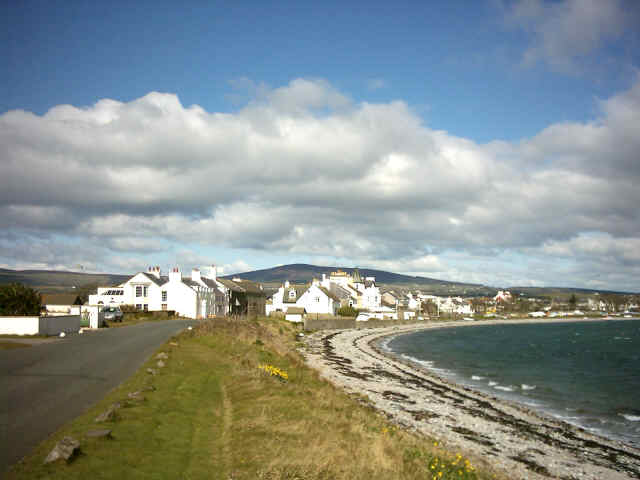
Public utilities make excuses, private ones smarten up or get fined.
The Isle of Man Water and Sewerage Authority is spoiling beaches, causing a health hazard, and making excuses,.
It’s time for the Tynwald, the oldest parliament in the world, to smarten up too.
Jim Thornton
Labyrinth by Roberto Bolano
Weaving a tale from a picture
Do you ever sit in a restaurant and speculate about other diners’ relationships? Father/daughter or new mistress? Gay or colleagues? Who having an affair with who? Of course you do.
Last week’s New Yorker story, Labyrinth by Roberto Bolano, translated from the Spanish by Chris Andrews, is a masterpiece of such observation.
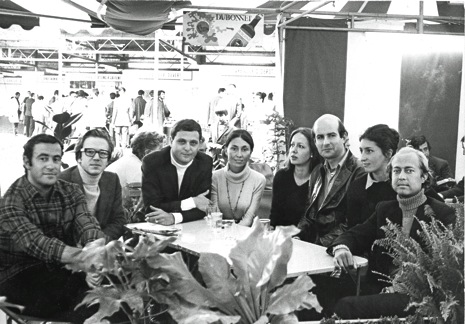
A group of intellectuals, the writer Jacques Henric (left), editor Philippe Sollers (3rd left), critic Julia Kristeva (centre), and poets Pierre Gyotat (3rd right), and Marc Devade (right) are photographed in a Paris cafe.
Bolano tells us, in detail, what we can learn, or imagine we can learn, about their marital and extramarital relationships.
Henric failing to turn up for an assignation with J-J Goux (2nd left); “Let’s imagine […] his absence on this occasion is strategic, as amorous absences nearly always are.”
The two women on the right, Marie-Thérèse Réveillé and Carla Devade recognising a South American writer, who had passed through the office the previous day, and aroused erotic and protective thoughts in their minds.
Gyotat in bed with Marie-Thérèse. Gyotat pursuing Carla.
The story ends with Devade touching his crotch; “He has an erection and yet he doesn’t feel sexually aroused in any way”.
They are all real people who, when not fornicating with each other, wrote about Marxism, feminism, semiotics and every sort of constructivism for the literary magazine Tel Quel, run by Sollers from 1960 to 1982. If it strikes an Englishman as bonkers, dangerous, or both, they embraced it.
Eventually Henric married Catherine Millet, the author of the autobiographical Sexual Life of Catherine M. Sollers inspired a Japanese rock group, Sollers. Kristeva founded the Simone de Beauvoir prize for promoting gender equality. Gyotat wrote three controversial novels, Tomb for 500 soldiers, Eden, Eden, Eden, and Prostitution, and went off his rocker in the early 1980s. Devade painted pretentious abstracts.
Bolano, the Chilean writer off camera left, was also real, and more gifted than anyone in the picture. He died in 2003, age 50. I hope he got off with Marie-Thérèse.
Read the story here.
Jim Thornton
The Winter Palace
By Philip Larkin
Looking up “In times when nothing stood” for yesterday’s post about Larkin and Zephaniah (click here), I found this on the facing page of Collected Poems ed. Anthony Thwaite. Dated 1st November 1978, it remained unpublished by Larkin.
It’s bleak of course; Larkin on senility could hardly be anything else. But there’s plenty of the other stuff we love. The colloquial “I give all that the cold shoulder”, the dig at university learning, and the self deprecation of the middle verses. The ending is untypical. Instead of railing against the horrors of extinction he almost welcomes his fate.
Is this why he didn’t publish? Because he’d failed to achieve the starkness of, say, Aubade from a year earlier? Surely not.
No. It wasn’t up to his standards. The final line is weak, a cliché, and he’d already used the “fields” and “snow” images in earlier better poems, Days, First Sight. You can almost hear him muttering “Mystical balls. No good”.
Larkin wrote better, but most poets would be proud of the things he rejected. Here it is.
Most people know more as they get older:
I give all that the cold shoulder.
I spent my second quarter-century
Losing what I had learnt at university
And refusing to take in what had happened since.
Now I know none of the names in the public prints,
And am starting to give offence by forgetting faces
And swearing I’ve never been in certain places.
It will be worth it, if in the end I manage
To blank out whatever it is that is doing the damage.
Then there will be nothing I know
My mind will fold into itself, like fields, like snow.
Turning down the Queen’s honours
Philip Larkin, OBE decl. Benjamin Zephaniah, OBE decl.

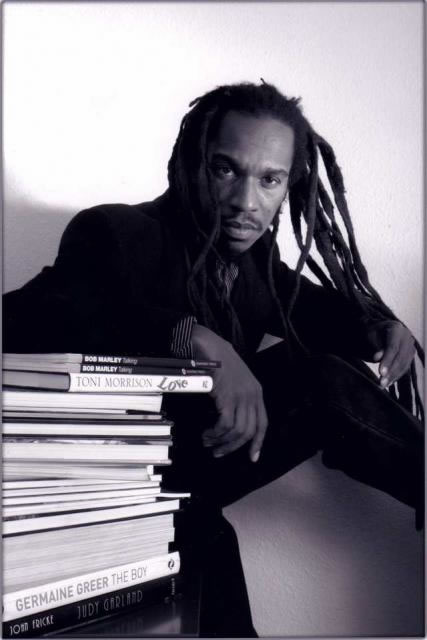
Were you as chuffed as me to see Larkin on yesterday’s list (released under the Freedom of Information Act) of those who declined honours? Poets include Rudyard Kipling, Thomas Hardy, WB Yeats, Robert Graves, AE Housman, Graham Green, and Benjamin Zephaniah. A select list indeed!
According to Andrew Motion’s biography (p 383) Larkin didn’t turn down the OBE in 1968 because he was anti-royalist – he thought he deserved better! Over the following years he bantered with his “loaf haired secretary”, Betty Mackerath, about “anything from the palace?”, and in the 1975 birthday list a better offer, the CBE, came through. He went with Monica Jones to accept that in person.
He declined the Poet Laureateship in 1984 when Betjeman died, mainly because he couldn’t face the hassle and felt the muse had deserted him. In November 1985, Mrs Thatcher put him up for the big one, Companion of Honour. He accepted, but only by post; he was too ill to make the investiture and died a few days later.
Here’s what he wrote for a plaque celebrating the Queen’s Silver Jubilee in 1978.
In times when nothing stood
but worsened, or grew strange,
there was one constant good:
she did not change.
Unfortunately he spoilt it for posterity by writing this unpublished verse around the same time.
After Healey’s trading figures,
After Wilson’s squalid crew,
And the rising tide of niggers-
What a treat to look at you.
Oh dear! The best that can be said is he was a creature of his time.
But it adds spice to seeing Benjamin Zephaniah on the same list. He turned his OBE down in 2003. Here’s an extract from the poem he wrote at the time.
Bought and Sold
Smart big awards and prize money
Is killing off black poetry
It’s not censors or dictators that are cutting up our art.
The lure of meeting royalty
And touching high society
Is damping creativity and eating at our heart.
The ancestors would turn in graves
Those poor black folk that once were slaves would wonder
How our souls were sold
And check our strategies,
The empire strikes back and waves
Tamed warriors bow on parades
When they have done what they’ve been told
They get their OBE’s.
Blimey! There’ll be sparks one day in poetic heaven!
Jim Thornton
 Ripe-tomato.org