Pooley Country Park
Tax-funded environmental art
Nature is steadily reclaiming the disused Pooley Pit workings along the Coventry canal near Polesworth. Ponds form in pit subsidence. Trees colonise the spoil heaps. Wildlife returns. Drivers on the adjacent M42 watch a new forest appear. Last September a 40 foot yellow chimney appeared over the trees.


Gold Leaf Buried Sunlight, by Dundee based sculptors Matthew Dalziel and Louise Scullion, is made up to look like a column of golden birch leaves. But it’s really painted fibreglass – a wise construction decision. Metal would have cost even more than the £110,000 the local council paid, and caused greater wildlife disturbance. Click here for a time lapse video. At least it has no sound system. Dalziel and Scullion’s environmental land art is often noisy.

Modern Nature (six aluminium lamp posts with solar panels on top) sits on Elrick Hill in Tyrebagger Forest near Aberdeen. The Tyrebagger Trust, a lottery funded offshoot of the Forestry Commission, paid £1m for it and another 14 similar sculptures in 2001, and then went bust. After a bit of grumbling Aberdeen Council took on maintenance, and agreed to pay for insurance if a panel brained a walker. Originally a sound system broadcast the call of the capercallie as visitors approached, but it soon broke down, and the council haven’t bothered to repair it – no doubt to the capercallie’s relief!

The 80 foot Horn in Polkemmet Park, between a golf course and the Glasgow to Edinburgh M8, cost West Lothian Council £150,000 in 1997. It originally emitted snatches of birdsong or politically correct quotes; “A tree burning in the Amazon alters the air in Paris”; “It’s a whole new way of life” but to the relief of the golfers that’s also stopped working. I doubt the wildlife mind.
Generally left wing councils go in for this sort of thing. But the Pooley Park Chimney was driven through Warwickshire County Council by Tilly May, the Conservative member for Polesworth. If you live locally don’t waste your vote.
Jim Thornton
Mitt Romney’s sins
Discouraging abortion and encouraging adoption
Curious profile of Presidential candidate Mitt Romney in February’s Vanity Fair. Michael Kranish and Scott Helman (click here) claim to “pierce the Mitt bubble” and expose the “collateral damage” of his career to date. They direct most of their fire on him as a Mormon church leader.
Mormon’s don’t have paid clergy – members take turns. When he became “bishop”, leading about 500 members, and later “stake president” leading about 4,000, Romney had a young family and a busy career. He did both jobs in his spare time.
Kranish and Helman criticise his treatment of two women. Peggy Hayes was a church member who had babysat Romney’s children as a teenager. She married, had a child and got divorced. Age 23, a single parent with a three year old child, she got pregnant again. Romney, her bishop, gave her odd jobs and put her in touch with others who might help. One day he called on her – she was still pregnant – and suggested she considered adoption. Hayes was affronted but remained on good terms. When the child was nine months old and needed surgery she asked Romney to bless the boy. He sent a deputy, Hayes was unimpressed, and left the church.
Another married woman with five children was considering abortion of her sixth. She had a clot in her pelvis, and her doctors gave her a 50% chance of having a living child. Romney, at her request, visited her in hospital, advised against abortion, and told her about his nephew with Down’s who had turned out a blessing for his family. The woman claimed that her stake president, a doctor, had advised abortion and that Romney had countered that the stake president would not have said that. Romney cannot now recall the specific occasion, but freely admits to counselling other church members against abortion. Again he was sufficiently non-directive for the woman to ignore him.
Somehow we are supposed to be shocked.
But why? Romney forced no-one. He just gave his opinion according to his church’s teaching. No-one had to listen, and both of those who did, ignored his advice.
Jim Thornton
Not just any bad writing
Bad writing about Ernest Hemingway
Forgive me, this is going to be cruel. Here is the first paragraph of the foreword to Vol. I of The Letters of Ernest Heminway, ed. S Spanier & RW Trogdon, by Linda Patterson Miller, Professor of English at Penn State University.
Ernest Hemingway the writer changed the way people saw and thought about their world. But even as his works continue to command scholarly attention and global acclaim, the interplay between his artistry and the life that shaped it remains only half understood. A fuller understanding is needed, and the complete letters of Ernest Hemingway, which promise to challenge shop-worn myths, and assumptions about Hemingway and his transformative art will help make that possible.
It’s not just the verbosity – “Ernest Hemingway the writer”, “scholarly attention and global acclaim“, “saw and thought about their world” – that should upset you. Nor the clichés – “A fuller understanding is needed”, “transformative art”, “shop-worn myths”. Nor the tortured sentences. We could ignore all that.
But this is the forward to Ernest Hemingway’s letters. The man who wrote tight declarative prose, avoided adjectives and adverbs, who never wasted a word. The man who wrote a whole story in six words. Here it is. “For sale: baby shoes, never used.”
Who is this Linda Patterson Miller? Has she read Hemingway?
Jim Thornton
Botox for leaky bladders
Effective – at a heavy price.
It sounds crazy, but Botox injections in the bladder may help women with urinary incontinence – the idea is to paralyse troublesome overactivity of the detrusor (bladder wall) muscle.
But detrusor over activity is tricky. It waxes and wanes, and some cases may even be psychological. If symptoms improve, we can’t be sure the Botox did the trick. Complications like urine infection and retention happen without treatment, so it’s difficult to know how much to blame on the Botox. We need good quality, randomised controlled trials.
Unfortunately previous trials have been small, badly designed and have failed to give clear answers. But my colleague from Leicester, Doug Tincello, has just published the best yet. I chaired the independent committee that made sure it was done right, so perhaps I’m biased. But it really is a good trial.
It was funded by a charity set up by Jon Moulton, the venture capitalist behind Alchemy Partners, who has turned round dozens of ailing British firms and made zillions along the way. Early on Moulton gave Doug a hard time. He wanted results today, and was hacked off at the slow rate of progress. He had a point. The NHS needs a few more Jon Moulton’s!
But eventually 240 women participated. Neither they nor their doctors knew if they had got Botox or placebo, and nearly all were followed-up. The design was pre-specified so there was no possibility of selective reporting of what enthusiasts wanted to hear. And the results?
The stuff works. It really does. Botox-treated women were much less likely to be incontinent at all the time points assessed.
But the side effects were considerable. 1 in 3 women had a urine infection after Botox, compared with 1 in 10 in controls. Maybe a 3-fold increase doesn’t matter, antibiotics should cure it.
More worryingly 16% of Botox-treated women (4% of controls) were unable to pass urine at all and were still regularly self catheterising at 6 months! It’s not just the indignity. Serious infection may spread to the kidneys. Doug is following them up long term.
Finally Botox gradually wears off – symptoms had recurred in 70% by 6 months – so the whole procedure, which usually requires a general anaesthetic, has to be repeated.
Personally I’d advise women against Botox. But I don’t suffer from detrusor overactivity. Some women find it so disabling that they would put up with even these side effects for relief. At least they know what they’re letting themselves in for now.
For the full report click here.
Jim Thornton
An $18 billion scam in the jungle


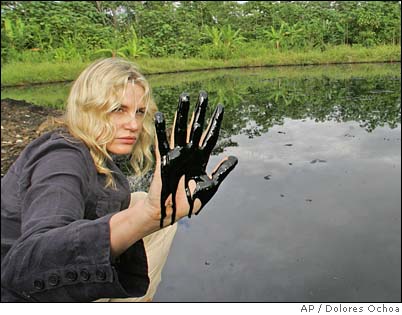
Mixing celebrities, lawyers and oil
In 1967 Texaco struck oil in the Oriente region of Ecuador, formed a consortium with the state oil company PetroEcuador, and received a 25-year drilling concession. Initially Texaco owned half the consortium but in 1976 its share was reduced to 1/3, with PetroEcuador owning the remainder. When the concession expired in 1992 PetroEcuador took over ownership of the whole thing and, at current prices, some $10 billion annual revenue. In 2001 Chevron acquired Texaco and its liabilities
Everyone accepts that oil drilling in Ecuador caused a mess; instead of pumping waste water from the wells back underground, where it would cause no trouble, the consortium left it lying in surface pits. There was nothing illegal, the Ecuadoran government approved the practice, and PetroEcuador have continued it since.
But there probably are some health risks, albeit small compared to the other hazards of rural Ecuador. In the early 1990s environmental groups started campaigning for the companies to clean the pits up, and in 1995 the consortium agreed to fund remediation. Texaco spent $40 million on its share and in 1998 the Ecuadoran government certified the job done, and granted it a release from any future claims.
PetroEcuador, in contrast, not only failed to clear up their bit, but carried on creating new pits – 300 in the last couple of years. This is as expected. Private companies have to obey regulations and clean up after themselves or they get fined. Nationalised ones are protected by politicians, so they make excuses instead.
But muddled environmentalists like blaming capitalists, and some lawyers don’t worry too much where fault lies, they go where the money is. In 2003, Steven Donzinger, a US lawyer, together with Ecuadorian colleagues, filed a claim for damages on behalf of the local people against Chevron. A legal battle of Dickensian complexity began.
Donzinger, is more publicist then lawyer, and he fought his case in the full glare of the media. He got Crude, a “Chevron bashing” Hollywood film made, and at the Sundance Film Festival the usual celebrities turned out in support – Trudi Styler, Sean Penn, Sting, Darryl Hannah.
But even in Ecuador you need more than celebrity endorsement to win a court case, and celebrities are stingy with their own money – Donzinger’s personal fee was going to be $200 million – so a hedge fund, Burford Capital, stumped up hundreds of millions of dollars in “litigation finance” in return for a slice of the action if he won.
The battle started well for Donzinger. A left wing government got elected, and their populist leader, Rafael Correa, making no pretence of neutrality, vowed that Chevron would pay for their “crime against humanity”.
Then an independent environmental report by a fellow called Richard Cabrear, commissioned by the Ecuadoran court, recommended that Chevron pay $27 billion damages. When Chevron demanded an independent review, a Colorado consulting firm, Stratus, endorsed the report as “sound, reasonable and consistent”. In Feb 2011 an Ecuadoran judge found Chevron liable for $18 billion damages.
But it won’t end there. When Chevron’s lawyers got hold of Donzinger’s emails and the out-takes from Crude, it turned out the whole thing was a scam.
The out-takes are incriminating. Donzinger threatens to expose the Ecuadoran judge German Yanez’s drinking and womanising if he “does not adhere to the law and what we need”. When someone suggests that if Yanez ruled against the plaintiffs he might be killed, Donzinger says, “He might not be, but he thinks he will, which is just as good.” When a groundwater expert tells him the contamination is less than he had thought, he replies, “This is Ecuador, OK? At the end of the day, if there’s a thousand people around the courthouse, you’re going to get what you want.” Later he calls the scientific data “just a bunch of smoke and mirrors and bullshit.”
But the emails were worse. The “smoke, mirrors and bullshit” remark was closer to the truth than Donzinger had intended. Donzinger’s team had not only “suggested” Cabrear to the judge, and agreed his appointment before it happened, but also ghost written his report. And the ghost writers? Stratus, the firm that later endorsed his report as “sound, reasonable and consistent”!
Chevron no longer have business in Ecuador, and international courts are unlikely to enforce such an obviously corrupt judgement, but they are still going after Donzinger for racketeering. Presumably to discourage him from starting up again. Eventually that case will peter out in a dusty courtroom somewhere.
And the polluted water pits? Maybe some celebrities will club together to fund a clean-up. If the lawyers stayed away, it wouldn’t cost much.
Jim Thornton
Shock BMJ headline
Privately funded research better reported than publicly funded
Relax. It’s not happened. The British Medical Journal is bashing the pharmaceutical industry as hard as ever; this week insinuating that even collaborating with the NHS is akin to bribery. But the same issue also included a series of papers on missing data from drug trials. i.e. results not reported because they, allegedly, failed to support the interests of the triallists. Everyone agrees this is a problem. Listening to the BMJ editor on the Radio 4 Today programme you’d think it mainly affected the private pharmaceutical sector – to be fair partly the fault of the BBC interviewer.
Two papers mention the source of funding for these troublesome studies. Ross et al reported less than half of trials funded by the US National Institutes of Health, i.e. publicly funded ones, got published at all.
Prayle et al. inspected the database, Clinicaltrials.gov. Instead of publication in general, they measured compliance with a government regulation that summary results should be published on the website. 40% of industry funded trials but only 9% of publicly funded ones had done so!
This is not an original finding. Direct comparisons of public and privately-funded research often show the latter is better quality. Here’s another study Jones et al. But don’t wait for the BMJ headline, or the Today programme to tell you.
Jim Thornton.
A Larkin Homage
The Whitsun Weddings & The Larkin Automatic Car Wash
The best loved poem of Britain’s best loved poet is not to be trifled with. But this is neither parody nor pastiche – Ewart called it a “para” poem.
Philip Larkin admired Gavin Ewart – he once wrote a poem “Good for you, Gavin”, in praise of his humorous staying power.
And Ewart admired Larkin – so much so that he wrote this Car Wash poem in the same style as the Whitsun Weddings. Not just rhyme and metre, but the same length, and short second lines to each verse.
The Whitsun WeddingsThat Whitsun, I was late getting away: All afternoon, through the tall heat that slept At first, I didn’t notice what a noise As if out on the end of an event Marked off the girls unreally from the rest. Success so huge and wholly farcical; Just long enough to settle hats and say There we were aimed. And as we raced across Philip Larkin |
The Larkin Automatic Car WashBack from the Palace of a famous king, And shorts of planners morse, the traffic lights, We wound our windows up and waited there. The science fiction light came creeping through In joy of safety. The tall half-children screamed And nothing better. To me it seemed so short, Yes, it was jolly, Fun for the kids we say, As thick there as before; and would in time, Gavin Ewart |
The Whitsun Weddings is one of the most moving poems ever written. I can’t read it aloud without tears.
The Larkin Car Wash is not in the same class, but it still shows the pure power of poetic technique. I’m in awe.
Jim Thornton
Love ends, death approaches
The Sunlight on the Garden
Written in 1936, soon after his first wife, Mary Beazley, had left him for their student lodger, “sat under thunder and rain” probably had her in mind. But McNeice remained on good terms with both lovers, and soon went off to the Hebrides, to write the poem Bagpipe Music and have a short-lived affair of his own. The resulting travelogue I Crossed the Minch, was illustrated by his new squeeze, Nancy Coldstream.
Some think the sense of doom refers to the impending war, but I doubt it – MacNeice put most of that into his masterpiece Autumn Journal. This is lost love and impending mortality – the end of verse 3 is from Anthony to Cleopatra, as he dies in her arms.
The Sunlight on the Garden by Louis MacNeice
The sunlight on the garden
Hardens and grows cold,
We cannot cage the minute
Within its nets of gold,
When all is told
We cannot beg for pardon.
Our freedom as free lances
Advances towards its end;
The earth compels, upon it
Sonnets and birds descend;
And soon, my friend,
We shall have no time for dances.
The sky was good for flying
Defying the church bells
And every evil iron
Siren and what it tells:
The earth compels,
We are dying, Egypt, dying
And not expecting pardon,
Hardened in heart anew,
But glad to have sat under
Thunder and rain with you,
And grateful too
For sunlight on the garden.
2012 Deadpool
A time to predict
Here’s my list for next year’s AO Deadpool. I feel bad about Phil the Greek. He’s been on for years, but I still hope he pulls through from his recent heart flutter. Even the bad guys, Assad and Brady. I don’t wish them dead.
Only exception – comatose Ariel Sharon. He’s been blocking lists too long. Hope he’s not dead already.
Last year I missed plenty – Gerry Rafferty, Betty Ford, Seve Ballasteros, Steve Jobs, Nat Lofthouse, Donald Nielsen, Osama bin Laden, Jack Kevorkian, Kim Jong Il, Christopher Hitchens, Sidney Lumet, Geraldine Ferraro, Peter Falk, Jimmy Saville and Vaclav Havel. But three big hits, Elizabeth Taylor, Amy Winehouse and Muammar Gaddaffi. Overall a good year. Not so good for them.
1. ANDRE, Carl. (Minimalist sculptor and acquitted wife murderer)
2. ARMANI, Giorgio. (Fashion designer.)
3. ASSAD Bashir. (President of Syria)
4. BOULEZ, Pierre. (Conductor and composer.)
5. BRADY, Ian. (Moors murderer)
6. CAMPBELL, Menzies (Ming) (Liberal Party leader)
7. CHAVEZ, Hugo. (President of Venezuela)
8. DOCHERTY, Pete. (Pop singer. Lead singer with Babyshambles)
9. DOMINO, Fats (Musician)
10. FERMOR-HESKETH, Thomas Alexander. (Lord Hesketh. Conservative politician and founder of Hesketh Motor Racing)
11. FOX, Michael J. (Hollywood Actor)
12. GRIFFITHS, Richard. (Actor)
13. HAWKING, Steven. (Astronomer)
14. HEALY Dennis. (Labour politician. Foreign secretary.)
15. HEANEY Seamus. (Poet)
16. HEFNER, Hugh. (Publisher of Playboy.)
17. HESELTINE Michael. (Conservative politician.)
18. JOHN Elton, aka Reg Dwight. (Pop singer)
19. LYNN Vera. Singer. (Forces sweetheart.)
20. MOORE Patrick. (Amateur astronomer. Presenter of “The Shy at Night”. TV show)
21. NAIPAUL VS. (Novelist)
22. NORDEN, Dennis. (Writer.)
23. NORMAN Jessye. (Opera singer)
24. MATHIS, Johnny. (Singer)
25. PARSONS, Nicholas. (Radio presenter, “Just a Minute”)
26. PHIL THE GREEK. Prince Philip. (The Duke of Edinburgh.)
27. PRATCHETT, Terry. (Novelist)
28. PRICE, Leontyne. (Opera singer)
29. RIVERS, Joan. (Comedienne)
30. RIX, Brian. (Farceur. Star of the Whitehall farces.)
31. ROTH, Philip. (Novelist)
32. SEEGER, Pete. (Folk singer)
33. SHARON, Ariel. (Israeli prime minister.)
34. Da SILVA Lula Ignazio “Lula” (ex president of Brazil)
35. SOAMES Nicholas. (Conservative Member of Parliament. Mid Sussex.)
36. SPASSKY Boris. (Chess ex world champion)
37. STILES Nobby. (England footballer. Member of the 1966 World Cup winning team.)
38. THATCHER, Margaret. (Prime Minister of Britain)
39. THORPE, Jeremy, (UK Liberal Party leader)
40. WOOD, Ronnie. (Pop star. Rolling Stone’s guitarist)
Jim Thornton
Mostly Rhymers
Poets in The Anthologist by Nicholson Baker
In Nicholson Baker’s 2009 novel, The Anthologist, a second rate poet, Paul Chowder, struggles to win back his girlfriend, and complete his anthology of rhyming poems. Along the way, and without listing the poems in the fictional Only Rhyme, he gives us his thoughts on poetry. Why iambic pentameter is a misnomer, on unrealised beats at the end of lines, on why enjambment hurts, unless it’s your thing. He tells us about Louise Bogan and Ted Roethke’s passionate short-lived affair, Mina Loy and Filippo Marinetti’s slightly longer one, about many poetic suicides, and Ezra Pound’s editing. And he bangs on about rhyme – why it’s good, why we like it, but why you can have too much of it.
There is a partial list of poets from the book on Wikipaedia, and I really should have been happy with that, but for some reason I started to make a complete list and couldn’t stop. Must get out more.
* Chowder/Baker has something definite to say. Mentioned poems in italics.
Adams, Leonie.
Arnold, Mathew
Ashbery, John
Attridge, Derek.
*Auden, WH. Song of the Master and Boatswain. Musee des Beaux Arts
Auslander, Joseph.
*Barratt Browning, Elizabeth. The sonnets
*Bashō, Matsuo
Bell, Marvin.
*Berryman, John.
*Behn, Aphra
*Bishop, Elisabeth. The Fish. Filling Station
*Bogan, Louise. Solitary Observation Bought Back from a Sojourn in Hell. Roman Fountain.
Bridges, Robert.
Browning, Robert.
Byrd, William
Byron, Lord
Campion, Thomas
Carey, Alice. Nobility
Causley, Charles.
Chaucer, Geoffrey
*Coleridge, Samuel Taylor. Kubla Khan. The Rime of the Ancient Mariner
Collins, Billy.
Cooke, Edmund Vance. How did you die?
*Cope, Wendy. The Aerial.
*Cummings, EE. Buffalo Bill’s
*Daniel, Samuel. Certaine small poems lately printed.
De la Mare, Walter.
Doolittle, Hilda.
*Dryden, John.
*Eliot, Thomas Stearns. The Love Song of J Arthur Prufrock. The Waste Land
*Fenton, James. In Paris with you. I’ll Explain. The vapour trail
Ferlingetti, Lawrence.
*Frost, Robert. The Road Not Taken
Garrison, Deborah.
Gascoigne, George
*Geisel, Ted (Dr Seuss)
Ginsberg, Alan.
Goldsmith, Oliver
Gosse, Edmund.
Graham, Jorie
Hiatt, John
Heaney, Seamus
*Hardy, Thomas. A Singer Asleep.
Hass, Robert
Henley, William Ernest.
Herrick, Robert
*Hill, Selima. A Small Hotel.
Hollander, John.
Horace,
*Houseman, AE. White in the moon the long road lies.
Hughes, Ted.
*Hunt, Leigh. Jenny kissed me.
Isherwood, Christopher.
*Johnson, Samuel The vanity of human wishes
Jollimore, Troy.
Joyce, James.
Keats, John.
Kooser, Ted.
Kinzie, Mary.
*Kipling, Rudyard. The Benefactors
Kunitz, Stanley.
Lanier, Sidney
*Larkin, Philip
*Lear Edward. The Pelican chorus. The Pobble who has no toes
Lehman, David.
Levy, Newman
Lewis, Wyndham.
*Lindsay, Vachel. Factory Windows are Always Broken. The Congo
*Longfellow, Henry Wadsworth. The Day is Done. The Arrow and the Song. Driftwood
*Lowell, Amy.
*Loy, Mina. Songs to Johannes
*Macaulay, Thomas Babington. Lays of Ancient Rome
Macleish, Archibald
*Marinetti, Filippo Thommaso.
Marvell, Andrew.
*Masefield, John. Cargoes
*Merrill, James
*Merwin, William Stanley. The Vixen. To the corner of the eye
*Meynell, Alice.
Millay, Edna St Vincent.
Milne, AA.
Milton, John.
Moore, Marianne.
Morley, Christopher.
Moss, Howard.
*Muldoon Paul.
Nash, Ogden.
Nemerov, Howard.
Nicholas, Christopher.
Ochester, Ed.
O’Hara, Frank
*Oliver, Mary. Singapore. The Summer Day
Olsen, Charles.
*Parker, Dorothy. The Dark Girl’s Rhyme
*Patmore, Coventry. Magna Est Veritas
Pinsky, Robert.
Plath, Sylvia.
Plumly, Stanley.
*Poe, Edgar Allen. The Raven.
*Pound, Ezra.
*Raleigh, Walter. His Pilgrimage
Regnier, Henri de.
Rimbaud, Arthur
Ritter, Mary Louise.
*Roethke, Ted. In Evening Air. Meditation in Hydrotherapy
Rohrer, Matthew.
Rosetti, Christina
Rosetti, Dante Gabriel
Rukeyser, Muriel.
Ryan, Kay
Sandburg, Carl
*Scott, Sir Walter. Song of the Mermaids and Mermen.
*Shelley, Percy Bysshe. Ozymandias
Shapiro, Karl.
Simic, Charles
Silverstein, Shell.
*Snodgrass, William De Witt. Lobsters in the Window
Stafford, William.
Stevens, Wallace.
Strand, Mark
Swenson, May.
*Swinburne, Algernon Charles
*Teasdale, Sarah. The answering voice – an anthology of love poems by women. Blue Squills
*Tennyson, Alfred Lord. Princess. Break, Break, Break. The Charge of the Light Brigade
*Transtromer, Thomas.
Updike, John.
Virgil
Warren, Robert Penn.
Whitman, Walt.
Whittier, John Greenleaf.
Williams, William Carlos.
*Wordsworth, William. A slumber did my spirit seal
*Wright, James. Lying in a Hammock at William Duffy’s Farm in Pine Island, Minnesota
Wyatt Thomas. The lover showeth how he is forsaken of such as he sometime enjoyed.
Yeats, WB.
It would be a fine anthology.
Jim Thornton
 Ripe-tomato.org