Who’s wearing Miriam Thornton?
Lauren Goodyear from TOWIE
 The star of The Only Way is Essex picked this last night – from Renee London, designer Miriam Thornton.
Never mind the fraud. Mind the science.
The Diederik Stapel case
 Diederik Stapel, Professor of Social Psychology at Tilburg since 2006, and Dean of the Faculty of Social and Behavioural Science since 2010, has been making up data for years. Some people had long had suspicions, but firm allegations surfaced in August this year, and the boss of Tilburg, the magnificently titled Rector Magnificus, commissioned an enquiry. Here’s the interim report. It was pure fraud. Decide what you want to prove, make up the data, give it to a student to analyse and hey presto, you’re published.
But Stapel wasn’t just an obscure academic. He was famous, because he told a certain sort of person what they wanted to hear. A quick search of Pubmed reveals 45 scientific publications. Most consist of such dense jargon as to make them almost unreadable, but many have a headline message. Here’s a few.
- Powerful people are more likely to commit adultery because they feel confident that their advances won’t be rebuffed. Psychol Sci. 2011; 22: 1191-7.
- People are more likely to be racist when the environment is disordered, e.g. rubbish on the streets. Science. 2011; 332: 251-3
- Power makes us more critical of others bad behaviour, but more likely to engage in it ourselves, i.e. more hypocritical. Psychol Sci. 2010; 21: 737-44.
- People behave better when there are wine glasses on restaurant tables. Pers Soc Psychol Bull. 2008; 34: 1047-56.
- We can be made to feel emotions, like happiness and sadness, without being aware of the cause. Psychol Sci. 2008: 19: 385-91
- Competition make us feel different from the people were compete with. Co-operation makes us feel similar. J Pers Soc Psychol. 2005; 88: 1029-38
- Finally, just a few weeks before his downfall, he announced unpublished research showing that thinking about meat-eating makes people antisocial.
Movember
Wrong in more ways than this
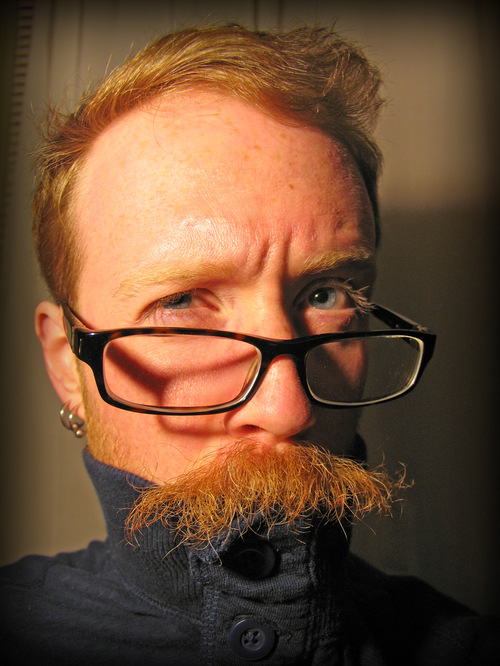
 Men sport wispy moustaches. I pretend not to notice – it seems kinder. Then one day “nice tache” pops out – nice in the sense of nasty, but let’s not to be rude – and someone tells me what’s going on.
It’s a men’s health campaign. Click here. Encourage us to stop smoking, drink less, take exercise, lose weight, check our balls and undergo screening for bowel and prostate cancer. They asked me to donate! I’d rather poke a sharp stick in my eye.
It’s not just the matey tone, “mo bros” for fuck’s sake, and attacking the pleasures of smoking, sloth and gluttony. That’s standard health police fare – a pleasure to ignore. When do-gooders advise less salt, I sprinkle on a bit extra. It annoys my wife and daughters, another bonus.
It’s the screening. Any well-informed man should run a mile from it. No way do the benefits outweigh the harm, hassle, and worry. [All data below from the relevant Cochrane reviews] Bowel cancer screening has been evaluated in four decent trials, one of the best a trial from Nottingham, led in recent years by my colleague John Schofield. It reduces bowel cancer related deaths by about 16%. Sounds good, but at what cost.
If ten thousand 50-year olds crap on a bit of newspaper and spoon up a sample, three hundred will have a tube up their bum and polyps removed, a couple will have a serious complication, bleeding or perforation, and three bowel cancer deaths will be prevented. Hmm?
But it’s worse than that – despite the huge numbers in the trials, 320,000, there was no effect on overall mortality. No effect. Relative risk 1. Confidence interval 0.99 – 1.02! That really is no effect. None at all. Zilch. Zero. How many more ways can I put it? This is a dead parrot!
There are three possible explanations – the screening causes extra deaths from some mechanism as yet unknown (this is entirely possible), the men saved from bowel cancer death die of something else pretty soon anyway, or the effect is so small that it is swamped by random variation in other causes of death. This latter explanation is favoured by screening supporters, and may be correct, but it gives the lie to the claim that preventable bowel cancer is an important public health problem!
Prostate screening is worse. Ten thousand men have a blood test, 1000 get an abnormal result and a biopsy (Don’t ask! They wisely keep quiet about it on Movember.com), and 400 turn out to have prostate cancer. Then what? A radical operation to remove the gland, or watch and see what happens – survival is the same. Surgery has a high risk of making you impotent and incontinent, but doing nothing with a cancer growing inside you is hardly conducive to happiness. You’ll envy the “bro” who missed his “Well Man” check-up. Or maybe not. Maybe the blood tests, biopsies, operations, anxiety, incontinence and impotence prevent some prostate cancer deaths. Sadly no. Despite a 35% increase in prostate cancer diagnoses, there was no effect on prostate cancer mortality. Relative risk 0.93; 95% CI 0.82-1.04. This means the observed 7% reduction could well have occurred by chance. And just in case you’re feeling optimistic, here’s the all cause mortality. RR 1; 95% CI 0.98-1.02. Sorry guys. Another dead parrot.
We need a campaign encouraging men to get on with their lives and keep away from meddlesome doctors. I’d put my hands in my pocket for that. I might even grow a moustache. But it won’t be pretty.
Jim Thornton
George F Kennan
Poet, player and cold war diplomat
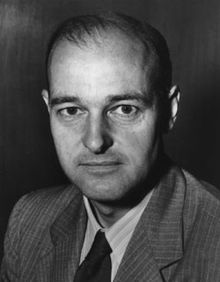 Good stuff in the new biography by John Gaddis. Kennan was the long serving diplomat who first articulated the US “containment” policy towards Russia, which, some say, led to the Vietnam war. He worked for every president from Roosevelt to Kennedy, and his New York Times obituary described him as “the American diplomat who did more than any other envoy of his generation to shape United States policy during the cold war”.
I’m more interested in revelations about his private life. Publicly he was very traditional, stayed married to his Norwegian wife Annelise Sorensen from 1931 until his death in 2005 at age 101, and had four children. In 1941 when the American Berlin delegation was interned in Bad Nauheim, with Kennan as the senior diplomat, he was so unimpressed by his fellow Americans comfort-seeking behaviour that he wrote this sarcastic poem.
From you, embattled comrades in abstention,
Compatriots to this or that degree,
Who’ve shared with me the hardships of detention
In Jeschke’s Grand and guarded hostelry—
From you, my doughty champions of the larder,
Who’ve fought with such persistency and skill,
Such mighty hearts, such overwhelming ardor,
The uninspiring battle of the swill—
From you, my friends, from your aggrieved digestions,
From all the pangs of which you love to tell,
Your dwindling flesh and your enraged intestines:
Permit me now to take a fond farewell.
For five long months you’ve slept and nursed your bellies,
Or strolled along the Usa’s quiet shores,
Eaten your rolls and failed to eat your jellies,
While others toiled and tramped and fought the wars.
The world might choke in food-restricting measures;
Chinese might starve; and Poles might waste away;
But God forbid that you—my tender treasures—
Should face the horrors of a meatless day.
In later life he stuck to his view that the West in general and Americans in particular were decadent, lazy, and sex obsessed. Coming across a pop festival in Denmark in the 1960s, with its free love and drugs he mused that a company of Russian infantry would soon sort them out.
All a bit rich when we learn about his own many affairs – one at the very moment he was grumbling about his colleagues in Bad Neuheim. Gaddis even speculates that the one important misstep of his career, some ill-chosen words which led Stalin to expel him as ambassador, may have been intentional. Being thrown out for a slip of the tongue was less serious than being expelled for falling into a Russian honey trap. Annelise appeared to both know about, and tolerate his infidelities.
Here’s a story from his letters. Late one dark night soon after the war started he met a Hamburg prostitute in the street. He claims he “wasn’t interested” in sex but wanted to talk.
“A few moments dickering resulted in a compromise whereby I agreed to pay the fee for the usual service and she to honor me with her company in a public ‘Lokal.’ We settled down, I over a bad highball, she over a ‘half-and-half’ and a new box of cigarettes. … She was still a young woman with a good figure and a fresh, firm face. Her clothes were in such good taste that one might have almost have been deceived about her profession.”
He questioned her about the rounding up of street girls to send to Nazi labour camps, and fretted about her safety. She told him about her fiancée. “He’s a flyer now. He’s in Poland. When he comes back, he’ll marry me— perhaps.” The conversation became intimate – about how her fiancée was only interested in sex, had another lover on the side, and how at the start of her relationship she used to play at being a prostitute for him.
Eventually Kennan paid the bill, and walked her to her nearby apartment. They kissed and he left.
I wonder.
Jim Thornton
An honest Russian lawyer?
Vassily Aleksanyan Dec 15 1972 – Oct 3rd 2011
 When the USSR disintegrated in 1993 the Russians needed money fast, so they flogged off a Siberian state oil company called Yukos. But no-one knew what it was worth – that was one reason the USSR disintegrated – and times were hard, so smart guys with access to credit made killings. Soon a fellow called Mikhail Khordokovsky owned most of the shares. Since Yukos was drilling about 2% of the world’s oil he becamevery rich. But getting there had been messy. A couple of Yukos executives had been accused of killing the local mayor. One got convicted of murdering someone else. Khordokovsky needed a good lawyer and he found Vassily Aleksanyan.
Soon Harvard graduate Aleksanyan was busy. According to his friends, disentangling Yukos’s murky past and transforming it into a transparent modern company. According to his enemies, laundering Khordokovsky’s ill-gotten gains. Whatever, he did well, until he somehow got infected with HIV, and Khordokovsky fell out with President Putin. The company was sent a multibillion dollar unpaid tax bill, Khordokovsky was imprisoned, and the rest of the Yukos board quickly went into exile. For reasons unknown Aleksanyan stuck around until in 2006, he also was arrested. Allegedly the authorities withheld medical treatment in an attempt to make him spill the beans. As his health declined he became an international cause celebre with human rights activists, who eventually persuaded the Russians to release him on compassionate grounds. Too late. On Oct 3rd he died.
You’re wondering about his sex life. Me too, but the internet is silent on the topic. You’ll have to draw your own conclusions.
An honest lawyer in bed with bad guys
Some found it paradoxical
But good looking and dead of AIDS
Was the bed not metaphorical?
Soon to appear on AO deadpool. Jim Thornton
Put on your carpet slippers and stride out
Anne Sexton on Remembrance Sunday
What is it about women’s confessional poetry? I cannot think of a single line by Sylvia Plath which has meant anything to me. With few exceptions Sharon Olds leaves me cold. But Anne Sexton hits the spot time and again.
Written in the last few manic months before her 1974 suicide, and included posthumously in The Awful Rowing Towards God, this is a good poem for today.
Courage
It is in the small things we see it.
The child’s first step,
as awesome as an earthquake.
The first time you rode a bike,
wallowing up the sidewalk.
The first spanking when your heart
went on a journey all alone.
When they called you crybaby
or poor or fatty or crazy
and made you into an alien,
you drank their acid
and concealed it.|
Later,
if you faced the death of bombs and bullets
you did not do it with a banner,
you did it with only a hat to
cover your heart.
You did not fondle the weakness inside you
though it was there.
Your courage was a small coal
that you kept swallowing.
If your buddy saved you
and died himself in so doing,
then his courage was not courage,
it was love; love as simple as shaving soap.|
Later,
if you have endured a great despair,
then you did it alone,
getting a transfusion from the fire,
picking the scabs off your heart,
then wringing it out like a sock.
Next, my kinsman, you powdered your sorrow,
you gave it a back rub
and then you covered it with a blanket
and after it had slept a while
it woke to the wings of the roses
and was transformed.|
Later,
when you face old age and its natural conclusion
your courage will still be shown in the little ways,
each spring will be a sword you’ll sharpen,
those you love will live in a fever of love,
and you’ll bargain with the calendar
and at the last moment
when death opens the back door
you’ll put on your carpet slippers
and stride out.
Anne Sexton. From The Awful Rowing Towards God
A Marriage by Julie Bruck
From last week’s New Yorker.
His paintings were small, suggestions
of houses, pinpricks of green for trees.
She’d set her glass down, say, Paint
like you’re blind, from memory and passion –
two words he especially didn’t care for.
She’d say, Paint like you’re on fire.
But their house was already burning,
And he was going blind and deaf.
So he’d carry the painting back down
to the basement, resume with
his thinnest sable brush. He would
Never touch her the way she wanted,
Though she kept asking him to,
Like this, in front of everybody.
|
A marriage going wrong. The two styles, passionate on fire, or tiny pinpricks of green with the thinnest sable brush, metaphors for the differences that drive couples apart. Hardly important, but trying to correct them makes things worse. We never learn to let people alone.
What did St Augustine say? “A tree praises God mainly by being a tree.” So does a wife, or a husband.
And the final line? How she wants to be touched and how his painting makes him feel.
I’m looking out for Julie Bruck.
Jim Thornton
Bin Laden of the internet
Anwar al-Awlaki,
The only American executed under a presidential “targeted killing” order.
Al-Awlaki came to prominence as one of a bunch of self-appointed radical Imams with links to the 9/11 attacks. His US citizenship, engineering degree from Colorado and mosque in San Diego made him newsworthy. The evidence against him was only circumstantial and he didn’t relish taking the rap, so he condemned the attack as un-Islamic, got a short-lived reputation as a moderate, and skipped off to Britain. Soon he was calling again for jihad among the sillier fringes of Islamic student groups, and setting up all sorts of internet propaganda pages. By 2004 even the tolerant Brits were hacked off, so he decamped to Yemen, where his father is a senior politician.
His Western knowledge and perfect English inspired many new recruits, including the perpetrators of the 2005 London bombings, and before long he had a popular Facebook page and videos on You Tube. This pissed off Osama bin Laden who had neither. It also pissed off Barak Obama, who might have turned a blind eye – all religions have barmy clerics calling on followers to kill unbelievers – but couldn’t ignore his actions. He organised two failed bombings – flight 253 from Amsterdam to Detroit by Umar Farouk Abdulmutallab and the UPS bomb plot against Chicago synagogues. His fingerprints were on the Times Square bombing, and the Fort Hood massacre. Earlier this year Obama lost patience and ordered the CIA to kill him any way they liked. On Sept 30th, a drone got him.
His father protested that he was just an all American boy, and the usual bleeding hearts fretted over lack of due process. But the simple souls who he led astray, and the innocents who would sooner or later have been killed should be delighted.
Imam Al-Awlaki was no great scholar
Not even top dog in the Al Quaeda
But he authorised bombers on his mobile phone
So Obama blew him up with an unmanned drone.
Let this be a lesson to all you clerics
Blog what you like to us agnostics
But killing the innocent is so uncool
You’ll soon get a write up on our Deadpool
Jim Thornton
Forthcoming on AO Deadpool Click here
Didn’t heed advice
Muammar Gadaffi, Brotherly Leader and Guide of the Revolution of Libya
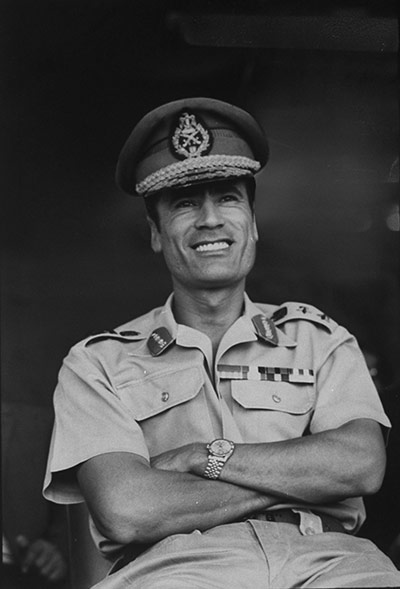
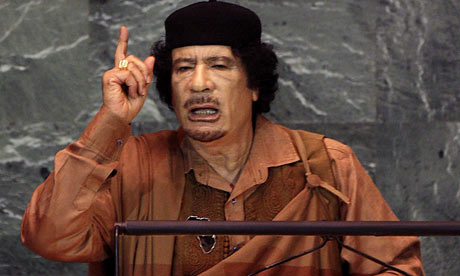
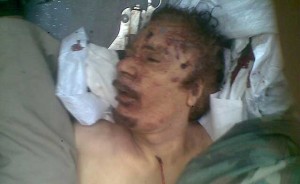
It’s tough on the modern dictator. He gets the job because he’s the most impulsive, dangerous, and violent man in town, and keeps it by the well tried techniques of carrot, stick and bombast. He makes fiery speeches, bombs his enemies and appropriates the oil to reward his friends and pay the secret police. For 40 years he rides crises out, gets the girls, and the oil keeps flowing, so no-one looks too closely at his torture chambers. In his funny hats and gold braid, surrounded by his buxom Amazonian Guard, he becomes almost loveable. Foreign leaders court him. And then one day a fruit seller in the next door country immolates himself and the people ask for free elections. Normally a few tanks would sort them out, but this time the West also gets involved. Soon NATO jets are shooting up his troops, and advisers counselling a quick exit to Venezuela. It was good advice, but he’d always ignored that. Suddenly he finds himself dragged out of a drainpipe with a loaded gun to his head. It’s tough on the modern dictator.
Things had started well. The handsome curly-haired colonel, who seized power from King Idris in a bloodless coup in 1969, talked a good game. Forcing up oil royalties annoyed the companies, but made him popular at home. The money went into schools, hospital and water projects, and for a bit health and literacy improved. But Gadaffi was just a poor kid from the desert; he didn’t know how to run a country, so he was tempted by central planning. He called his policy “Islamic socialism” and wrote a Little Green Book about it – not a good sign. Soon the people were restless.
He would have fallen prey to the next strongman, but the oil price kept going up, and the sweetest crude poured out of every hole in the desert, so cheap the oilmen could afford his extortionate royalties and still make a tidy profit. All Gadaffi had to do was keep himself in the news as the permanent revolutionary. Any murderous nut-case could be sure of fraternal greetings from the Brotherly Leader.
Unfortunately the Leader rarely limited himself to fraternal greetings. He sent arms to the PLO, IRA, ETA, Red Brigades, and many others. He fell out with half the Muslim world when his agents killed the Shia leader Musa Al-Sadr, and he fell out with most of the rest when he went to war, albeit briefly, with his neighbours Egypt and Chad. Western leaders fretted over his efforts to get hold of chemical weapons and nuclear bombs. The general public was maddened when his diplomats walked free after one of them had shot police officer Yvonne Fletcher outside their London embassy. By the time his agents blew up La Belle nightclub in West Berlin and planted the bomb that bought down Pan Am flight 103 over Lockerbie in 1988, he had become an international pariah.
But his outrages had also made his name. Unlike the Tunisian fellow who wisely went into exile six months ago, (what was his name?) he was as famous as Idi Amin, Saddam Hussain and Pol Pot. Nevertheless by the time of the 2003 Iraq invasion even Gadaffi was feeling the heat. Fearing invasion, he admitted responsibility for Lockerbie and his other atrocities, and paid compensation. He even claimed to have given up his weapons of mass destruction. Tony Blair and other western leaders came to visit, and he was welcomed back into the international fold. He must have hoped to die in his bed, but it was not to be. The Arab Spring, Western jets and his own pig headedness finally unseated him in the best way possible – a bullet in the head.
Amelia has been fretting about spelling his name in English. She was right to worry. A perfect storm of problems – Arabic letters without English equivalents, and changing phonetic transliteration conventions applied to idiosyncratic Libyan dialects, all muddled up with his refusal to speak English in public, despite alleged fluency, and the occasional trouble maker who liked the ending “daffy” – have led to at least 57 variants. Here’s a few, together with their advocates – Gadaffi (BBC and Al Jazeera), Gadhafi (CNN), Qaddafi (Library of Congress), Al-Qadhafi (US State Dept), and El-Qaddafi (White House and New York Times).
But they’re all wrong – someone found his son’s passport in an abandoned palace last week. His family spell it Gathafi. And his first name? Let’s not go there.
The Colonel’s coup was bloodless
Unusual for Gadaffi,
But lucky for King Idris,
Who had sold his oil so cheaply.
Paying for fresh water,
Bringing a bit of glamour,
– And not foreseeing the slaughter –
The people liked Muammar
But his Little Green Book was barmy,
Soon everyone thought he was gaga,
To be mates with Robert Mugabe
And Idi Amin Dada
Unlike his hats, he was not so smart.
He never seemed to wise up,
Making friends with Pol Pot,
Bombing a Berlin nightclub
His medals made a mockery
The people began to disaffect
When a plane blew up over Lockerbie
He was the first suspect.
Reagan and Thatcher got angry.
Even the Arabs got cranky.
Only the Russians stayed friendly
They needed the oil, see.
Surrounding himself with a buxom guard,
“Terrorists don’t shoot women”.
No-one believed a single word.
More likely he wanted to shag ’em
But after 9/11 things got hotter.
George Bush mocked his curly hair.
So he joined the War on Terror,
And made friends with Tony Blair
After lasting so long,
He must surely have wondered
If he’d prove us all wrong,
Die in bed at a hundred.
But fool to the last, he failed to heed,
The Arab Spring, advice to run,
So he ended at last, as he richly deserved
Dead in a ditch. Wrong end of a gun.
Jim Thornton 31 October 2011
This is reprinted from AO deadpool
Larkin and Hopper
To the Sea and People in the Sun
Some years ago Alan Bennett reviewed a collection of essays, Larkin at Sixty for The London Review of Books. He didn’t think Larkin would have liked it much, and wondered what present the poet would have appreciated more. He mentioned this painting by Edward Hopper.
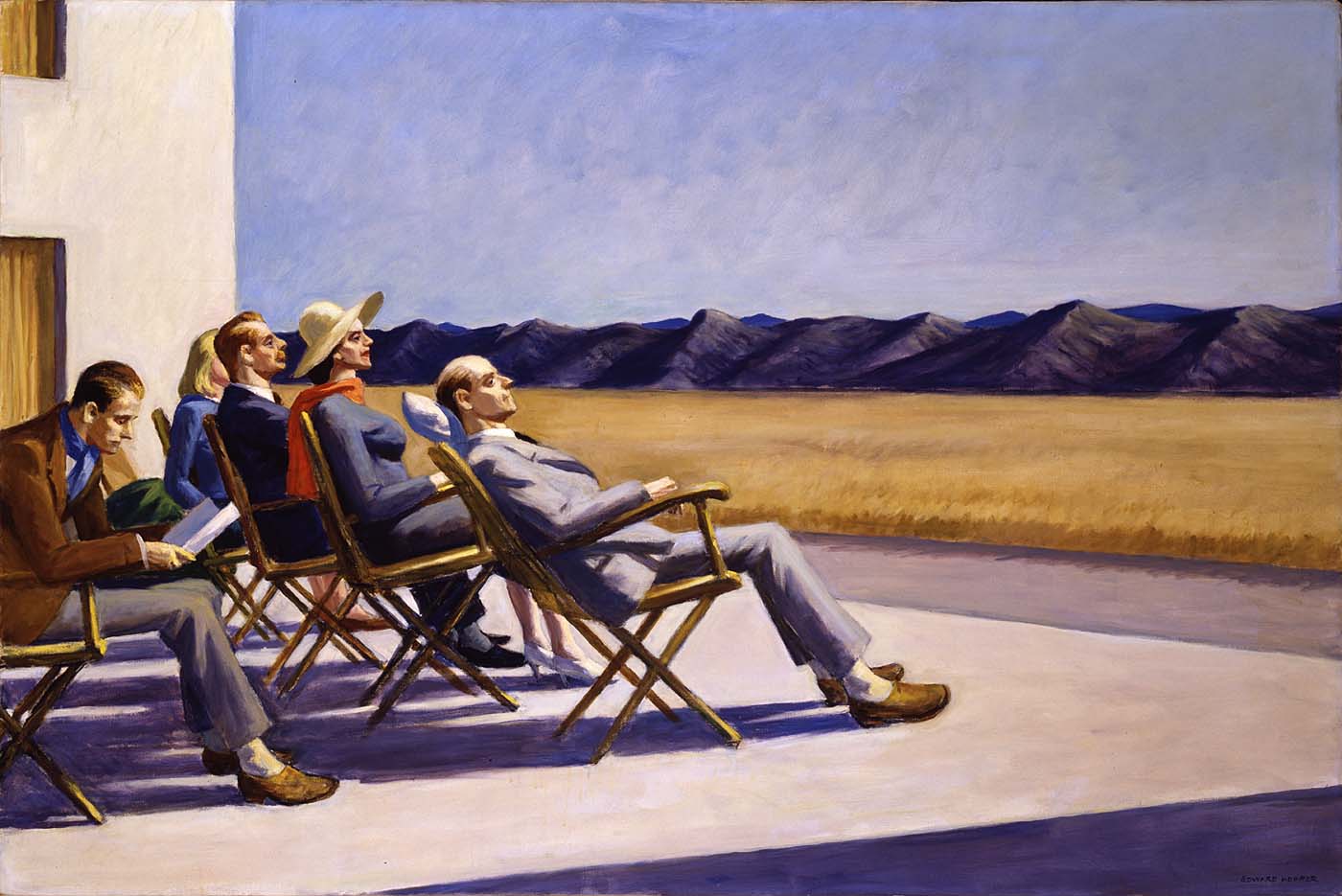
People in the Sun by Edward Hopper
I wonder if Bennett had this poem in mind.
To the Sea by Philip Larkin
To step over the low wall that divides
Road from concrete walk above the shore
Brings sharply back something known long before –
The miniature gaiety of seasides.
Everything crowds under the low horizon:
Steep beach, blue water, towels, red bathing caps,
The small hushed waves’ repeated fresh collapse
Up the warm yellow sand, and further off
A white steamer stuck in the afternoon –
Still going on, all of it, still going on!
To lie, eat, sleep in hearing of the surf
(Ears to transistors, that sound tame enough
Under the sky), or gently up and down
Lead the uncertain children, frilled in white
And grasping at enormous air, or wheel
The rigid old along for them to feel
A final summer, plainly still occurs
As half an annual pleasure, half a rite,
As when, happy at being on my own,
I searched the sand for Famous Cricketers,
Or, farther back, my parents, listeners
To the same seaside quack, first became known.
Strange to it now, I watch the cloudless scene:
The same clear water over smoothed pebbles,
The distant bathers’ weak protesting trebles
Down at its edge, and then the cheap cigars,
The chocolate-papers, tea-leaves, and, between
The rocks, the rusting soup-tins, till the first
Few families start the trek back to the cars.
The white steamer has gone. Like breathed-on glass
The sunlight has turned milky. If the worst
Of flawless weather is our falling short,
It may be that through habit these do best,
Coming to the water clumsily undressed
Yearly; teaching their children by a sort
Of clowning; helping the old, too, as they ought.
Hopper’s subjects, taking the sun in their stiff suits, gaze at an undulating moutain range instead of the sea. But they also experience “half a pleasure half a rite”.
Is it a ridiculous conceit to imagine Larkin as the poet on the left reading his book?
Jim Thornton
 Ripe-tomato.org