Nottingham’s London Road Turnpike
Drivers on Nottingham’s London Road, along the A60 from the A6008 roundabout near the present BBC building to Trent Bridge, are following the route of an ancient road.
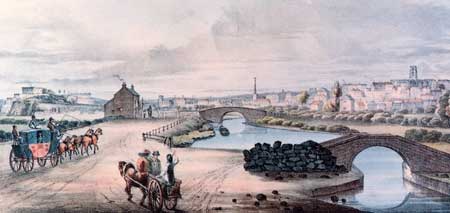
There was once a mile of marshes and flood plain between the city of Nottingham and the river at Trent Bridge. Up to the 18th century these were common lands criss-crossed by the channels of the river Leen. A series of wooden bridges were replaced in about 1766 by stone structures and by 1790 a single ten arch bridge was erected. It was badly maintained, and in 1795 it had to be pulled down after flood damage.
In 1796 an Act of Parliament established a Turnpike Trust for the route from the north side of Trent Bridge to the west of St. Mary’s Church. The new turnpike ran alongside the new Nottingham canal, which extended from the river Trent to the town somewhere about Poplar, and had been opened in 1793. The city section of canal still exists and forms part of the Trent and Mersey navigation. The new turnpike crossed the Meadows upon arches that permitted the floodwater to get away. Traces of some remain today.
The road was a great success. With the owners investing the income on upkeep, and competing to draw traffic from the canal, it was well maintained and busy. It became a favourite promenade from Nottingham. The picture dates from about 1808.
It is not known exactly when the tolls were done away with, but they certainly lasted until 1860.
Jim Thornton
Amy Winehouse
No need to follow her career closely to see this coming. Only those who thought, implausibly, that her public image was faked up, failed to predict Miss Winehouse.
Her voice was great, but men and drugs let her down. Her jazz loving, taxi-driver father left home when she was a child, only to come back into her life when she was famous, and Blake Fielder-Civil, her on-off boyfriend and husband-for-a-bit,was little better.
Her tough exterior may have helped with difficult boyfriends, but the little girl inside was never strong enough to cope with the poisons she ingested. Cigarettes gave her emphysema, alcohol made her fall over, and the illegal stuff had worse effects. Soon a near death-cult developed around her, fuelled by funeral videos and rumours of wrist-cutting parties. Her biggest hit single, “Rehab”, a celebration of fatalistic refusal of addiction treatment, became almost a personal anthem, and Karl Lagerfeld, to his shame, even developed a fashion line around her, based on sickly drug-addled girls.
Even if the cigarettes improved her voice, the rest of her troubles did her no good at all. In the eight years after her debut album “Frank”, she managed only one other, her masterpiece “Back to Black”. Although she won awards and sold many records, for the last few years of her life she was much more famous for her ever-enlarging beehive hair-do, love life and drug-taking. Like Janis Joplin, another talented singer with a memorable voice and problem hair, the bad end came at the young age of 27.
Some pundits blame her managers for not looking after her better and others the paparazzi for pestering her, but that’s hardly fair; the rest of us bought the papers and the fashions, and ultimately no-one forced the drugs on her. She sniffed, injected and swallowed them herself, bought and paid for.
“Back to Black”, and “Love is a Losing Game” are my favourites. Here’s a poem.
She partied hard to hide her fear
Sniffed and injected whatever was near
With her painted eyes and giant beehive
No-one thought she would long survive
Beaten and dumped by hopeless men
She fell off the wagon again and again
Her wonderful voice did buy her fame
But love remained a Losing Game
Some say she had a death wish,
Some blame the paparazzi
Surely the men who sold her crack
Knew she would end it, Back to Black
But whatever you think, you must agree
She went too soon, for you and me
Jim Thornton From AO Deadpool August 2011
Norman Wisdom
Comic who didn’t die
Norman Wisdom made his first low-budget comedy in 1953. The critics hated it, but audiences loved the little underdog who left a trail of mayhem behind him and eventually got the girl. He cranked out fifteen more and made a fortune. At his peak, his films made more money than the James Bond franchise in the Sean Connery era. Then, quite suddenly, it wasn’t funny any more. In the swinging sixties maybe slapstick went out of fashion, or perhaps a 50-year-old playing a teenager for laughs had become more grotesque than funny! Whatever the reason, the run stopped dead.
But Wisdom was still alive with nearly half his life in front of him. What should he do? He started badly. He went to Hollywood but made only one film there, his wife left him, and a disastrous effort in 1969 to revive the aging funny man in a sex romp was so embarrassingly dire that he never made another big screen movie.
But he was lucky in another way. His films were just as funny with the sound turned down. Wisdom’s remarkable physical clowning, his too-tight jackets, pratfalls and facial expressions were the only good bits in them. The plots were so weak and the jokes so laboured that non-English speakers enjoyed them more than the original audiences. The films carried on selling all over the world, with fans and regular revival festivals as far away as Hong Kong and Australia. He made a good living on cruise ships and the chat show circuit.
Most incongruously, Wisdom (or at least his character “Pitkin”) became a star in Albania. Enver Hoxha, the mad dictator of that benighted country, had woken up one morning and decreed that Wisdom’s comedies were the only western films that could be shown. Allegedly one was shown on Albanian TV every day for thirty years. There were even Wisdom TV channels.
Whether he was really popular, or just slightly more interesting than a turned-off set, I’ve no idea, but back in England he became better known for being “famous in Albania” than for the films themselves. No one watched them any more. He travelled with the England football team to Albania and, to hysterical cheers, came on the pitch at half time. In England he came on at half time if an Albanian club visited, if an Albanian player turned up, or if the hot dog man was Albanian! Every article or TV documentary about Albania mentioned his fame there.
Eventually he worked his way back into some sort of English favour; at least he got minor parts in TV sitcoms and turned up on English chat shows again. When he developed senile dementia and his family moved him into a nursing home and sold off his Rolls Royce, he was famous enough for the BBC to make a programme about that. He lived so long that, in 2008, Sky News prematurely released his obituary.
Famous in Albania, programmes about your dementia, and a premature obituary. As the poet Philip Larkin once said in another context: “That’s what you get for not dying, see!”
— Jim Thornton
Reprinted from AO Deadpool 2010
Abortion reform: a modest proposal
Make people pay
I would hate to go back to the days when abortion was illegal; when desperate women risked their lives going to back street abortionists. I’m glad it is now legal and safe. I’m a gynaecologist, and part of my job involves doing abortions. I’m hardly anti-abortion.
But I cannot understand why our taxes are being spent to make it free. Or to put it another way, why we’re paying to encourage abortion. There are 160,000 abortions in Britain every year. That’s nearly one in four pregnancies being aborted. It’s too many. Do we really want the government to subsidize more of it?
I can understand why we make the rest of health care free; we generally want more of that. But abortion? Why was it illegal on 31 Dec 1967, but free on the NHS on 1st Jan 1968? Surely abortion should remain legal, but people who want one should pay for it.
Here’s my proposal. Abortion should be permitted on the same grounds as at present, but no longer provided on the NHS. Those who want it should pay. A private abortion costs about £500. Not cheap, but most people could afford it. Those who worry about poor women being able to afford it, could set up abortion charities. They would be successful.
“Pro-lifers” should be pleased. Some “pro-choicers” might object that it would increase unwanted pregnancies. I doubt it. More likely it would encourage people to be more careful to avoid pregnancy, so that abortions would fall without having much effect on overall pregnancies.
The women who avoided abortion would be happy.
So would this “pro-choicer. Let’s give it a try.
Jim Thornton
River Wye
Glasbury to Chepstow
The river Wye, on the England/Wales border, is one of the least spoiled large rivers in the United Kingdom.
In the 17th century an Act of Parliament removed riparian owners rights and confirmed it as a “free and open” navigation up to Hay and it became an important waterway in the early industrial era. Weirs of various degrees of permanence were built to allow large barges to pass and the river must have been fairly polluted. However with the development of canals and railways the commercial traffic disappeared and the river naturally cleansed itself. Over the last century fishermen have pushed to reduce pollution, followed more recently by a new constituency, canoeists. The following is a guide to finding camp sites and access for launching along the main canoe-touring stretch from Glasbury to Chepstow. Compiled from various sources and many paddles.
It seemed pretty clean when I first canoed it as a child in about 1970, and was still so when I last did so in Spring 2011. I predict that with increasing numbers of canoeists caring about the river, it will steadily improve.
- Glasbury

From here to Hay access is disputed but the current informal agreement is for canoeing between 10 am and 4pm, leaving the morning and evening for the fishermen. The normal launching point is on the left bank just above the bridge. A fee of 50p per canoe is payable to the post office.
- 3 miles- Hollybush Inn right
- 4.5 miles – Broken weir. Shoot right
- 5.5 miles – Hay on Wye right
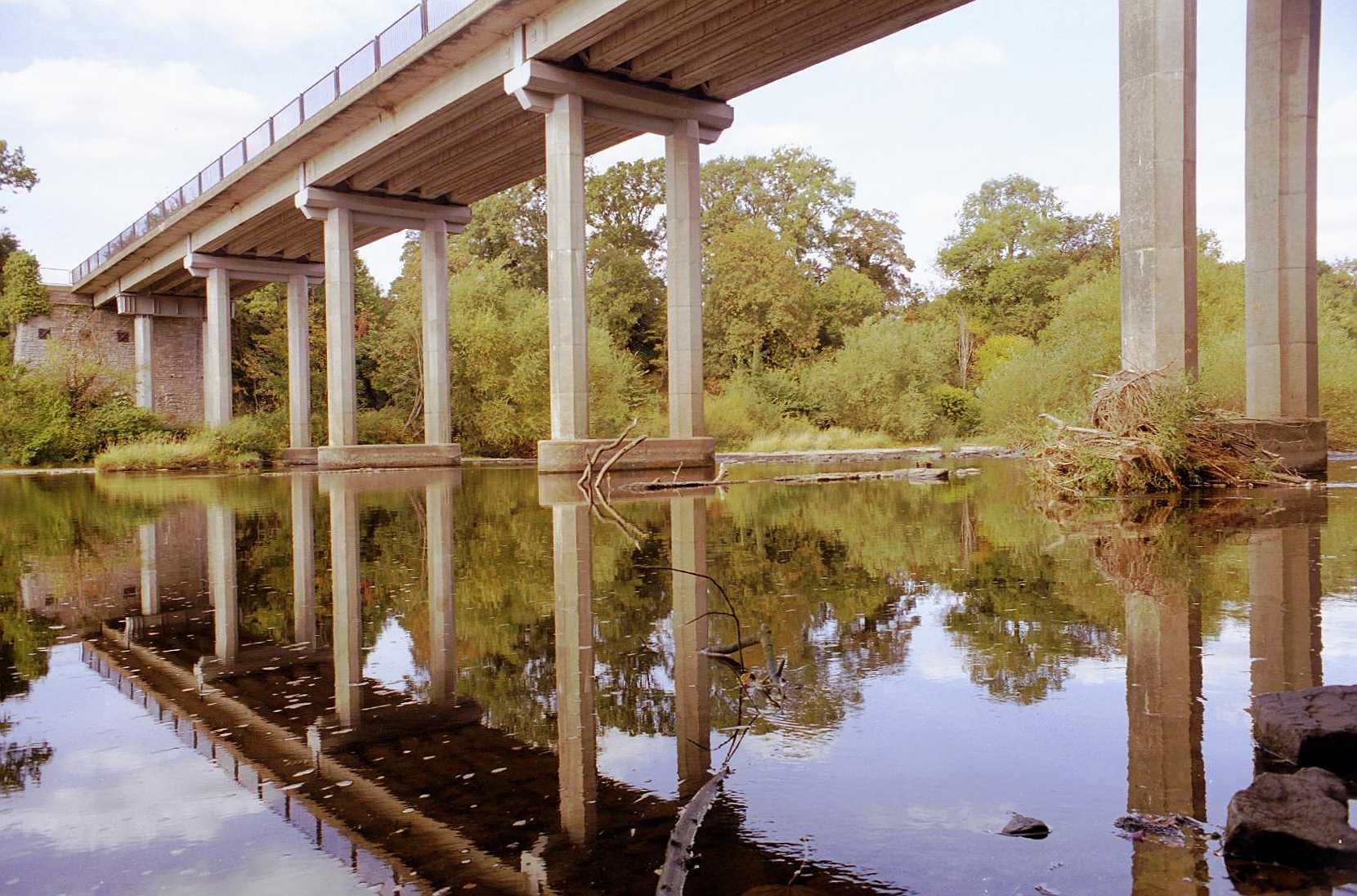
Shallows below the bridge.
Good public access on right bank 50 yards below the bridge. The campsite has no river access but is about 300 yds from the left bank below the bridge. Mr & Mrs Davies. Tel 01497 820780
- 10.25 miles – Whitney toll bridge. I love toll bridges. Imagine the environmental benefit if all roads were toll roads!
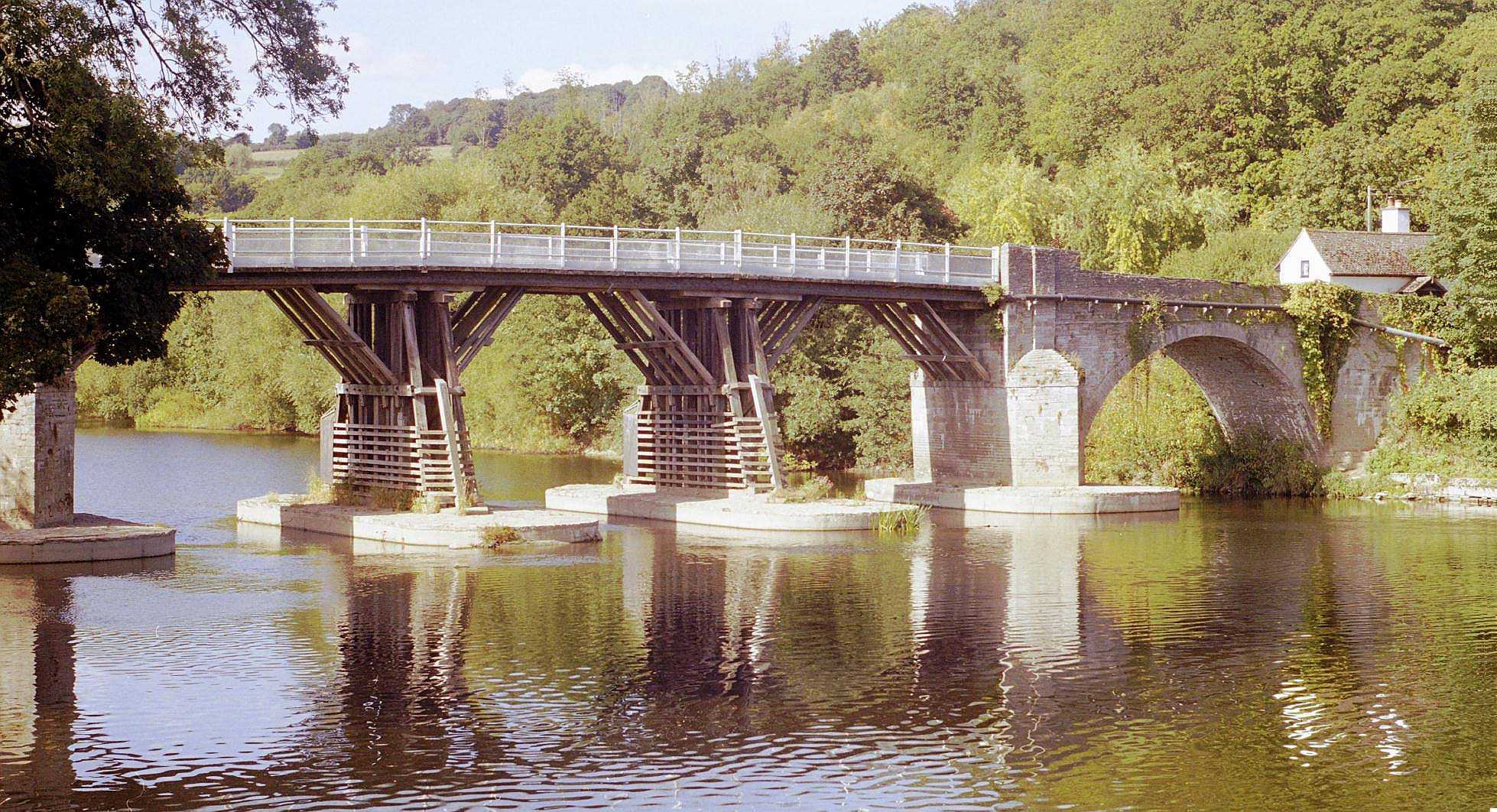
- 10.5 miles – Boat inn left. Camping
- 12 miles – Lockster’s pool. Camping right
- 16 miles – Turner’s boat. Camping.
- 19.5 miles – Bredwardine.
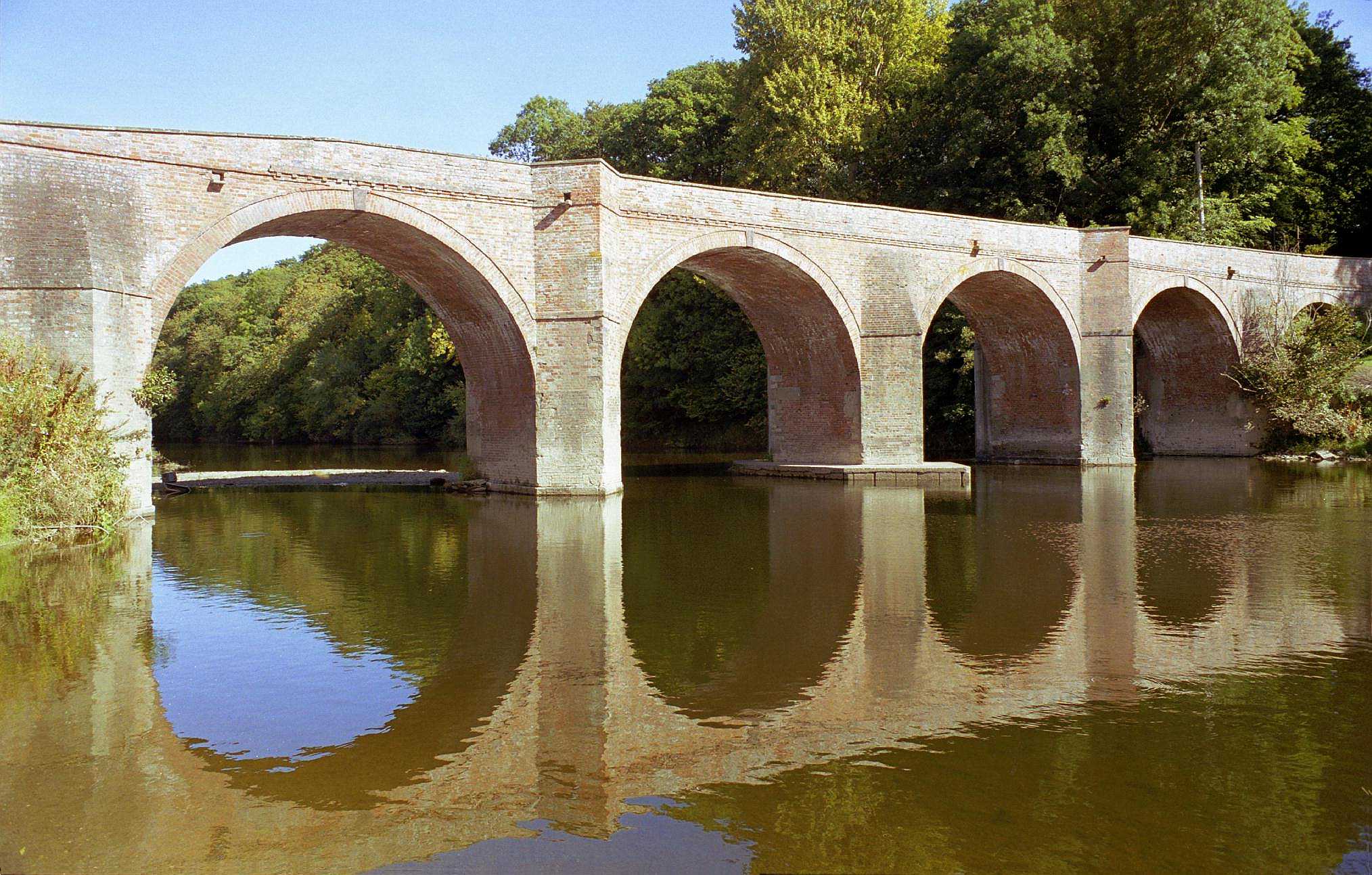
- 20.5 miles – Brobury scar
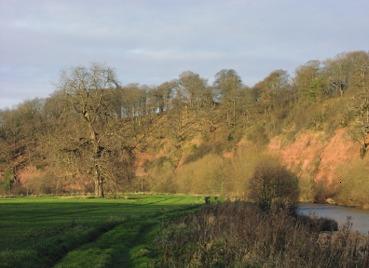
- 21.5 miles – Moccas Court right bank
- 22.5 miles – Byecross campsite right bank
- 22.75 miles – Monnington falls

- 23.5 miles – Preston
Half a mile below the falls on the right bank. Campsite basic, just a tap, and a Portaloo from April-Oct, but great site (like Locksters Pool) if you like peace and quiet. Open fire allowed so long as you only use driftwood. Pub.
NOTE Unless you are prepared to camp on an island or to use the Hereford Racecourse site, which is well back from the river, the next campsite is 20 miles downstream at Holme Lacey.
- 23.75 miles – Byford
- 28 miles – Weir gardens
- 33 miles – Hunderton railway bridge, now a footbridge
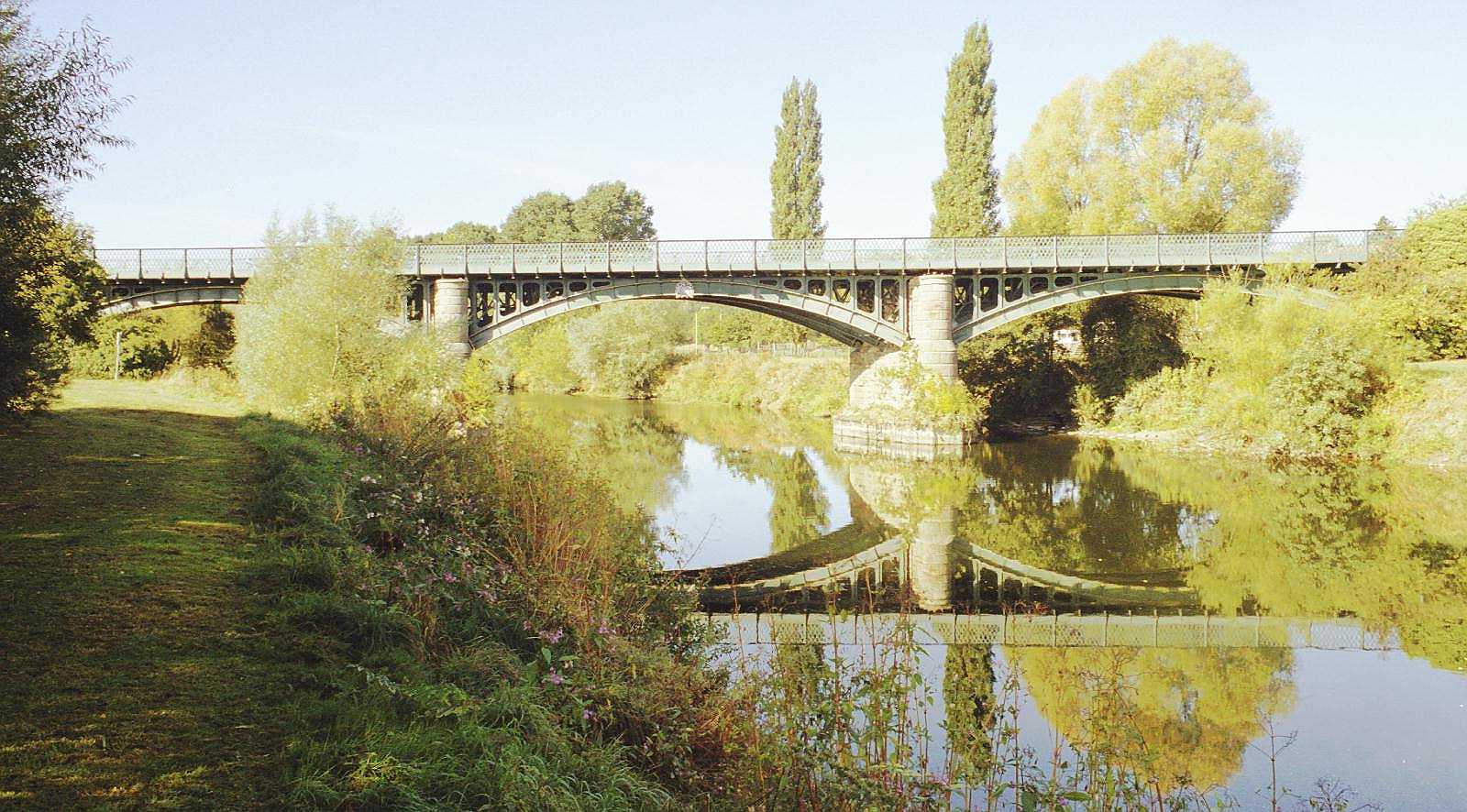
- 33.75 miles – Hereford
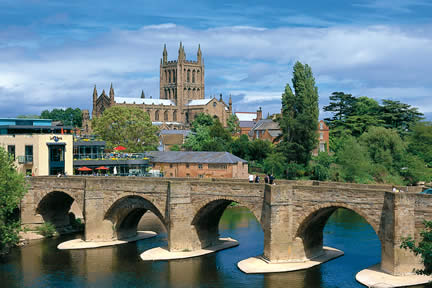
Land right below the old road bridge. This is a public park with plenty of pay and display car parks. No permission required to land or launch but the nearest camping is at Hereford Race Course two miles from the river on the other side of town. Open April to September. Tel 01432 272634
Colin Wilkinson reports “Hereford Rowing club allow camping in their field, best to call first. You get use of their showers, pay at the bar, though they’re not sure of the price, we were charged £5 per head, the next couple £5 per tent. Excellent, as very close to town”.
Headquarters of Bulmers cider. Market demand is leading the world’s largest cider company to promote organic cider and to encourage local apple farmers to change to organic methods
- 34.5 miles – railway bridge
- 35 miles – Bartonsham sewage outfall
In 1988 this treatment works run by the Welsh Water Authority was the subject of questions in Parliament for failing pollution standards. Since privatisation it has been substantially upgraded and effluent quality has improved.
- 37 miles – Wye invader
- The river cuts into the St Maughans formation of old red sandstone at two sharp left hand bends under cliffs at 40 and 41 miles. Holme Lacy village lies at the top of the latter cliff. Between the two bends the river has recently moved but the old cliffs mark its old course

- 42 miles – confluence with river Lugg
- 42.5 miles – Holme Lacey bridge

- 51 miles – Hoarwithy

Two campsites here. Tresseck farm reopened in 2003. Landing steps on right below the bridge. Portaloos. Open fires allowed with driftwood. Click here for their wonderful website with fine pictures of the river access. A grand site.
Mr. Jenkins 400 yards below the bridge on the left is another super site but a longer walk into the village. To reach the village directly land on the right immediately below the bridge. It’s rather steep. ¼ mile to Hoarwithy.
The New Harp Inn is a wonderful friendly pub. In 2003 the landlord let us camp for nothing so long as we drank his beer
- 57 miles – Hole in the wall
- 61 miles – road bridge
- 61.25 miles rowing club left
You can usually camp here, but do ask first. They’ll make a small charge if they remember what it is!
- 61.75 miles – Ross on Wye
- 62 miles – Wilton bridge
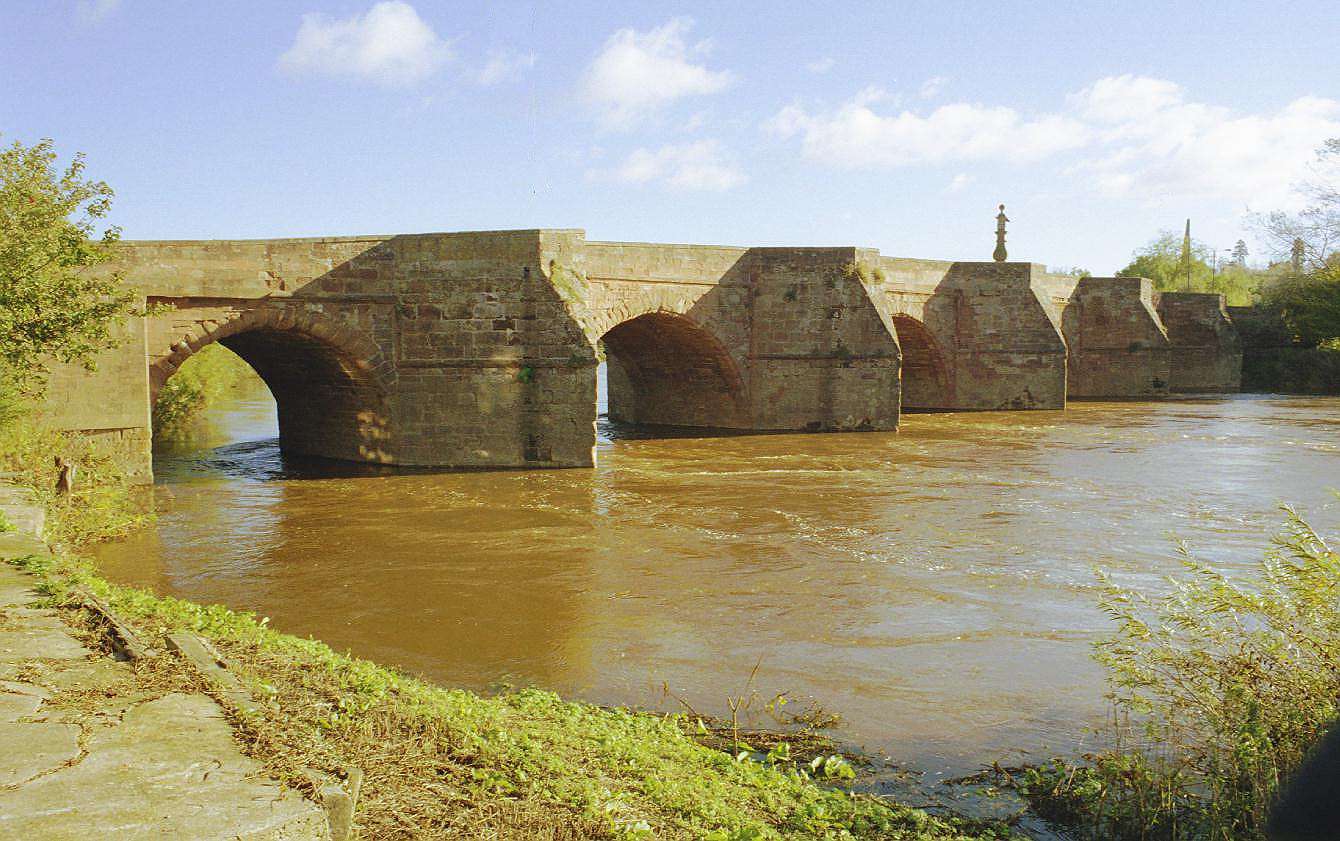
It replaced an earlier wooden bridge. as well as at least one ferry. There was also a ford on the same site. It was originally a toll bridge. 🙂 In my humble opinion the next stretch of river, Ross to Tintern, is the finest stretch of canoe touring in the world.
- 67.2 miles – Goodrich castle

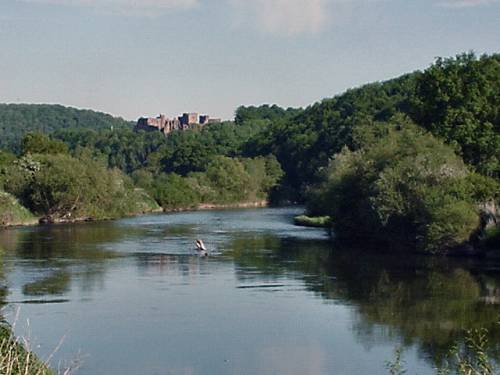

- 67.5 miles – Kerne bridge. Don’t try landing at the bridge.

About here the river starts to cut a deep gorge, first into the harder upper red sandstone and after a short distance into the carboniferous limestone of the forest of Dean.
- 69 .5 miles – Lower Lydbrook
Picnic site and car park on left bank just above the rapids. W.C. Pub. Honesty box, but landing has not been allowed here since Oct 2006
- 70 miles – Welsh Bicknor


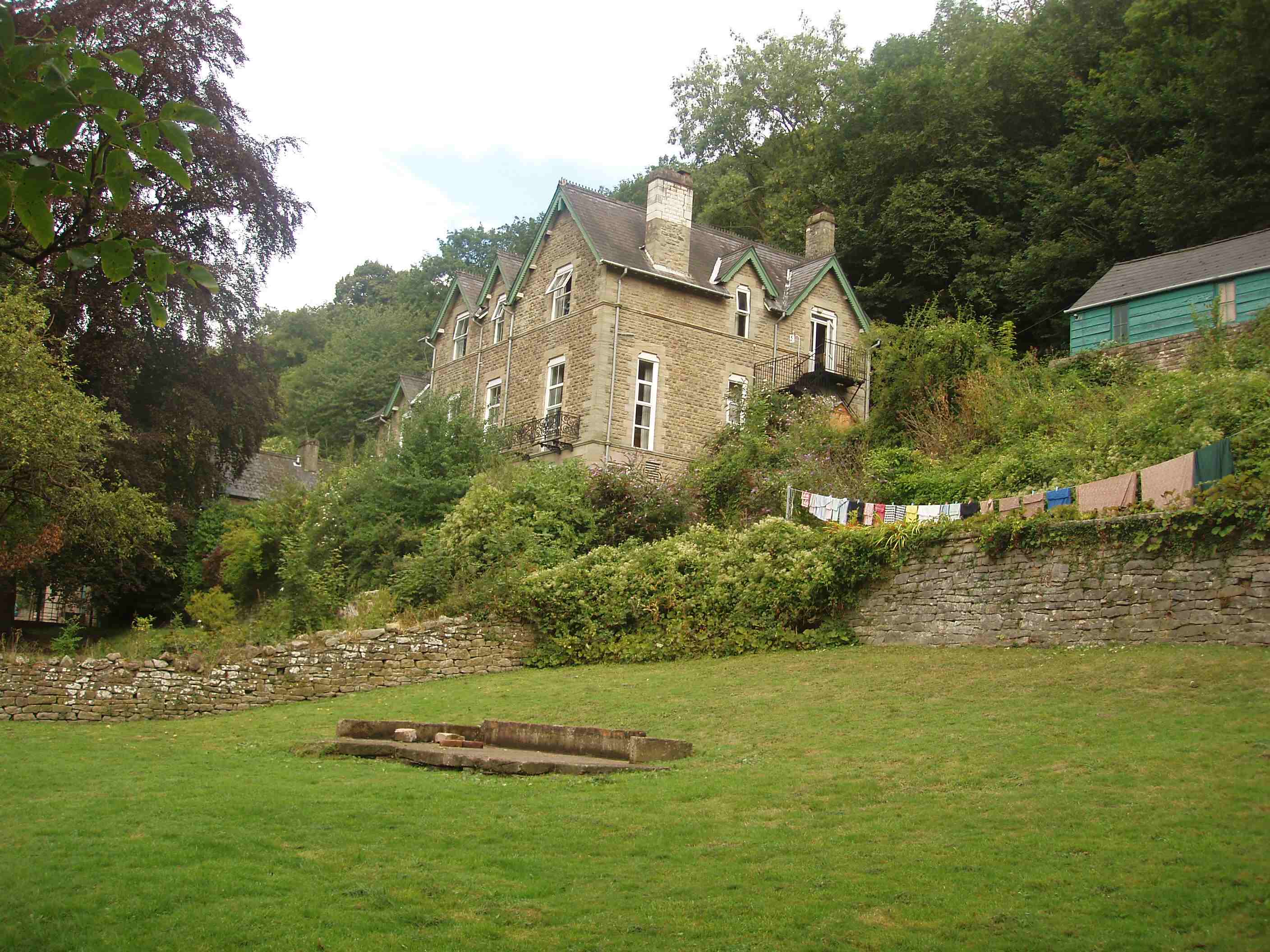


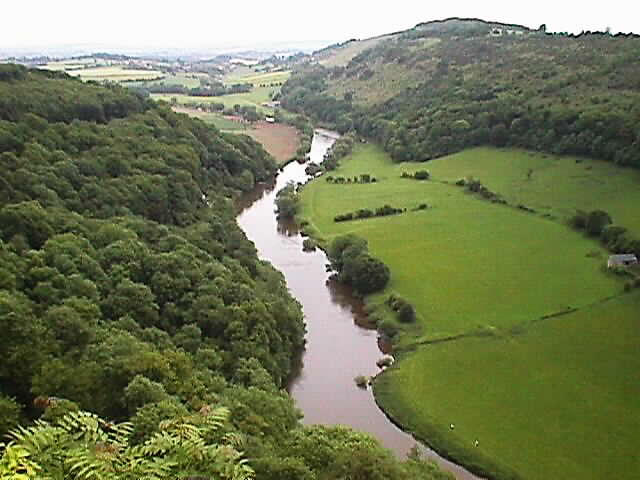
- 74 miles – Huntsman’s bridge. Access right.

- 75.5 miles – Symonds Yat West
Pick-up/Drop-off point (fee). Pub. W.C. Camp/Caravan Site. Good site. All facilities, but often fully booked and they may not take single night bookings in summer. March to October.
A garish funfair, some sort of children’s maze, and motor boats plying tourists up and down the river rather spoil the splendid natural beauty of Symonds Yat for me. I don’t think we can blame the government for the funfair or the motor boats directly, although the maze is Lottery funded
- 76 miles – Symonds Yat East
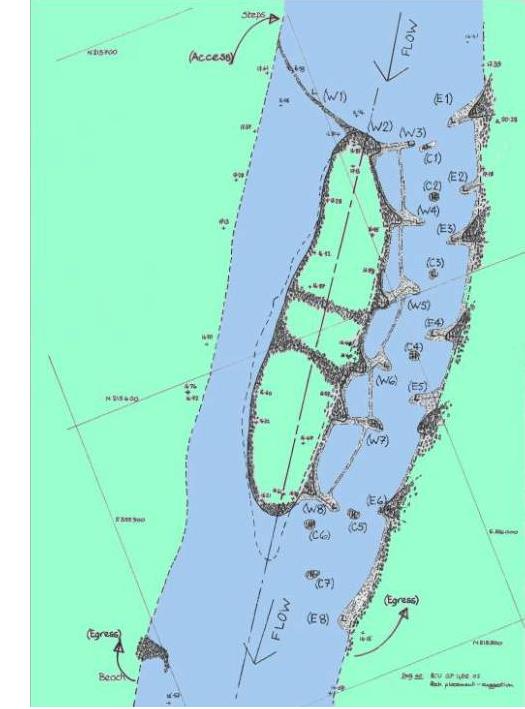
- 76 miles – Symonds Yat rapids
The British Canoe Union (BCU) bought this stretch of river in 2003 for £125,000 and put rocks and other obstructions in the river to create a slalom course. They said that otherwise the rapids would have disappeared. The taxpayer (the Environment Agency) contributed £50,000 :(.
I have mixed feelings about the whole thing. One part of me wants the river left as nature intended. Another says that if people are prepared to pay for artificial rapids, who am I to stop them. I even discovered that I had contributed to the original campaign to buy the rapids! Keeping hundreds of canoeists bunched up in the 100 yard stretch probably improves the experience for tourers elsewhere.

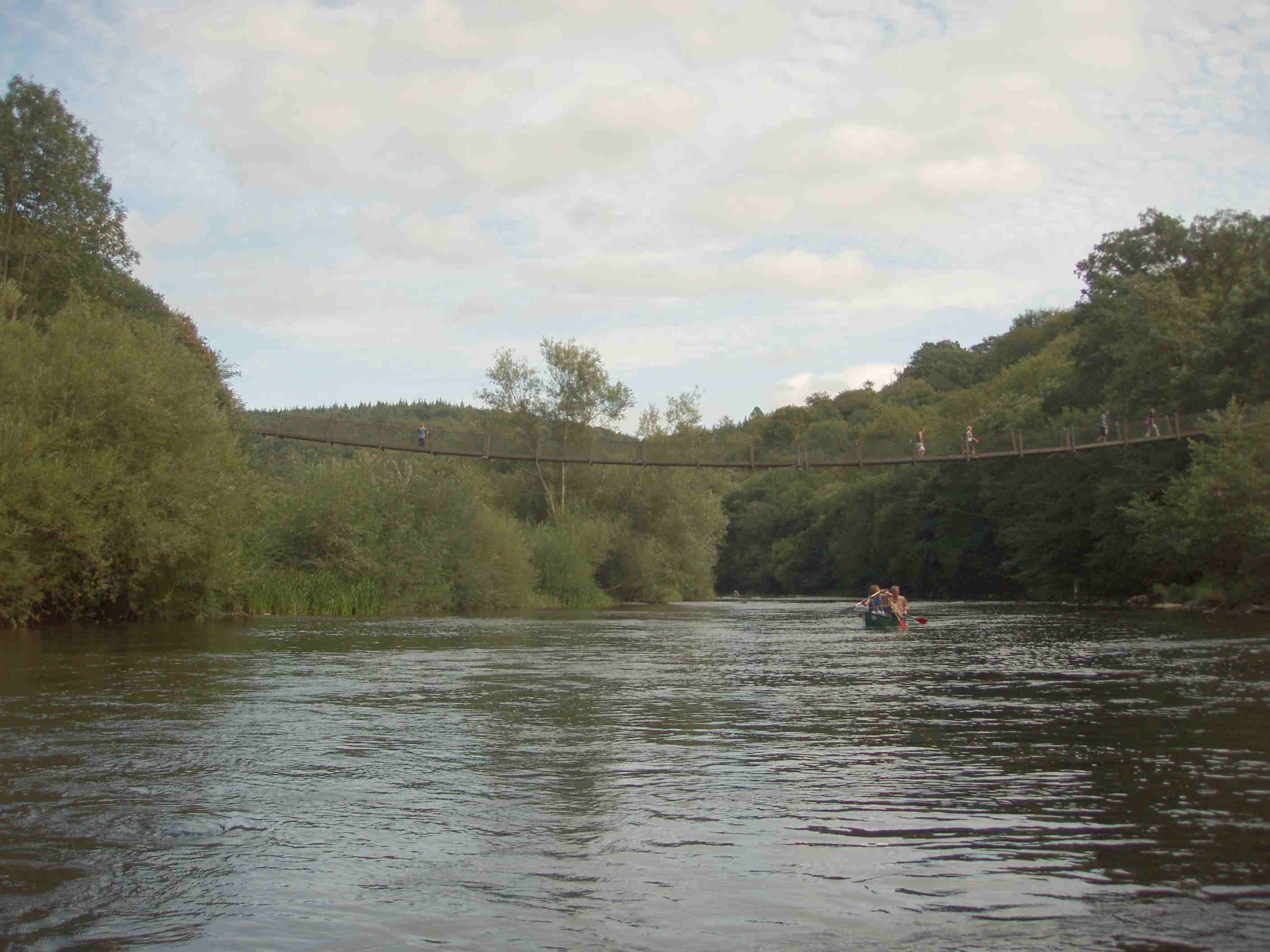
- 77 miles – Biblins campsite and footbridge. Adventure centre site geared to youth groups. It’s not really suited to family campers.
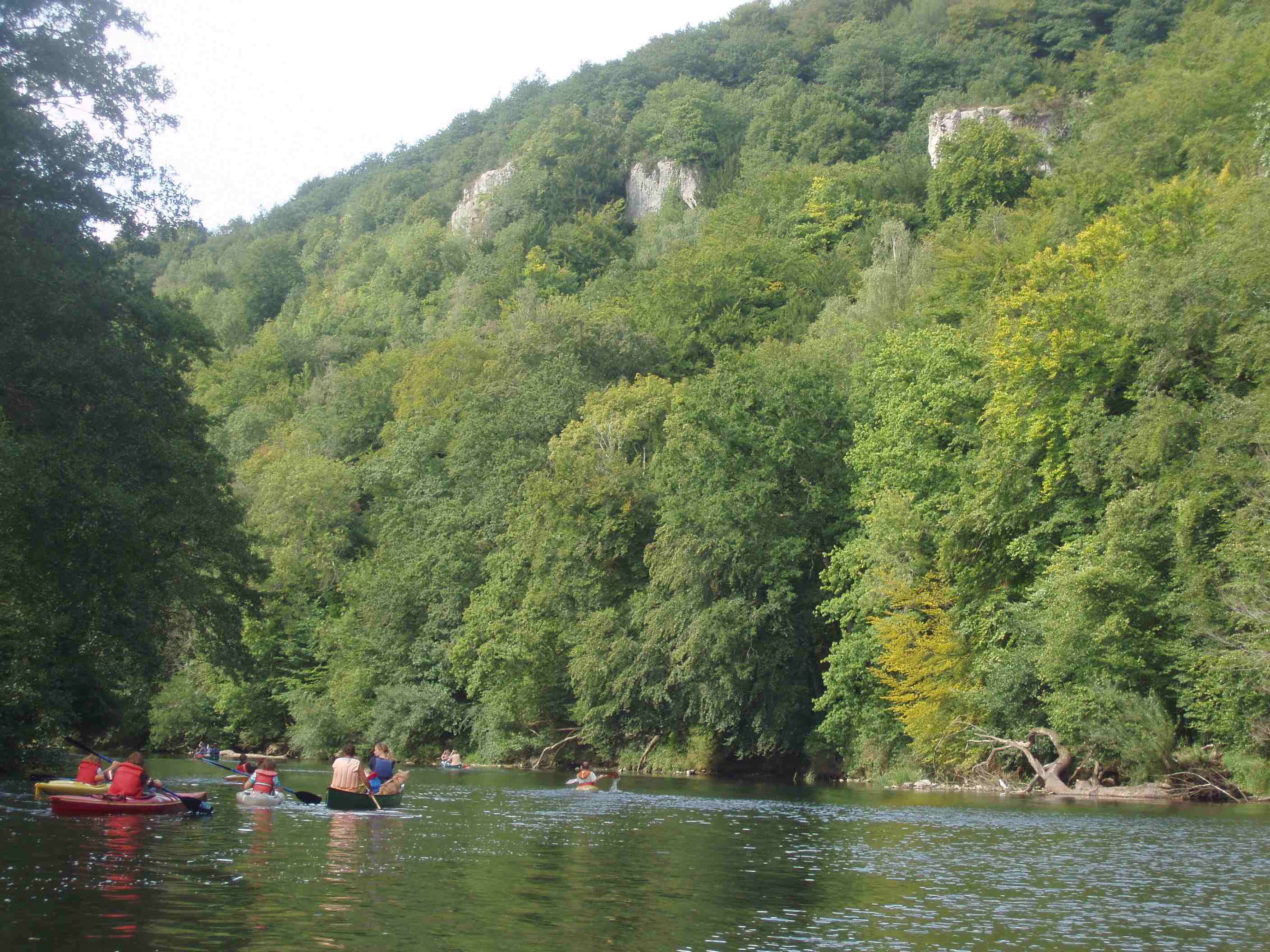
- 79 miles – Seven sisters rocks right. The river is now cutting through carboniferous limestone.
- 82 miles – Wye bridge, Monmouth

Excellent access adjacent to the rowing club on the right before the Wye bridge. Car park. Don’t attempt to land at the Monmouth school rowing club on the left back just above the bridge – they are not welcoming. Camp site on bank of river Monnow at Monnow Bridge.
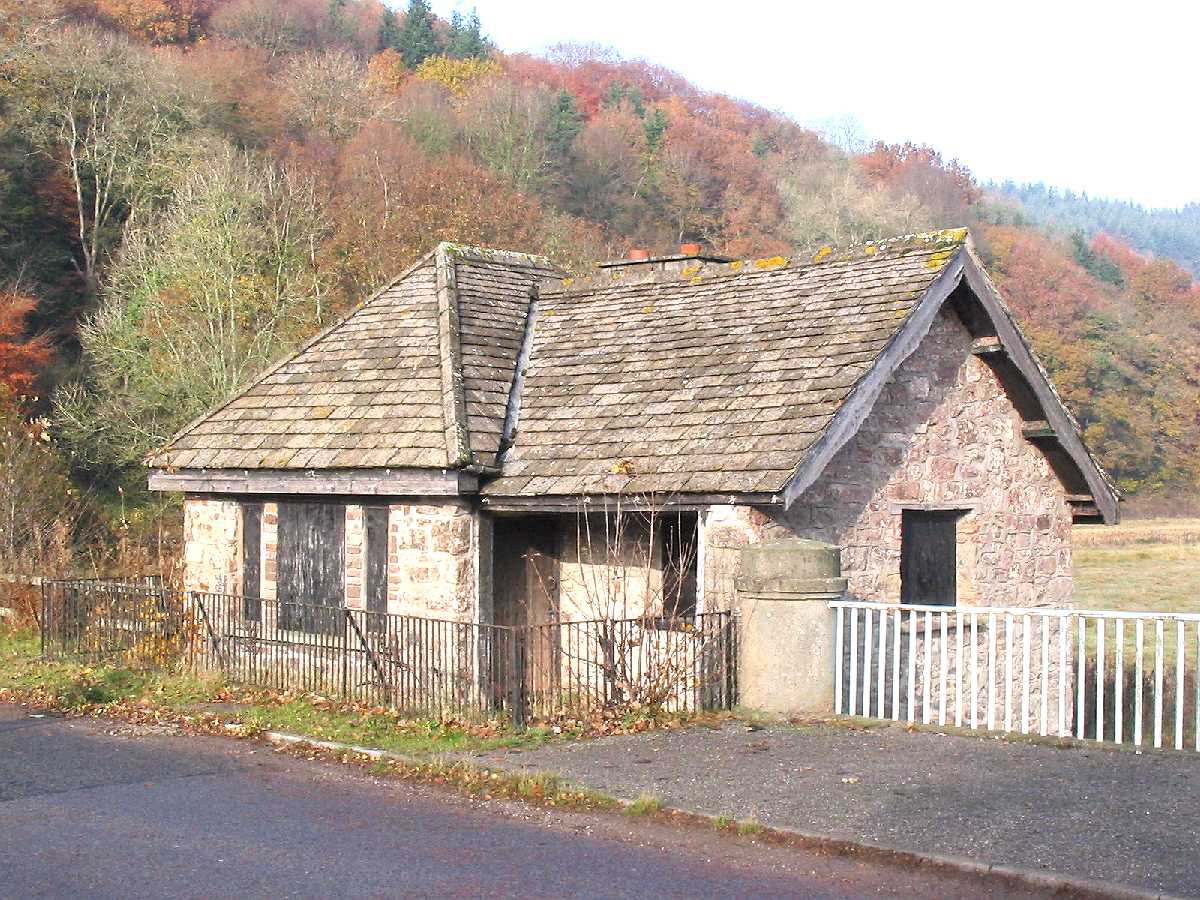
- Bigsweir bridge A466. Originally a toll bridge. Here’s the old toll house.

- 91.5 mile – Brockweir bridge. Land left just upstream of bridge. Beyond here the river is tidal and muddy. Experts only.
- 93.5 miles – Tintern bridge and Abbey. Land right, just before the abbey and car park, in front of small houses. Easy to miss, muddy, slippery steps and metal platform to pull boats up on. Free parking and easy access for pick-up vehicles, lovely public loos nearby, tea rooms further up village.
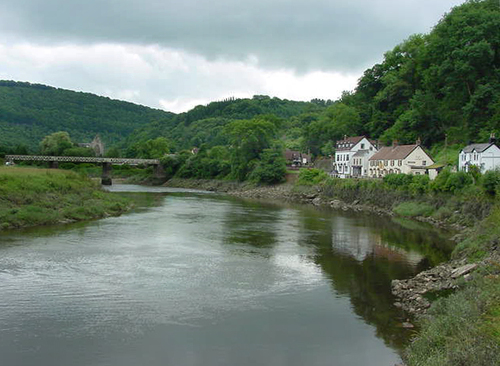
- 100 miles – Chepstow. Landing point. Car park (fee). Camp site 2 miles from river: Mrs M. Cracknell, Beeches Farm, Tel 01291 689257
The Rio Tinto mines
Near Huelva in south west Spain
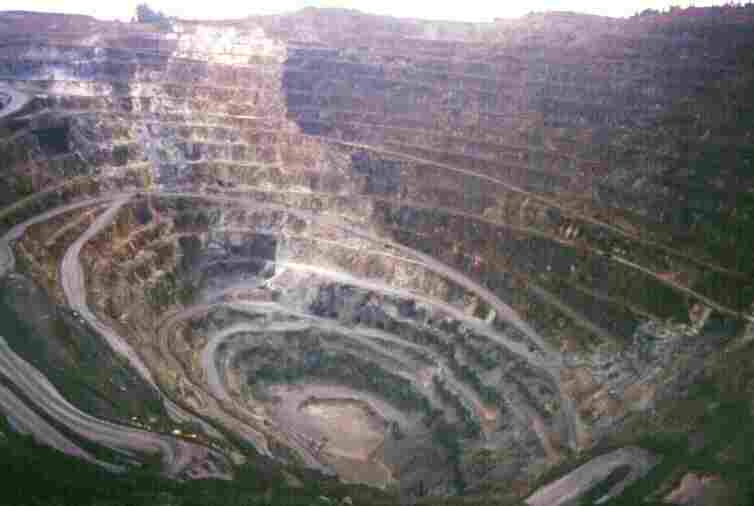
Few places have been so thoroughly devastated by industrialisation as this. Villages destroyed, holes dug 1000 feet deep, and whole mountains blasted away, leaving mineral-rich rock faces with rivulets of rust streaming into the red river.
But it is also inspiring. Thousands of men have struggled here since Roman times to dig the minerals on which civilization was built. Many died, but some became rich, invested their profits in better machines and dug bigger mines. As much as any scientist, and more than any general, they built the foundations of our present prosperity. The marks of their industry are all around.

The village of Minas de Riotinto was built by the Rio Tinto mining company in the early 20th century to house some of the workers from the village of the same name that they were about to destroy.
- Visit the Mining Museum, (Museo Minero y Ferroviaro) located in the former British hospital, Plaza del Museo s/n 21660 to get your bearings.
- Cross the road to the Barrio de Bella Vista, or the English colony. A Victorian housing estate with its won mock Gothic church, village green and social club.
- Travel on the tourist train from the Centro de Recepcion del Ferrocarril along the banks of the Rio Tinto itself. The line was built at the end of the 19th century to carry iron to Helva for export to Britain and the rest of the world.
Geology
Rio Tinto lies on the huge Spanish/Portuguese pyrite belt which runs for about 230 km between Seville and the Atlantic. Formed by seabed volcanic activity in the lower carboniferous era about 320 million years ago, it contained about 1.7 billion tons of ore before humans started mining it.
Within the belt are eight giant mining areas, each with more than 100 Million tons of ore, Rio Tinto, Aznalcollar-Los Frailes, Sotiel-Migollas, Tharsis, La Zarza, Masa Valverde, Aljustrel and Neves Corvo, and many smaller ore bodies.
The Rio Tinto area is the largest and most spectacular, but environmentalists will also want to visit Aznalcollar, the site of a terrible pollution accident in 1998 when a failure of the Los Frailes tailings dam spilled toxic slurry into the Guadiamar river and threatened Donana National park.
Within the Rio Tinto mining area are five main ore bodies the San Dionisio, the south lode, the planes-San Antonio, the north lode and the Cerro Colorado. They are believed to have once been a single, continuous stratum of ore 5 km long by 750m wide and about 40 meters thick, containing half a billion tons of ore. Before man came along natural erosion had whittled that down to about 250 million tons.
The following are some of the biggest holes in the ground.
- Corta Pena de Hierro (“iron mountain”). One of the oldest mines in the area, going right back to Phoenician times. A special tourist bus runs most days from the Minas de RioTinto museum. The well springs here are the source of the Rio Tinto river. It gets in the news occasionally because scientists from NASA are drilling in the area in the hope of learning about early life forms, the MARTE project.

- Cerro Colerado the second largest

- Corta Atalaya the biggest of all.
José Alencar Gomes da Silva
In 2002 it was election time in Brazil, and Luiz Inácio “Lula” da Silva, a left-wing union firebrand, looked like he might win. The poor dreamed of land reform and communism, the rich had nightmares about the same things, and the outside world looked on anxiously. Leftist movements generally end in tears in South America. Would this be the next Chile or Venezuela?
But Lula took a businessman, José Alencar Gomes da Silva, as his running mate, reassuring the middle classes, and the pair of them won two elections before peacefully handing over power in a free and fair one last year. Lula is now feted everywhere as the architect of Brazil’s steady growth, reduced debt, increased employment and social liberalisation, but he owed much of his success to Alencar.
Alencar, like Lula, was born in rural poverty, and created his company Coteminas (a huge textile and clothing conglomerate) from nothing. By all accounts he was a good boss. He made a fortune and spent it running for election. His first attempt was unsuccessful, but in 1998 he got in as a senator for the centre-right Liberal Party, and turned out to be a skilled and popular politician — so popular, in fact, that Lula invited him to balance the ticket. Alencar didn’t need asking twice. He deserted the Liberals for Lula’s Workers Party, and together they led two almost miraculously successful governments. Alencar’s role was to keep Lula economically sane, the middle classes onside, and troubleshoot whenever one of his colleagues imploded. During one crisis, and over his protestations that he knew nothing about the military, Lula made him defence minister. He made a decent fist of the job for two years before a reliable replacement could be found.
Although his health and love life caused trouble from the start, he made them both an electoral asset. In 1997 he underwent his first operation for a slow-growing (albeit eventually fatal) abdominal sarcoma. Over the next 14 years, with 16 further operations (as well as trips to the US for experimental chemotherapy), the public took him to their hearts, not just for the brave fight but for paying the doctors’ bills himself! Apparently most Brazilian politicians stick ’em to the taxpayer.
During his 2002 campaign, a woman called Rosemary de Morais popped up, claiming to be the unacknowledged love child of Alencar and a nurse named Tita. She produced a fair bit of evidence that he had been Tita’s lover in 1954, the year Rosemary was born, but he denied paternity, ungallantly claiming that Tita must have been bonking someone else. The lawyers had a field day, but in South America it does no harm to get into a bit of that sort of trouble, and Alencar managed to float serenely above the scandal. The case rumbled on until July 2010 when a judge ruled that Rosemary was Alencar’s daughter, on the basis that refusing to give a DNA sample proved his guilt. His lawyers were just rolling up their sleeves to appeal when Alencar inconveniently died. We can only speculate whether the decision to cremate him quickly was a final effort to keep his DNA out of Rosemary’s hands.
Here’s Alencar’s poem:
José Alencar earned his stash
From making women’s clothes.
He spent it getting elected,
But it took him two goes.
When Lula tapped him
To be Vice Presidente
He joined the Workers Party
And kept Brazil solvente
The people loved him for bravely fighting
The cancer that was killing him
The doctors kept on operating
But never let up billing him.
His lover’s child sued him
For deserting her mother
But he refused a sample.
So was he the father?
Straight after the funeral
They turned him to ash
To stop her from grabbing
The remains of the cash.
— Jim Thornton
Nottingham, April 2011
Reprinted from AO Deadpool
Elizabeth Taylor
From child star, to collector of husbands and diamonds, Elizabeth Taylor was high maintenance. In 1963 it took a record $1M to persuade her to take her most famous role, Cleopatra. She got husband number five, Richard Burton, but the cost overruns and resulting flop nearly bankrupted 20th Century Fox.
Burton found her expensive too. Her engagement ring, featuring the 33-carat Krupp diamond, was followed by gifts of no fewer than three other diamonds big enough to be given a name: the La Peregrina Pearl, the Taj-Mahal and (eventually) the biggest of them all, the £1M, 69-carat Cartier (later Burton-Taylor) diamond. He shouldn’t have been surprised; she had form. She’d pulled in a £500,000 divorce settlement from husband No. 1, Hilton heir Conrad Jr.
Michael Todd (No. 3), and his best friend Eddie Fisher (No. 4) had also both done their best to keep her happy with big rocks; Fisher later complained that a £50,000 diamond kept her sweet for only about four days.
The problem, as Burton saw it, was she had been too famous too young, and a spoiled brat ever since. He had a point. Wholesome good looks and a winning manner had made the child star. As an adult, the looks got less wholesome, and pulled in seven husbands, but she skipped the winning manner, which led to eight divorces. Her performance in Cleopatra was dire, and her illnesses kept costing other people fortunes. When later in life she put on weight and developed back trouble and an alcohol problem, few had much sympathy for her.
But that was unfair. Plenty of people drink too much and get fat, and the back troubles allegedly stemmed from a fall during shooting of National Velvet, the film which had made her famous, about a kid who rides the winner of the Grand National. And she wasn’t a bad actress. Although her first Oscar, for playing a whore in Butterfield 8, was by common consent won by the sympathy vote — Michael Todd had been killed in a plane crash the previous year — her second, for Who’s Afraid of Virginia Woolf?, opposite Burton, was well deserved.
In three of her best films (Cat on a Hot Tin Roof, Suddenly Last Summer and Reflections in a Golden Eye) she played women married to men with sexual secrets. Eight marriages to seven men must teach you a bit about male sexuality. She probably learned a bit from the male friends she didn’t marry, too. Nearly all were gay.
After the death of one of them, Rock Hudson, she supported many gay causes, even selling her diamonds for some. She managed to get her penultimate husband, John Warner, a Virginia politician, not only elected to the U.S. Senate, but to make him one of the most socially liberal Republicans to ever come out of the South. It was no surprise that she stood by her friend Michael Jackson as he faced his child-abuse accusations.
Through it all her fame kept growing. Hobnobbing with royalty one day, and picking up husband No. 7, a lorry driver named Larry Fortensky in rehab the next, she rose far beyond normal celebrity. By her death, Andy Warhol’s iconic silkscreen prints of her had become as valuable as those of Marilyn Monroe. She outlived all but her last two husbands, and even her New York Times obituarist — but not me, and not you.
Elizabeth Taylor had a bad back
Maybe she spent too long on it.
But seven men married her
She must have been good on it.
Some gave her money
And some gave her ice.
Burton did both
And married her twice.
Andy Warhol, Rock Hudson
They both got away,
Despite painting and dating her,
Because they were gay.
As she got fat
And ran out of rich husbands,
She supported her charities
By selling her diamonds.
Who cares now how spoilt
She was, for most of her life?
If you’re not J Warner or L Fortensky
Just thank the Lord, she wasn’t your wife!
— Jim Thornton
Nottingham, March 2011
Reprinted from AO Deadpool
Beryl Bainbridge
English novelist, died 2 July 2010 aged 77 or 78.
When she caught her husband having an affair, Beryl Bainbridge divorced him and started writing. But no-one wanted to publish her, and they still got on, so she let him back. Second time round she made him live in the basement and pay rent, but then she misbehaved, and he moved out for good. Sometime later his mother turned up at the door and tried to shoot her. Her life remained famously chaotic – single mother of three children, she never remarried, but had loads of affairs, mainly with hopeless married men, until she eventually “gave up sex at 60”. It all went in the novels.
Born in Liverpool in 1933 or 4, (sources disagree but it won’t affect her Deadpool points) to a bankrupt salesman and resentful mother, life was grim for the child, but great for the novelist. A short career as an actress – in the 1960s she had a minor role in the TV soap Coronation Street, and factory jobs – most famously in a bottling plant, provided more material for the black comedies. Once she got going, they came almost annually – The Dressmaker (1973), The Bottle Factory Outing (1974), Sweet William (1975), A Quiet Life (1976), An Awfully Big Adventure (1989).
Later she turned to fictionalised historical events Young Adolf (1978) about Hitler’s trip to Liverpool, Watson’s Apology (1984) about a vicar who murdered his wife, The Birthday Boys (1991) about Scott of the Antarctic, According to Queeney (2001) about Dr Johnson, Every Man for Himself (1996) about the Titanic, and Master Georgie (1998) about the Crimean War. At her death, she was writing The Girl in the Polka-Dot Dress, about the assassination of Bobby Kennedy.
Although at least four novels were made into films – Hugh Grant starred in An Awfully Big Adventure – and she was shortlisted for the Booker Prize five times, she never won. All the more reason to read her. Missing out on fancy literary prizes is usually a good sign, and her novels were short, sad, dirty and funny. She smoked and drank heavily, and breast cancer eventually got her. But at least today, let’s do what she would have done – stick up two fingers to the health police, light a fag, open a novel, and raise a glass. If you’re under 60, and can find a willing partner, have a shag in her memory too.
Beryl Bainbridge wrote about sex
And death and destruction,
But still made us laugh
About Dr Johnson
She saw the funny side
Of murder and war.
She once dodged a bullet
From her mother-in-law
She loved a lot of men
And wrote about Sweet William
But she ended up single
And gave up fornication.
Some people just thought
She did a bit of acting
In Coronation Street,
And wrote about bottling.
So, although her books were short,
And funny and wise,
Perhaps that’s why
They never gave her the prize
Jim Thornton, Nottingham. 3 July 2010
Reprinted from AO Deadpool
Algirdas Brazauskas
Take care what you ask Amelia. After fun with bad Beryl Bainbridge, I asked for more, so she gave me an old commie bird, dead six days before — she must have been struggling to shift him. Lymphatic cancer pushed him off the perch and now I’ve got to write about him.
December 20th 1989 was Algirdas Brazauskas’ big day. As leader of the Lithuanian Communists he broke away from Moscow, and four months later the whole country declared independence. Gorbachev imposed an economic blockade, huffed and puffed for a year, and finally attempted a military coup. But plucky Lithuania struggled on until August 1991, when Gorbachev faced his own coup, Yeltsin clambered onto his tank, and the USSR broke up.
It all seems inevitable now but was hardly guaranteed — ask the students in Tiananmen Square. Sure, the Berlin Wall had fallen the previous month, and it was widely assumed that Poland, Hungary and Czechoslovakia might gain independence, but Lithuania and the Baltic States were much deeper within the Soviet sphere. Brazauskas could well have ended up in a Moscow dock. But he didn’t, and after many twists and turns ended his last term as the democratically elected prime minister of independent Lithuania in 2006.
What else can I tell you? He’d led communist Lithuania since 1977, when Brezhnev was president. His enemies called him unprincipled, his friends said he was flexible and sensitive to changing moods. Whatever, he was a wily old career politician — “When Brazauskas goes to a village, he not only remembers the names of the farmers but also the names of his cows.” He had two wives and, by some accounts, plenty of girlfriends, and in 2003 he joined the order of Vytautas the Great with the Golden Chain, Lithuania’s highest honour. Don’t ask.
— Jim Thornton
Reprinted from AO Deadpool 2010
 Ripe-tomato.org