Noel Whittall
Forgotten Fragments of History # 1
Nearly ten years ago I posted The Dictator and his Wife, by the Yorkshire poet, Noel Whittall, on my iGreens website – it’s still there. Here’s the first appearance on ripe-tomato.org, of his sideways take on serious matters.
The piano was never an effective engine of war,
those tiny wheels allowing little manoeuvrability
on the battlefield.
Eventually the arrival of the tank put an end
to any military aspirations it may have harboured.
However, in its musical role the piano
continued to give sterling service in saloon bars
through peace and war
right up to the adoption of the juke box
as the entertainment weapon of choice.
Noel Whittall
More of his poems are available in Curriculum 4 Leeds Poets, published by White Line Press, 1A Headingley Mount. Leeds. LS6 3EL
Green Oranges on Lion Mountain
By Emily Joy

Em, a lightly fictionalised youngish doctor from York (pen name of Dr Gail Haddock, a Scottish GP) wants to save the world, save lives and save her soul. And find herself a man. She goes to work for VSO (Voluntary Service Overseas) in Sierra Leone. Step one – mug up Maurice King’s Primary Surgery. When Dr Haddock learned I was distributing Maurice’s Primary Mother Care (details here) she sent me a copy of her lovely memoir Green Oranges on Lion Mountain. Here’s my review.
Em arrives in Serabu Catholic Mission Hospital, a plump, pampered, agnostic westerner, who has failed to learn to operate. The diminutive but intimidating Sister Ignatius, a. k. a. Margaret Thatcher, and the gentle Dr Philippe, “On y va”, knock her into shape. The first half tells of the typical triumphs and disasters of a naive volunteer in Africa – advanced disease, servant problems, operating way beyond your level of competence. Some fistulas close, bones heal and grafts take, but often they don’t. Mothers and children die, and some wounds never heal.
Her predecessor has gone into public health on the grounds that you can do more good there, and soon Em, like so many before her, wonders how much she is really helping. Unused electric birthing chairs donated by well meaning charities, and smuggling condoms past the Catholic authorities, sap the will. Em is good on her own self doubts and on the real heroes, the stoical patients and local staff.
Eventually the Liberian civil war spreads to Sierra Leone and Sister Ignatius shows her mettle facing down the soldiers. Em stays on too, against her better judgement, largely to avoid the embarassment of being the first to leave. She survives, but 50,000 Africans and the missionaries Father Felim MacAllister and Karin, Zietje and Eelco Krijn, killed in nearby Panguma hospital, weren’t so lucky. The book is dedicated to them.
And a man? No joy for Joy in Sierra Leone – she had to return to Scotland to find one of those.
Jim Thornton
Green Oranges on Lion Mountain. Emily Joy. 2004. Eye Books, London. www.eye-books.com
The Warwick Arthroplasty Trial
Good to see orthopaedic surgeons doing randomised trials, but sad to report how quickly they are learning to fudge their trial registry problems.
The Warwick Arthroplasty Trial, comparing hip replacement with resurfacing in young patients, was registered here in 2007, and published in the BMJ here this week. The authors claim no difference in outcomes at one year.
But despite a planned sample size of 172, the published version included only 126 (60 resurfacing; 66 total). There’s no explanation for the difference in the BMJ paper but the full protocol published in 2010 here, reads:
“With an allowance for 10% drop-out, the total number of patients required will be 172. If recruitment proves to be problematic during the course of the trial, then with the agreement of the trial steering committee the target will be lowered and the more usual 80% power level will be considered sufficient. For this scenario, the total number of patients required will be 120 (including 10% for drop-out).”
In principle OK, except that this protocol was published in Jan 2010, the same month the final participant was recruited! I know I’m a suspicious blighter, but had they already decided to stop early and were pretending it was a planned early finish? There is no mention of any of this in the BMJ paper.
Some might argue that since the trial was negative, at least they weren’t stopping because they had peeked at the data and found a positive result. But it does matter, because they are claiming equivalence in the short term, and it’s obvious that many surgeons believe nothing of the sort.
The BMJ correspondence also suggests that they used the wrong endpoints. Apparently both the Harris and Oxford scores have a ceiling effect. You get top marks if you can walk around a shopping mall, and no extra if you can climb Everest or sail solo round Cape Horn! I’ve no idea if this is true, but I do know that if you design a trial to have a reasonable chance of ruling out the minimum worthwhile treatment effect, and give up part way having detected no difference, you have not shown equivalence.
There’s no reason why orthopaedic surgeons should appreciate the importance of all this, but the Warwick Clinical Trials Unit, fully registered with the NIHR should know better.
Funding – Research for Patient Benefit scheme of the National Institute of Health Research. i.e. the government.
Jim Thornton
Saying the opposite
Two Trees by Don Paterson and Ice Cream by Andrew Motion
These poems achieve much by saying the opposite of what they mean. Paterson’s is about everything but trees, and Motion’s everything but ice cream. It’s a powerful trick.
Two Trees
One morning, Don Miguel got out of bed
with one idea rooted in his head:
to graft his orange to his lemon tree.
It took him the whole day to work them free,
lay open their sides, and lash them tight.
For twelve months, from the shame or from the fright
they put forth nothing; but one day there appeared
two lights in the dark leaves. Over the years
the limbs would get themselves so tangled up
each bough looked like it gave a double crop,
and not one kid in the village didn’t know
the magic tree in Miguel’s patio.
The man who bought the house had had no dream
so who can say what dark malicious whim
led him to take his axe and split the bole
along its fused seam, then dig two holes.
And no, they did not die from solitude;
nor did their branches bear a sterile fruit;
nor did their unhealed flanks weep every spring
for those four yards that lost them everything,
as each strained on its shackled root to face
the other’s empty, intricate embrace.
They were trees, and trees don’t weep or ache or shout.
And trees are all this poem is about.
Marvellous.
Andrew Motion is not my favourite poet, for an irrational reason – I don’t think I’d get on with him. We’ve never met and are not likely too – I don’t move in poetry circles. But he’s a public figure, ex poet laureate, so I feel I know him, and he has always seemed too politically correct for comfort. It started with his biography of Larkin, with its patronising attitude to Larkin’s human weaknesses. Martin Amis put it well: “In Andrew Motion’s book, we have the constant sense that Larkin is somehow falling short of the cloudless emotional health enjoyed by, for instance, Andrew Motion.”
But it’s an irrational feeling. The poet Motion still hits the spot, albeit less often than the great man. This does. I just checked and discovered I had misremembered the title. It’s To Whom It May Concern, not Ice Cream. Hmm? It’ll remain “Andrew Motion’s Ice Cream poem about war” to me.
To Whom It May Concern
This poem about ice cream
has nothing to do with government
with riot, with any political scheme
It is a poem about ice cream. You see?
About how you might stroll into a shop
and ask: One Strawberry Split. One Mivvi.
What did I tell you? No one will die.
No licking tongues will melt like candle wax.
This is a poem about ice cream. Do not cry.
It makes me cry.
Jim Thornton
Another one to watch
The first problem is the name. ELITE is not comparing early with late starting of post menopausal hormone therapy (HT*). Rather there are two separate trials, an “early” and a “late” one. Both compare HT with placebo.
Participants in the “early” trial are women within six years of the menopause, and in the “late” one, women more than 10 years after it. Here is the text from the trial registration website here.
“A total of 643 (actual) (504, initially proposed) postmenopausal women were [sic] randomized according to their number of years since menopause, less than 6 years or 10 years or more, to receive either oral 17B-estradiol 1 mg daily or a placebo. Women with a uterus will also use vaginal progesterone gel 4% (or a placebo gel) the last ten days of each month.”
Two trials should have two hypotheses, two primary endpoints and two sample size calculations etc., but this has only one. Here it is.
“The primary hypothesis to be tested is that 17B-estradiol (estrogen) will reduce the progression of early atherosclerosis if initiated soon after menopause when the vascular endothelium (lining of blood vessels) is relatively healthy versus later when the endothelium has lost its responsiveness to estrogen.”
This makes no sense. Hopefully when the trial(s) get(s) analysed the statistician will prevent them comparing the early with the late group, and instead set up a new hypothesis for the “early” trial something like “starting HT soon after the menopause reduces carotid artery intimal thickness, a presumed risk factor for later cardiovascular disease”. The late trial can test a similar hypothesis
The primary outcome is the rate of change of distal common carotid artery (CCA) far wall intima-media thickness (IMT). This is measured twice at baseline and then every 6 months on trial.
This is an ambiguous endpoint since the duration of participation is reported to be between 2 and 5 years. (There is similar ambiguity about the same endpoint in the KEEPS trial. I’m trying to persuade the chief investigator of that study to let me see the protocol/analysis plan to clarify that.)
Although there is not much detail on Clinicaltrials.gov, there is plenty else about the trial on the web. e.g. here.
“In ELITE, Hodis will compare estrogen’s effects in women who are six or fewer years past menopause to its effects in women who are 10 or more years beyond menopause. Out of 504 women who will enroll in the study, half will be randomly assigned to take 17beta-estradiol (a form of estrogen identical to women’s own estrogen) daily, while the rest will take a placebo.”
This is a newspaper article, and I guess the journalist may have misunderstood. But it sounds again like the comparison is going to be between the younger and older women, not between the groups as randomised. Elsewhere the triallists are reported as already believing that the active treatment will work.
Donna Shoupe, professor of obstetrics and gynecology, said … “I think the ELITE study will be a landmark study that will establish the real benefits of estrogen replacement,”
Howard N Hodis was also chief investigator for the Estrogen in the Prevention of Atherosclerosis Trial (EPAT). Registered here in 2005, which would be OK, except that the trial had been published four years earlier here! In that trial 111 women got estradiol and 111 placebo. Twenty one never had a follow-up carotid intimal thickness measure so they ended up comparing the rate of change in intimal thickness between 99 estradiol and 102 placebo women. According to the paper the trial was powered to show a “standardized difference in progression rates between the two treatment groups of 0.40 or greater”.
Here is the graph of what happened. The dotted line is placebo, and the solid estradiol. Low numbers are good.
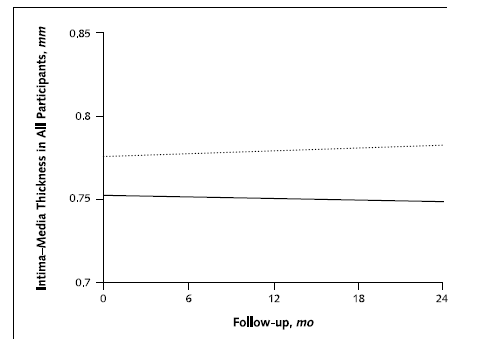
The solid (HT) line is lower but this is just a chance effect. To be more precise the difference on the left at baseline is chance. It is not statistically significant, and nor should it be, because the groups were selected at random. By chance the women randomised to placebo had slightly thicker carotid arteries before they started treatment.
The trial is testing a difference in the slope. It would be good to show a scatter plot of the raw values, or at least error bars on each line, but even without these you don’t need a statistician to tell you the slopes are the same – both essentially level. Any tiny trend at 24 months is much less than the chance difference at the start. But the authors analysed away as follows:
“The top panel of Figure 2 [the figure above] shows the time course of changes in common carotid artery intima–media thickness that was predicted by the mixed-effects model (goodness-of-fit P value = 0.2). In the placebo group, subclinical atherosclerosis progressed by 0.0036 mm/y. In contrast, the estradiol group experienced regression of subclinical atherosclerosis (negative average rate of change in intima–media thickness) at a rate of 0.0017 mm/y. The difference in the average rates of progression between the two treatment groups was 0.0053 mm/y (95% CI, 0.0001 to 0.0105 mm/y) (P = 0.046, and P = 0.045 after adjustment for oophorectomy status).”
But remember what the trial was designed to show – a “standardized difference in progression rates […] of 0.40 or greater”. They observed a difference of 0.0053, so the result is negative. Let’s say it again – a NEGATIVE result.
But who cares? Someone has squeezed the magic P<0.05 out of the data. So the authors’ conclusion, trumpeted in hundreds of HT drug company sponsored articles ever since:
“Overall, the average rate of progression of subclinical atherosclerosis was slower in healthy postmenopausal women taking unopposed ERT with 17b-estradiol than in women taking placebo.”
Perhaps I’m being harsh. Standards of trial reporting were lower in 2001. Let’s hope ELITE will be analysed and reported properly. But if it comes up with a positive result after some fancy statistical contortions, sceptics should look closely.
Jim Thornton
*Hormone replacement therapy (HRT) changed to hormone therapy (HT) Jan 2016
Hand on the Shoulder
Sex and spies
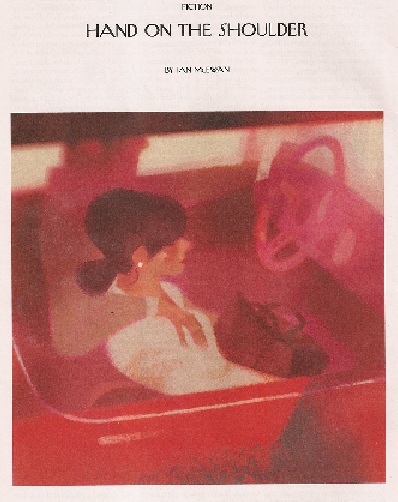
In his short novel Chesil Beach, Ian McEwan detailed the embarrassments of a bad wedding night. In last week’s New Yorker story, Hand on the Shoulder, he tackles the discomfort of a partner’s knobbly pubic bone, the difficulty for a straight woman satisfying a gay man, and the older man’s other problem – forgetfulness.
Once the towel solution is found, the luscious Serena enjoys the repressed and bony Jeremy lasting so long, because she always gets off. But lasting forever is no way to make a girl feel good about herself. So when Jeremy’s tutor Tony puts his hand on her shoulder, not just in the classic seduction move, but to recruit her as a spy, she falls for it.
Soon Jeremy has gone off with his boyfriend and Tony starts her education. Not just in fine wine, fancy food and alfresco sex, but in the great game itself – maintaining the balance between competing great powers. She’s a fast learner, and her sister’s antics with drugs and boys distract her parents from what is going on. But adulterers usually get caught in the end – at least those we hear about do. In this case a memory lapse about the washing of a shirt brings the lovers down.
McEwan presents it straight. Tony does tell her to put the shirt in the laundry basket and appears to really forget doing so. His wife’s discovery and his angry reaction seem real. They certainly fool Serena who realises the game is up. But the timing, just two days before her MI5 interview must be a clue. Has this all been planned? Since this is an excerpt from McEwans’s forthcoming novel Sweet Tooth, I guess we will soon find out.
And the illustration above? Smart young girl in left-hand-drive red sports car, overnight bag on her knee and lover’s arm over her shoulder. Come on New Yorker picture editor! We drive on the other side of the road in Cambridge, England.
Jim Thornton
Memantine and/or donezepil for moderate Alzheimers
Is this cheating?
You would imagine that when the UK Medical Research Council (MRC) funds a multi-million pound trial of a drug to treat Alzheimers disease, and publishes the results in the New England Journal of Medicine, the world’s highest impact medical journal, that things would be done properly. But take a look at the DOMINO trial report last month(NEJM 2012: 366: 893-903) which claims to show that both drugs improve memory and function compared with placebo. Here is a link to the full text although you will need a subscription
The trial was registered here with a planned sample size of 800 (200 per factorial group donezipil+placebo, memantine+placebo, D+M, placebo). But only 295 participants appear in the published trial. The authors give two explanations. The first makes no sense and the second comes near to an admission of cheating.
Their first explanation is that they reduced the sample size to 430 on the basis that half way through they noticed that the standard deviations (SD) of the two primary outcome scores were smaller than predicted. These were the Standardised Mini-Mental State Examination (SMMSE) which ranges from 0-30, where 30 is the best score, and the Bristol Activities of Daily Living Scale (BADLS), range 0-60, where 0 is good. A smaller SD means that a smaller trial would have the same power to detect the pre-defined minimum clinically important difference (MCID) in these outcome scores. Namely 1.4 units on the SMSME scale and 3.5 on the BADL.
But how had the authors got those MCID numbers? They interviewed experts, who said that numbers of 1.4 and 3.5 had no real meaning. So instead they asked the experts to express the MCID in terms of fractions of the score SD. On this basis the MCID was set at 0.4 SD (Howard et al 2010 you’ll need a subsciption for the full text). But reducing the sample size to detect a difference expressed in terms of SD, on the basis that the SD is smaller than expected, is not just circular. It’s bonkers!
But they did not even recruit the new target of 430. They gave up at 295 because “the disadvantages of a delay in reporting the results outweighed the benefits of increasing the power”. How could anyone decide this without knowing the results? Someone peeked at the data, saw that they could squeeze out a positive result, and said “let’s stop”. That’s cheating.
If this had been a commercial trial, the NEJM would have devoted a special issue to the iniquities of big pharma! But somehow, we imagine government salaried doctors are honest seekers after truth. I doubt it. Twelve of the authors report receiving payments of various sorts from pharmaceutical companies. More seriously, many are NHS consultants whose chances of a getting a clinical excellence award, worth anything up to £50K per annum will improve with this paper!
Even if treatment really does give a 1.9 point better SMMSE, and a 3 point better BADL, what does that mean?
Here is the crucial figure.

Note that only part of the scales are shown and the bars indicate standard errors rather than deviations – the raw data are all over the place – and remember the SMMSE ranges from 0-30 and the BADL from 0-60. All four groups deteriorated over the one-year follow-up. 78 (not shown on the figure but clear from another table) could not even do a score, 39 of them because they were dead, so only 217 completed the primary outcome at one year. And what did those who took the drugs get? One point on the 30 point SMSSE scale and 3 on the 60 point BADL scale! Talk about straining to deliver a mouse!
This matters because the press reports this as a breakthrough, pressure groups jump up and down, the National Institute of Clinical Excellence (NICE) approves NHS funding, and we all end up wasting billions on these ridiculous drugs. No wonder the lowly carers in residential homes for the elderly are underpaid.
Jim Thornton
Mild endometriosis and pelvic pain
Is it a normal variant?
Some time ago colleagues and I took laparoscopic photographs of the pelvis in three groups of women – those with pelvic pain, those without pain who were undergoing laparoscopy prior to being sterilised, and women without pain who were undergoing it to investigate infertility.
We then asked independent experts to score the photos without knowing which group the patient was in. Our reasoning was that if the surgeon knows the patient had pain, he or she might look hard for endometriosis. But if the operation was being done for another reason, such as sterilisation, the surgeon may not even notice mild spots of disease. This may lead to a spurious association.
We found that moderate and severe endometriosis (AFS score >5) was more common in women with pain than in those without pain undergoing sterilisation. No surprise there. But mild disease (score 1-5) was equally common among women who were just being sterilised.
I interpreted that as mild endometriosis being a normal variant. Unfortunately when we submitted our paper for publication to high powered journals the referees said “Everyone knows that already!” So it ended up in Eur J Obste Gynaecol. Not very high impact. But some people have recently asked to see a copy, so here it is. pelvic pain EJOGRB
Jim Thornton
More naming and shaming
Biased HT* authors
A couple of years ago Athina Tatsioni and her colleagues collected 114 editorials or reviews, authored by people with financial ties to hormone therapy (HT) manufacturers, in which there appeared to be bias in favour of HT. Click here for the paper. Or get the pdf here partisan perspectives.
Tatsioni identified five prolific authors of such biased editorials, and listed the articles in an appendix. However, she did not name the offenders. Readers had to find the appendix, count who had contributed the most, and check elsewhere for conflicts of interest.
So I’ve done that for you. Here are the experts who authored more than 10 articles each. Unless otherwise stated, conflicts are sourced from Climacteric‘s editorial board site here. Andrea Genazzani and Marco Gambacciani list no conflicts on that site so I’ve used other public sources here, and here. I’ve not found any public conflict of interest statements for Henry Seeger or Tomasino Simoncini.
| Expert | Links with the following manufacturers | No of HT favourable reviews/editorials authored |
| Marco Gambacciani University of Pisa, Italy | Bracco, Eli Lilly, General Electric, Igea, Lunar Corporation, MS&D, Novartis, Novo Nordisk, Organon, Pfizer, P&G, Schering, Solvay, Wyeth. | 23 |
| Andrea Genazzani University of Pisa, Italy | Bracco, Eli Lilly, Igea, Lunar Corporation, MSD, Novartis, Novo Nordisk, Organon, Pfizer, Procter & Gamble, Schering, Solvay, and Wyeth. | 39 |
| Professor Alastair MacLennan University of Adelaide, Australia | A variety of pharmaceutical companies | 19 |
| Professor Alfred O Mueck University Women’s Hospital of Tuebingen, Germany | Bayer-Schering, Novartis, Novo Nordisk, Procter & Gamble, Schering-Plough/Merck Sharpe & Dohme and Solvay | 32 |
| Amos Pines | consultant for distributor who represents about 20 pharma companies | 21 |
| Henry Seeger | None found | 15 |
| Tomasino Simoncini | None found | 11 |
| Dr David W Sturdee,Solihull Hospital, Birmingham, UK | Amgen, Theramex, Procter & Gamble, Wyeth, Bayer Schering and Novo Nordisk. | 31 |
It appears that Andrea Genazzani, Marco Gambacciani, Alfred Mueck and David Sturdee were four of the biased editorialists. Who knows if Alastair MacLennan, or Amos Pines were the fifth.
Readers of reassuring articles about the safety of postmenopausal HT by these authors, may wish to bear this in mind. See also the original Naming and Shaming here, and the special case of John Stevenson here.
Jim Thornton
*Hormone replacement therapy (HRT) changed to hormone therapy (HT) Jan 2016
Canoe access below Tadcaster weir
Ancient navigation rights recognised
Lovely article by Chris Hawkesworth in April’s Canoe Focus (2012, No. 193; p18). Canoeists wanted to paddle on the river Wharfe, between the weir and the old road bridge at Tadcaster in Yorkshire. Local anglers refused, claiming ownership. They said the tidal limit was three miles downstream, so the right to navigate tidal parts of a river did not apply. Under English law, unless there is an ancient right of navigation on non-tidal sections, the riparian owners – that is the people who own the bank – also own the right to access the water and to pass over their stretch of river.
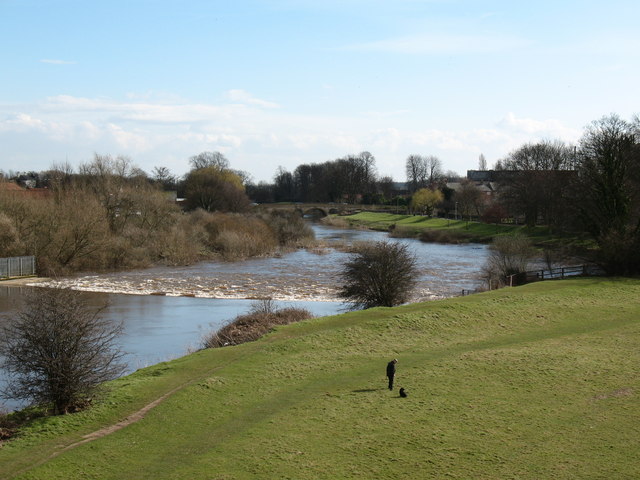
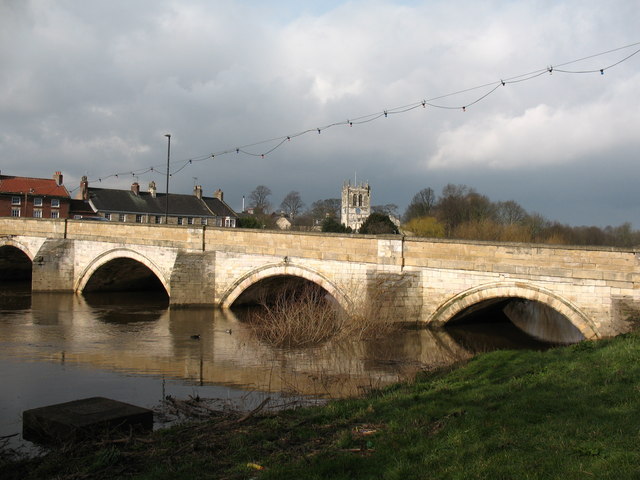
Enter Hawkesworth. On the Ordnance Survey (OS) map he noticed a Roman road that must have once crossed the river there. The local Britannia Inn has a sign painting of a barge upstream of the bridge. Some digging in the archives revealed hundred-year-old pictures of boats accessing the corn mill adjacent to the weir. He even found records that the Royalist fleet moored in Tadcaster during the Civil War.
He had a minor setback when the OS map supported the anglers claim on the mean tidal limit, but enquiries of the Environment Agency (EA) soon established that the water was saline at least as high as the bridge, and probably up to the weir. It turned out that, according to the EA, the tidal limit had moved up river as a result of local mining subsidence. Even the long term tilt of the whole UK land mass was working in the canoeists favour.


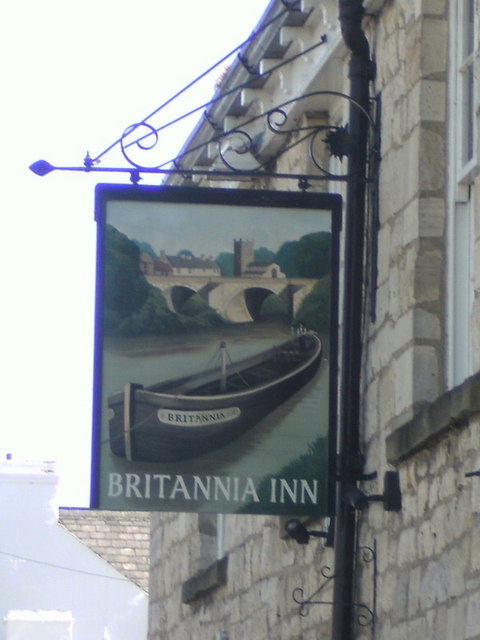
In the face of all this evidence the anglers backed down, and the local council confirmed that the river was a navigation below the weir.
But then someone discovered lampreys living under the left bank. No-one wants to fish them, but they need to be looked after because they are a rare species locally, and easily disturbed. So if you do paddle here, launch from the excellent access on the right bank and leave the lampreys in peace.
Jim Thornton
 Ripe-tomato.org