Stuck in Paris with You
This love poem by James Fenton needs no introduction beyond a comment on the mis-title above. Correct is In Paris With You – no Stuck. But Nicholson Baker recalled it as a poem about being “stuck” in Paris with a lover, in his novel The Anthologist.
Is the addition of Stuck an improvement? I think it strengthens the opening “opposite of what he means” line. Anyway, here it is.
In Paris With You
Don’t talk to me of love. I’ve had an earful
And I get tearful when I’ve downed a drink or two.
I’m one of your talking wounded.
I’m a hostage. I’m maroonded.
But I’m in Paris with you.
Yes I’m angry at the way I’ve been bamboozled
And resentful at the mess I’ve been through.
I admit I’m on the rebound
And I don’t care where are we bound.
I’m in Paris with you.
Do you mind if we do not go to the Louvre
If we say sod off to sodding Notre Dame,
If we skip the Champs Elysées
And remain here in this sleazy
Old hotel room
Doing this and that
To what and whom
Learning who you are,
Learning what I am.
Don’t talk to me of love. Let’s talk of Paris,
The little bit of Paris in our view.
There’s that crack across the ceiling
And the hotel walls are peeling
And I’m in Paris with you.
Don’t talk to me of love. Let’s talk of Paris.
I’m in Paris with the slightest thing you do.
I’m in Paris with your eyes, your mouth,
I’m in Paris with… all points south.
Am I embarrassing you?
I’m in Paris with you.
James Fenton
Global warming 5
Who should pay?
It’s not just a choice between rich Americans driving smaller cars, or poor Chinese walking to work – it’s a choice between generations.
Some say the rich West should pay, on the grounds that we produced most past emissions. But that ignores the fact that the ability to deal with climate change also comes largely from Western economic growth. It would also fail to achieve our aims, because most emissions will soon come from the developing world.
But much of the Chinese carbon footprint is emitted while making goods for Americans. Surely Americans should also pay that bit of the carbon tax? Yes, but not directly. A direct subsidy to dirty Chinese industries would be harmful. Better that the Chinese raise the price of their exports. The American consumer would still pay, but some manufacturing might find it worthwhile to return to America, whose industries are clean and efficient.
The intergenerational issues are even trickier.
Conventional wisdom says that the present generation should make sacrifices to leave a healthy planet for their children. But money spent now to prevent hypothetical damage in the future might be better invested to deal with what really happens, when it happens. See previous posts, here and here.
There is also every reason to suspect that future generations will be better off than the present. Apart from local wars and pestilence this has been true of pretty much every generation in history. If Victorians had had anticipated global warming, should they have taxed themselves to prevent it?
No-one blames Victorian factory workers for not paying to allow David Attenbrough to enjoy the spectacle of polar bears in the Arctic. But perhaps wealthy Victorian factory owners should have paid then, to help maintain fresh water in India and Pakistan now. That’s a bit nearer to fair, but it’s difficult to see how they could have made a significant contribution without slowing their whole economy and harming their workers too.
A carbon tax that really bites will slow growth for rich and poor alike.
Jim Thornton
Next. How should we best prevent global warming?
Not enough sex?
Another poet’s complicated private life


In the 1960s John Betjeman was at the height of his fame; appearing on television almost weekly, burbling on about Victorian architecture, railways and churches. His just published collected poems would go on to sell over 2 million copies. It is difficult to think of an equivalent public figure today, both so conventional and so famous. But the TV audience knew nothing of his love life.
Married since 1933 to Penelope Chetwode, daughter of the former commander-in-chief of the Indian Army, he had conducted an open affair with the much younger Lady Elizabeth Cavendish for over ten years. Elizabeth was also of the very bluest blood; the daughter of the Duke of Devonshire, childhood friend of the future Queen Elizabeth, and later confidante and lady in waiting to Princess Margaret.
For the rest of his life, the two women shared him. To start with he had flitted between his home with Penelope in Wantage, the Chatsworth estate in Derbyshire with Elizabeth, and friends’ houses in London, but in 1954 he got his own small flat in Cloth Fair in the City of London. This soon became not just a convenient hideaway for his own affairs, but a popular one for his friends. Tony Armstrong Jones discretely conducted some of his courtship of Princess Margaret there.
Both women knew about the other. Penelope grumbled, but she had tolerated many other affairs before Elizabeth came along. Elizabeth for her part came from a circle where adultery was accepted but divorce almost unthinkable; hence Princess Margaret’s decision to relinquish her first love. It is rumoured that Elizabeth had helped draft the Princess’s famous public statement renouncing Group Captain Peter Townsend; “mindful of the Church’s teaching that Christian marriage is indissoluble.” If so, Elizabeth knew how she felt.
But neither knew that in the mid sixties Betjeman started up another longstanding affair with Margie Geddes, an ex-girlfriend from before his marriage to Penelope. That was only revealed after Margie’s death in 2006. Here are his three main lovers, and the Princess.

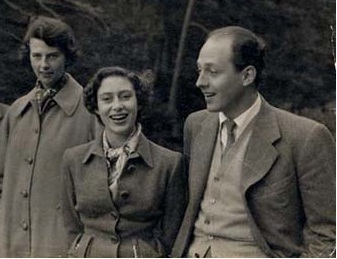

Penelope Chetwode. Elizabeth Cavendish, Princess Margaret and the poet. Margie Geddes
Towards the end of his life, when asked if he had any regrets Betjeman replied; “Not enough sex!” He didn’t do too badly.
Jim Thornton
Global warming 4
The costs of averting global warming?
In his original report Stern suggested that these would be an ongoing annual 1% of world GDP, although more recently he has revised this figure up to 2%. Both huge numbers, but on the face of it worth spending if they prevent 5% annual GDP damage down the line. Again sceptics have plenty to dispute.
First Stern’s 1% estimate was lower than other forecasters but OK, his revision up to 2% brings him more or less in line. More importantly, the costs of prevention happen now, while the supposed benefits occur sometime in the future. The benefits only appear worthwhile if we accept Stern’s very low discount rate. At higher discount rates we should invest the money, get richer, and be better placed to adapt to the warming when it comes.
Finally, Stern’s costs of mitigation, are only worthwhile insofar as they actually prevent global warming’s harms. But no-one believes they will prevent all harm, least of all Stern himself. He believes many bad things are already inevitable. So even on Stern’s disputed figures we are being asked to invest 2% now, not to prevent 5% damage in future, but to prevent some fraction of 5%.
Here’s the iGreen take. Sacrificing 2% of GDP now to prevent 5% of damage in future, only works at an implausibly low discount rate. With sensible discounting, the possibility of adaptation, and money spent now preventing only some harm, such a large investment in mitigation now is a poor deal.
Tomorrow – who should pay?
Jim Thornton
Alt.obits Deadpool
A morbid, disrespectful waste of time.
Dead pools are games based on predicting when people will die. Pick a list of, hopefully living, people on Jan 1st, and get points for each one who falls off the perch during the year. The more points the younger, if you’re the only player to choose them, or if they die on their birthday; stuff like that. None if you kill them – we’re tasteless, not evil. There are many deadpools; hollywood, political, pop star. All sorts..
Alt. obits (AO) is a news group for sad people interested in obituaries. Like me.
AO deadpool (click here) is the obituarist’s deadpool. Anyone can join, but to get the points your stiff must get a write-up in a national news outlet. Amelia, who runs it, usually lets the successful picker write the deadpool obituary. Irreverent is good. I usually add a bit of doggerel and repost them here.
Preparing the list is a Christmas tradition in our family.
Jim Thornton
Global warming 3
How much harm will “business as usual” cause?
It’s tempting to think the damage will be small. After all there was a 0.7 degree centigrade rise over the last century – a time of many disasters both natural and man-made – but none blamed on global warming. Most models predict perhaps another 1-2 degrees in the next fifty years, and maybe a couple more by the end of the century. Sceptics say resourceful humans will cope. We will, but that doesn’t mean it won’t be costly.
Sceptics also emphasise the winners and losers – costs to some from rising sea levels, and benefits to others as warming brings unusable land into cultivation. It’s unlikely that the present planetary temperature is absolutely optimal for human welfare.
Again the sceptics have a point, but the transition will be harmful. A world with sea levels a few meters higher or lower would be fine if it had always been like that, but we can’t easily move cities. Nor can the natural world easily adapt. There will be species loss along the way.
And the specific local risks are alarming. It’s not just sea level rise, and extreme weather events. Loss of the Andean and Himalayan glaciers, which provide freshwater to millions, the drying out of the Amazon basin, shifts in the Gulf Stream altering Western Europe’s weather. They won’t all happen, maybe none will, but even optimists agree there’s a significant probability that some will.
The Stern review attempted to put a cost on all this and came up with a figure of 5% of world GDP lost every year forever, if we continue business as usual.
The problem for planners is that different forecasters give different estimates. The graph below is the sort I can understand.

This graph pools various estimates of the net costs of business as usual into a single estimate and confidence interval (left), and compares this with the best estimate and confidence interval from Stern. I’m not qualified to judge who is correct but it’s obvious that the Stern review is at the pessimistic end of the range. Source: Tol & Yohe (2006), “A Review of the Stern Review”. World Economics 7 (4): 233–50. Access here.
Stern’s estimates of the costs of business as usual are pessimistic for three main reasons:
- He chooses pessimistic assumptions. He may or may not be correct, but compared with other forecasters he is pessimistic.
- He intentionally does not account for human adaptation. He has his methodological reasons, but this distorts his cost estimates upward. A couple of examples; the costs of losing fresh water consequent on glacial thawing, and of treating additional diarrhoeal disease and malaria. Both are nasty and costly, but they are also eminently adaptable to, especially if the affected countries experience even modest economic development.
- Finally, and most controversially he chooses a very low discount rate. This matters because the damage of warming will occur in the future, but we are being asked to spend money now to prevent it. £10 now is worth more than £10 in 20 years, because you can invest £10 now at say 3% annual interest and end up with £18 in 20 years. Future costs should therefore be discounted by a certain amount each year. The higher the discount rate the less we should be prepared to spend now to avoid the future cost. Stern chooses a discount rate of 1.4%, which strikes me, and most commentators, as ridiculously low. Most other experts choose rates of 3% or more.
There remains plenty of room for serious debate about the costs of business as usual.
Next – the costs of averting global warming
Jim Thornton
Global warming 2
Are man-made greenhouse gas emissions causing the warming?
The answer is both yes and “don’t know”.
Yes, because the greenhouse effect from CO2 has been known for years, tested a thousand times in the lab, and CO2 levels are rising. It’s basic physics.
But “we don’t really know”, because other factors, sunspots, clouds, reflecting snow, as well as positive and negative feedback loops also affect things. Sure we’ve got climate models, and some do OK. But we’ve only got one climate, so it’s difficult to test the models properly.
Many sceptics cite past associations of warming with sunspot cycles, and imperfect relations between temperature and CO2 in various data sets. But none of that refutes the alarmist case. They know the relation is complex. It is indisputable that CO2 is a greenhouse gas, levels have risen sharply over the last 150 years and it remains the most likely explanation for the temperature rise seen over the latter half of that period.
Whether the warming will continue is hard to predict. But continuing to burn fossil fuels will release more CO2, and the greenhouse gas effect isn’t going away. Hopefully there will be some negative feedback; maybe rising CO2 will increase plant growth and natural carbon capture. On the other hand perhaps the tundra will thaw and cause runaway CO2 release and more warming. Volcanoes and sunspots will surely mess up detailed predictions. But the alarmists best estimates that in the long run the warming will continue if we keep burning fossil fuel are surely correct.
Two: nil to the alarmists! You’ll be wondering – am I really a sceptic?
Tomorrow a look at the damage the warming might do.
Jim Thornton
Global warming 1
Serious sceptics
Tomorrow 25,000 delegates descend on Durban for the next UN climate change conference, following on from Kyoto, Bali, Copenhagen, Cancun and many others. The original Kyoto protocol expires next year and not much agreement is expected this time. You wonder why the delegates don’t save energy by changing to conference call.
Not everyone who is sceptical about international agreements to counteract global warming is a climate change denier. There’s much more to the argument than that. Let’s review some of them.
- Are we really experiencing unprecedented warming?
- Is it man made?
- How much damage will it cause?
- How much will it cost to prevent?
- Is it worth paying the costs of mitigation now to prevent damage costs in the future?
- Who should pay?
Is the warming unprecedented? Here is one reputable record, taken from the Stern report. (Unless otherwise specified the evidence in these posts is from that source. Access the full report here.)

This is an example of the famous hockey stick graph. It certainly shows a big recent rise. There are many reasons why skeptics dispute it.
They say the time scale is selected to maximise the apparent recent rise. Here’s a graph going back to the last ice age.
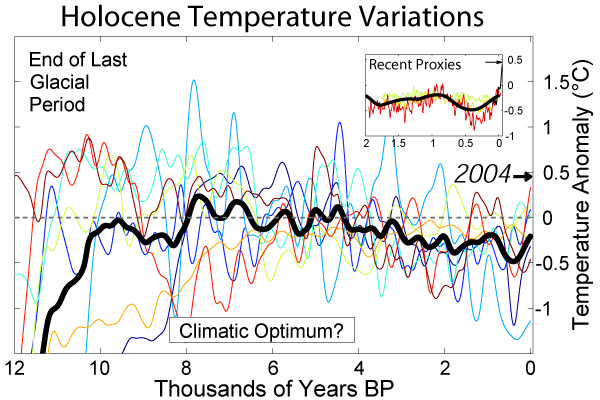
The recent uptick hardly features. But so what? Something unprecedented for a thousand years is unprecedented for modern man, whatever may have happened in the distant past. The alarmists win that point.
Another source of dispute is the habit of some alarmists of joining inferred climate measures based on glacial ice cores and tree rings with actual temperature measurements, which have only been available from the mid 19th century. You can see the problem at the right end of the first graph. The rise is pretty much dependent on the black line, real measurements, while the inferred measurements show no such rise. This suggests to some that one or other is unreliable and therefore that the whole graph is misleading. In the graph above the different series are shown correctly, but in popular alarmist articles time series collected in different ways are sometimes joined together as if they were a single series. Such “unacknowledged splices” drive sceptic bloggers mad.
Nevertheless, open minded people need to make a judgment. These are the only data we have, and there does appear to have been an unprecedented recent rise in global temperatures.
Tomorrow. Is it man made?
Jim Thornton
Save lives. Post this to your medical friends.
Crash-2 going viral
Watch the video and post the link to your colleagues. Click here
Jim Thornton
Has the BMA over-reached?
Smoking in cars
The British are pretty tolerant of government health regulation – we’ve had a National Health Service for 55 years. We grumble at punitive taxes on beer and cigs, but apart from a bit of smuggling, do nothing about it. Speed limits, seat belts, crash helmets – we hardly grumble.
But I had thought we would resist the smoking ban in public spaces. I don’t mean government buildings, hospitals, schools and such like, the passive smoking argument has some force in places you cannot avoid. But private pubs, clubs and restaurants? If owners allow smoking, and adults enter of their own volition, how could the state justify a ban? I still can’t understand it. But people accepted it, and set up outdoor smoking areas – so what do I know?
Last week the British Medical Association, my own trade union – forgive me – called for a ban on smoking in cars. A complete ban, regardless of who else was in the vehicle. Yes – even a car with a lone smoking driver. You might have thought that would be the ideal place to smoke, but the BMA argues that it would be easier to police than a ban limited to cars with children or non-smoking passengers.
Clearly the case against such a ban needs restating.
- Tobacco has been smoked in this country for hundreds of years. It remains a legal, regulated, quality-controlled substance.
- Smokers get pleasure from their activity. They also face risks of nasty diseases. But the risks are some way down the line, and we’ve all got to die of something. Smoking is not an irrational behaviour.
- It’s no business of the state to protect adults from the consequences of their own actions.
- The passive smoking argument does not apply to drivers smoking alone.
- The suggestion that smokers impose costs on others through their use of the NHS to treat their lung diseases is spurious. They impose nothing – the state imposes by having a National Health Service. The argument could just as easily justify prohibiting gay sex because of the cost of treating AIDS, or dangerous sports because of the costs of treating injuries.
I anticipate civil disobedience. The Scots and Welsh will cave in, they’re practically all state employees now, but the English will rise up. I think.
Or maybe not. I was wrong last time.
Jim Thornton
 Ripe-tomato.org